Game systems · Production decisions
Game Economy Design: What to Define Before Implementation
A game economy should explain how players earn resources, what they spend them on, and how those choices affect progress. Before commissioning the system, agree its rules, balance model, failure behavior and acceptance evidence—not just a shop screen.
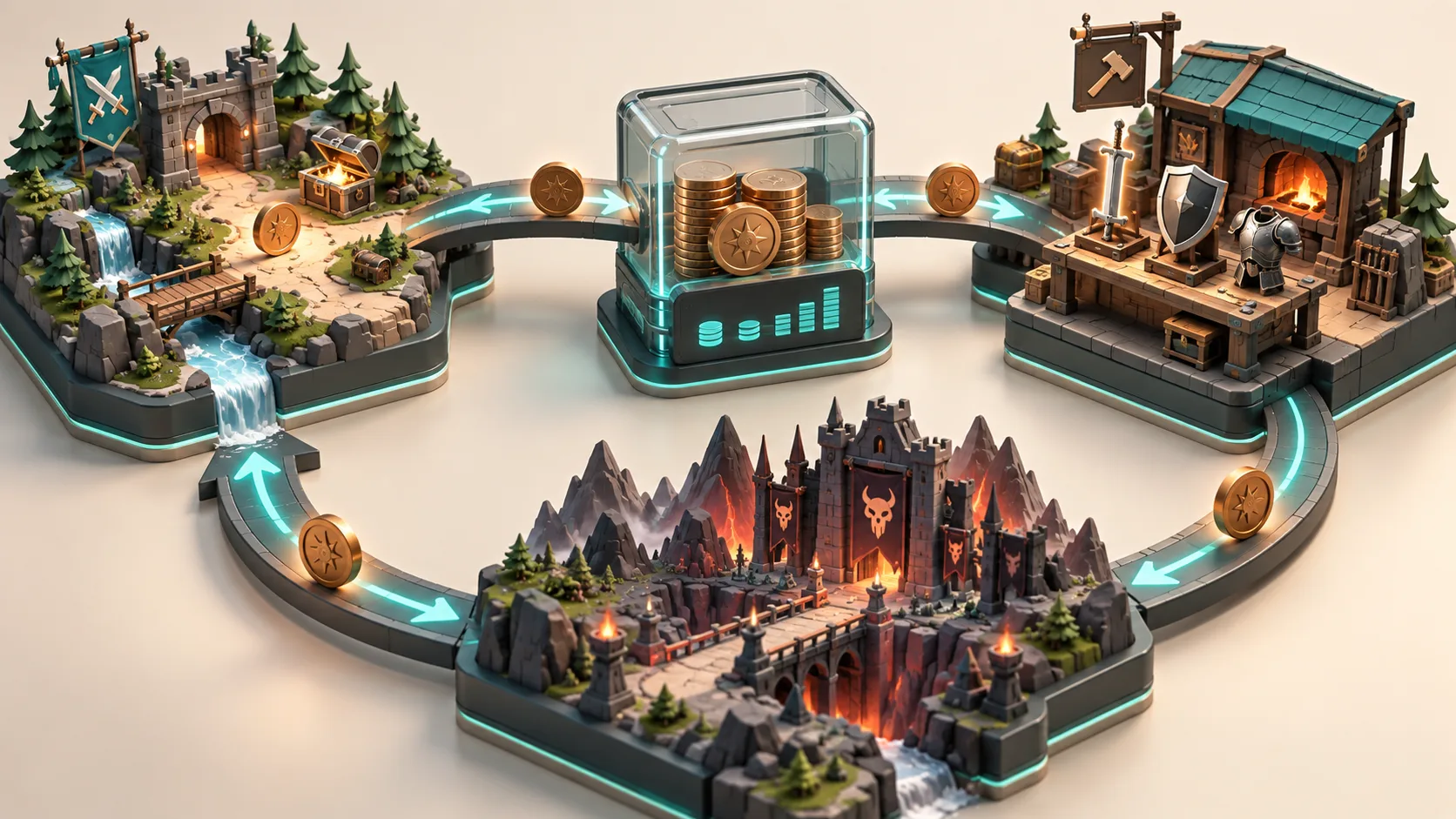
Game economy design is the definition of a game's resources, earning rules, spending rules and progression relationships. For a buyer, its useful output is a model that a development team can implement and test: a resource ledger, reward and cost tables, explicit constraints, representative player scenarios and a clear acceptance checklist.
This guide is for a founder, publisher or product owner commissioning a game or its progression system. It is not a promise of revenue, a guide to earning money by playing, or a replacement for purchase-platform integration. If you need the system built, start with our game development services and scope the economy as a named deliverable within the playable product.
Start with the player decision, not the currency count
Describe what the player should choose after a session. Can they improve a familiar tool, unlock a different play style, or save toward a later option? If every reward simply increases one number and every purchase follows a compulsory sequence, additional currencies will not create meaningful choice.
Write one short loop in plain language: complete a mission, earn a reward, choose an upgrade, use the improvement in a harder encounter. Then list the constraints. A first-time player may need an affordable improvement; a returning player may need a reason to replay; a skilled player may earn faster without making all remaining challenges irrelevant. These are design intentions to test, not universal numerical targets.
Separate the core mechanic from the progression layer. An economy cannot establish that an unproven game is enjoyable. The casual-game production guide covers that earlier playable proof. Here the decision is whether the resource system supports an already defined loop and can be delivered without hidden assumptions.
Specify every resource, source and sink
A source adds a resource: a first completion, a repeatable encounter or a granted reward. A sink removes it: an upgrade, a craft or a consumable. List both sides before tuning amounts. Include starting balances, caps, ownership limits, whether a resource expires, and what happens when a player reaches a limit.
| Resource | Source rule | Sink rule | Question to resolve |
|---|---|---|---|
| Earned coins | First clear and replay rewards are separate | Permanent upgrades | Can a player recover after spending on a different upgrade? |
| Upgrade material | Named encounter or completion condition | A specified upgrade tier | What happens to excess material at the maximum tier? |
| Consumable | A defined reward or exchange | Use during play | Is it consumed on activation, successful effect or mission completion? |
| Unlock state | Achievement or progression requirement | Usually not a spendable balance | Does unlocking also grant ownership, or merely permission to buy? |
This is a specification template, not a recommendation that every game needs four resource types. Remove any resource that lacks a distinct player purpose. A single well-understood coin currency is easier to explain, implement and validate than several overlapping tokens.
Use a worked balance scenario before writing the shop
Consider this illustrative design example, not a live game's configuration or a benchmark. A new profile has zero coins. Its first mission grants 200 coins; an armor upgrade costs 120; an alternative tool costs 80. A later attempt needs the armor upgrade, while a replay grants 60 coins.
A player who buys the alternative tool first retains 120 coins and can still buy armor. If a different optional purchase consumes the entire 200, two 60-coin replays restore the armor budget. That second route is only valid if those replays remain winnable without armor. Arithmetic alone cannot establish that the player has a viable recovery path.
The ledger equation is simple: closing balance equals opening balance plus valid earnings minus valid spending. The useful work is defining what qualifies as valid, in what order events occur, and which progression states the balance can reach. Replay rewards, failed runs, spent consumables and cap behavior belong in the same model.
Run at least a typical route, a low-success route, a highly efficient route and an unusual spending route. Record the assumptions: mission length, success rate, repeat reward, optional purchases and upgrade order. Test ranges rather than declaring one simulated average to be the experience of every player. Set project-specific tolerances for time to a meaningful upgrade and the longest acceptable recovery path; validate them with playtesting.
Keep progression and price curves connected
Reward growth, upgrade costs and encounter difficulty should be reviewed together. An upgrade can feel strong in the workshop and still become irrelevant if enemy growth immediately exceeds it. Conversely, a cheap repeatable reward may let players bypass the progression that the rest of the game assumes.
Ask for a versioned table with stable item identifiers, ranks, prerequisites, costs, effects and maximum levels. Require the developer to show which configuration entry a visible shop item actually uses. A spreadsheet is not a handover if the build contains unrelated hard-coded values.
Our ROADFORGE case study illustrates the connection between a shared coin wallet, replayable missions and workshop progression. Its documented implementation includes protection against duplicate collection and false charges when a profile write fails. That is evidence of the production problem, not a claim that every game needs ROADFORGE's rules or that a particular economy guarantees commercial results.
Choose the authority and backend deliberately
An offline single-player prototype and a connected competitive game have different trust requirements. Define where the authoritative balance lives, who may change it, whether play continues offline, and how conflicting changes are resolved. A locally saved balance is not equivalent to a secure online economy; a server connection alone does not establish correct transaction behavior.
Unity service note, checked 22 September 2026: Unity's documentation says Economy stopped accepting new project sign-ups on 8 September 2026. Existing projects with an active configuration remain operational. For new projects, Unity recommends a server-authoritative setup using Cloud Code, Cloud Save and Remote Config. Check eligibility before choosing the architecture; do not base a new proposal on an unavailable sign-up flow. See the official Economy service status.
For an existing eligible integration, Unity documents virtual purchases as exchanges with costs and rewards. That API vocabulary can help define the transaction contract, but it does not replace your game's prerequisites, acceptance rules or recovery design. See Unity's purchase API documentation.
Accept one complete transaction, including failure
Choose one representative upgrade and require evidence of the entire state change. Show the balance and rank before the request, the accepted operation, the committed result and the state after reopening the game. The interface should display the committed truth, not celebrate a purchase that failed to save.
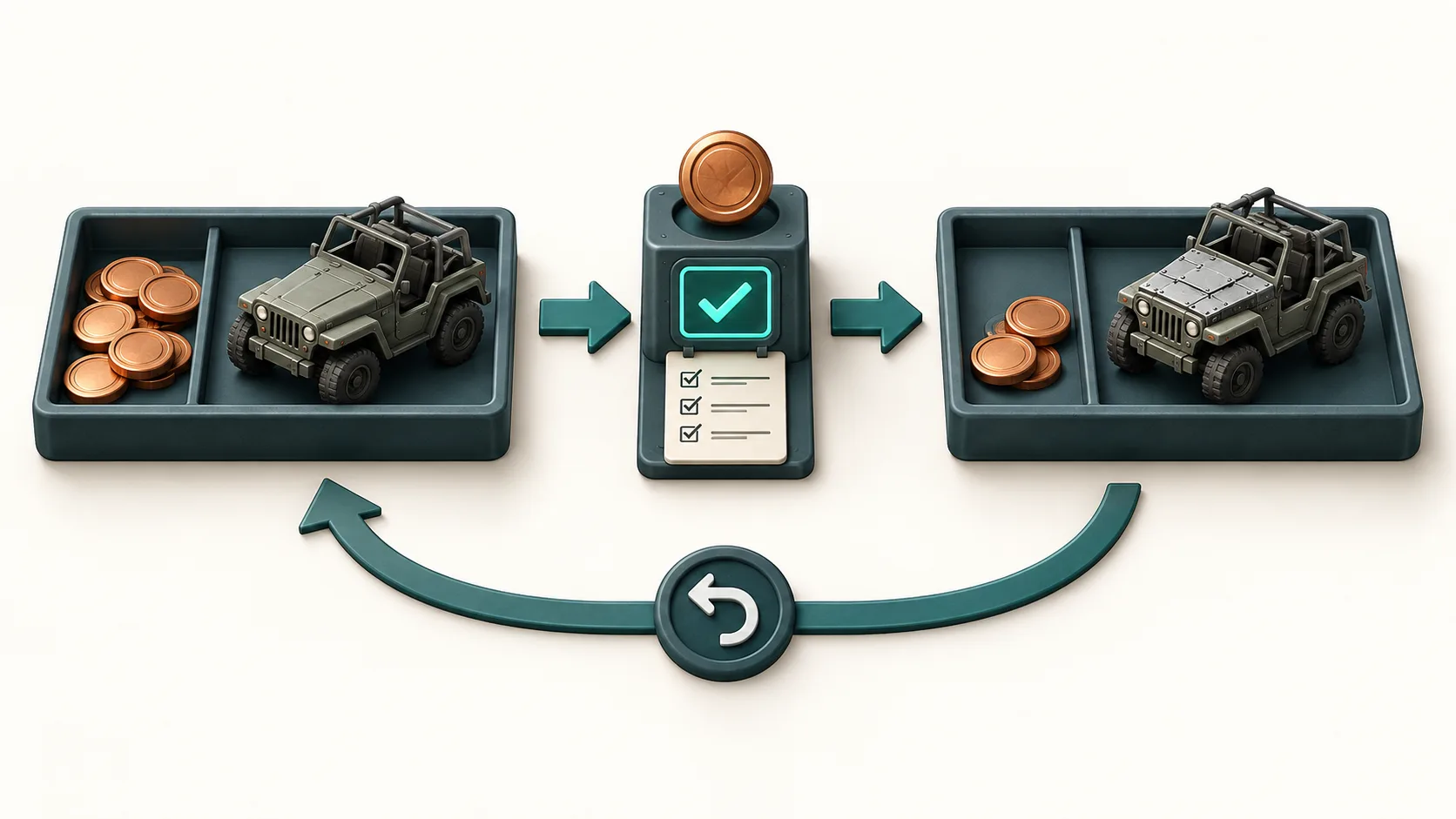
| Test | Expected invariant | Evidence |
|---|---|---|
| Normal upgrade | One valid cost and one intended rank change | Before/after state and a restart |
| Insufficient balance | No charge and no granted rank | Rejected request and unchanged saved state |
| Repeated input or retry | The same operation cannot be applied twice | Repeated request with the same operation identity |
| Save failure or uncertain response | No invented success; resolve the operation's actual outcome | Fault injection and recovery trace |
| Stale balance | Conflicting updates do not silently overwrite each other | Two competing requests and final authoritative state |
| Maximum rank or invalid prerequisite | No illegal purchase or negative balance | Boundary-state test profile |
Concurrency protection and duplicate-operation protection solve different problems. Unity's existing Economy SDK describes optional write locks for rejecting updates based on stale state. A write lock is not, by itself, a business-level guarantee that the same reward cannot be granted twice. Define a separate operation identity and retry policy appropriate to your storage and authority model. See Unity's write-lock description.
These are virtual-resource acceptance tests. Store receipts, refunds, purchase restoration and ad-provider callbacks need their own integration scope. Refer to the mobile game testing checklist when turning the economy cases into release evidence, without treating a successful shop animation as a complete QA result.
Make balancing configurable without making it uncontrolled
Typical balancing candidates include rewards, prices, prerequisites, caps, repeat rewards and progression curves. Choose which values live in packaged data and which may change remotely. Do not promise every change without a new build: new rules, code paths or content formats may still require an application update.
Every configuration release needs an identifier, owner, review record and fallback. Specify how old saves behave when a price or prerequisite changes. Test offline clients, cached versions and returning players before applying a change widely. Keep stable IDs separate from display names so a copy edit does not accidentally create a different item.
Define what rollback means. Restoring yesterday's price table does not automatically reverse transactions already committed at today's prices. Decide whether historic grants remain, whether a migration is necessary, and who approves any player-facing correction. This should be an explicit product decision, not an emergency assumption by whoever has dashboard access.
Measure the assumptions and require a usable handover
Connect the economy to questions that can change a decision: where do players run out of usable resources, which upgrades remain unaffordable, which sinks are ignored, and which earning paths dominate? Record the configuration version alongside relevant observations. Distinguish a deliberately slow progression route from a broken reward trigger or a save failure.
The Unity game analytics guide covers event contracts and validation separately. Do not infer balance quality from an unverified dashboard. Review findings by progression stage and player behavior where the data allows it, and avoid claiming that a small sample establishes a universal retention or revenue improvement.
Before accepting delivery, request the resource ledger, editable configuration, representative balance scenarios, acceptance matrix, tested build identifier, save/version behavior and a known-limitations list. Include the source implementation and the access needed to maintain it. The client should know who owns each account and who can approve future balance changes.
A practical final review asks the team to change one permitted reward, publish or package the configuration through the agreed process, run the scenario again and restore the previous configuration. If only the original developer can explain where the number lives, the handover is incomplete.
Game economy design questions
What should a game economy design document include?
Include the player loop, resource definitions, sources and sinks, starting balances, caps, reward and cost tables, prerequisites, progression scenarios, authority model, failure rules, configuration versions, acceptance tests and handover ownership. Each visible purchase or reward should map to a named rule that can be tested in a build.
How do sources and sinks affect game balance?
Sources add resources and sinks remove them. Their amounts, timing and availability determine which choices a player can afford and how quickly progression moves. Evaluate them together across different play and spending routes, including recovery from poor choices, rather than balancing each reward or price in isolation.
Which economy values should remain configurable after launch?
Rewards, prices, caps, prerequisites and progression curves are common candidates. Define which can change safely without a client update, version every release, validate older saves and offline behavior, and assign approval and rollback ownership. New mechanics or incompatible data formats may still require a new build.
Build a testable progression system
Turn the economy model into a working game system.
Send the gameplay loop, platform, current build stage and the reward or upgrade decisions you need implemented. We can scope the system, its configuration and the evidence required for acceptance.
Explore game development services Discuss your project Chat on WhatsApp