Game production · Pre-launch operations
Game Live Ops: What to Prepare Before Launch
Live Ops is not a promise to run more events. It is the ability to change a shipped game's approved settings and content safely, see what happened, and reverse a bad release. Define that operating path before the first public build.

Game live ops begins with a practical boundary: which decisions can change after launch without a new App Store or Google Play build, and which changes still require a tested client release? A remote switch may alter a supported feature or event schedule; it cannot safely add code the installed client does not contain. An asset package may deliver compatible content; it does not excuse missing version checks or device testing. The buyer should approve those boundaries before implementation starts.
This guide is for founders and product teams commissioning a game, not a promise that every project needs a permanent operations team. It complements our game development services. The casual game production guide asks whether the core loop and content pipeline are ready to scale; this article asks how approved changes will be released and controlled once that product is live.
Separate three kinds of change before choosing tools
List every likely post-launch request and label it as a configuration change, content delivery, or client/server code release. This simple classification prevents a costly assumption that a dashboard can update any behavior. Examples include turning on an already-built event, changing a reward cap, adding a compatible level bundle, fixing an incompatible save format, or changing payment verification logic. These are not the same deployment.
| Change type | Example | Pre-launch acceptance question |
|---|---|---|
| Remote configuration | Enable an existing event for a defined player segment | Does the shipped client validate the value, cache a safe default and show the right state offline? |
| Delivered content | Add a compatible level or art bundle | Can the client download, verify and fall back from a failed or incompatible package? |
| New build or backend release | Change a gameplay rule, data contract or transaction authority | Which store/backend release, migration and rollback route is required? |
Unity Remote Config documents remotely tunable key-value settings, environments and player-targeted overrides. Unity Cloud Content Delivery documents versioned content releases and platform/environment buckets. These are examples of implementation routes, not a claim that installing either product creates a full operations process. The client still needs to implement fetch, validation and fallback behavior.
Design the content model and compatibility rule
Before building a content editor, define what an event or content drop actually contains: start and end conditions, eligibility, assets, localized copy, progression prerequisites, rewards, expiry and a stable version. Decide which fields can change independently and which must move as one package. A reward table that references a missing item is a failed release even if each file uploads successfully.
Specify the minimum supported client version for each content package. Decide what older app versions should see: the previous package, a safe default or an explicit update prompt. Test low storage, lost connectivity and partial download rather than assuming the content service is always reachable. The game economy guide owns reward values and balance; here the concern is how an approved version of those values is published and, if necessary, withdrawn.
Keep configuration powerful enough to help, limited enough to be safe
Remote controls are useful for release flags, event schedules, segment rules and bounded tuning values. Every key should have a type, allowed range, default, owner, expiry or review date and client behavior when the value is missing. Do not make security, payment authority or durable ownership depend on a client-readable switch. Sensitive decisions still belong in an appropriate server-side system.
Use distinct development, staging and production environments. Test the exact configuration revision against the build and content release that will be shipped. A dashboard screenshot showing the intended value is weaker than a device recording and a revision ID showing what that build actually received. Unity's documentation describes Game Overrides for targeting settings to players; targeting logic should have a documented audience definition and a safe state for people outside it.
Plan segments and the release calendar without fragmenting QA
For each event or feature, define its eligible audience: platform, region, client version, cohort or account state. Write the exclusion rules as carefully as the inclusion rules. A staged rollout can reduce exposure, but only if the team knows how to compare the tested cohort with the release population and how to stop the rollout. Avoid overlapping experiments or events that compete for the same slot, reward or inventory state without an explicit priority rule.
The operating calendar should name a proposer, approver, publish window and expiry decision. It should also contain a freeze rule around store updates or planned maintenance. The goal is not a calendar full of promotions; it is a predictable path from approved content to the right players. If there is no real event strategy yet, build the smallest safe release mechanism and leave optional campaigns uncommitted.
Make rollback a tested action, not a reassuring label
Every production change needs a versioned previous state and a decision about whether returning to it is safe. Rolling back a content badge can stop future downloads of the new package, but it may not remove data already saved on players' devices. Reverting a price or reward table does not undo transactions committed while the newer version was active. Define the player-facing correction policy separately from the technical rollback.
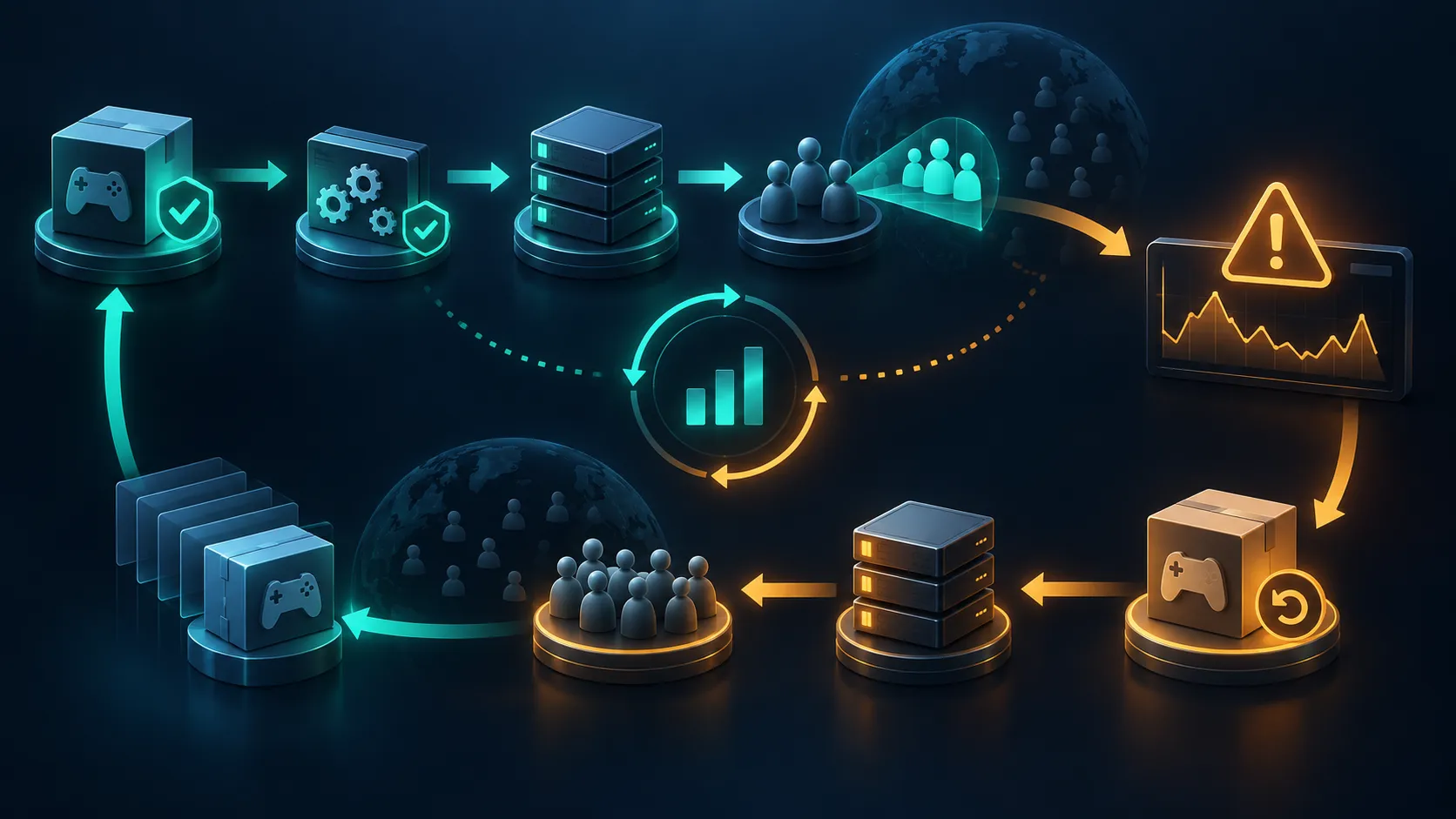
A useful rehearsal starts with a known staging build, publishes a harmless configuration change to a small internal or test cohort, captures its revision and visible result, then restores the prior revision. Repeat with a compatible content package and an interrupted download. If the return path changes saved progress, entitlements or inventory, stop treating it as a simple switch and write a migration or support decision. Unity CCD's release badges illustrate one way to point a client at a specific content release; the game's persistence rules still need their own test.
Observe the player impact and assign incident ownership
Choose a few signals that can answer whether the release is healthy: successful configuration fetch, content download or load failures, crash rate by app version, event participation and the product event that the change was meant to affect. Record which signal triggers pause, rollback or investigation and how long to wait before deciding. A dashboard without thresholds and an owner is only a display.
Keep the telemetry contract separate from the release mechanism. Our Unity game analytics guide covers event names, parameters, environments and validation. For Live Ops, the operational question is whether each release ID can be connected to the affected build, cohort, error trace and decision log without exposing player identifiers unnecessarily. A human should know who is on call or, for a small team, who is explicitly responsible during a planned release window.
Accept the handover as a reproducible release
Before signing off, ask the delivery team to demonstrate one complete change in a non-production environment and, when authorized, a controlled production rehearsal. The evidence package should include the client build, environment, configuration revision, content release ID, target cohort, approval, before/after screenshots or device recording, monitoring view, rollback result and known limits. Access should be role-based; the business owner should retain control of accounts and publishing permissions.
| Gate | Evidence to request | Do not accept as a substitute |
|---|---|---|
| Configuration | Approved revision, range/default tests, device result for targeted and excluded players | A dashboard value alone |
| Content | Compatible package, release ID, download failure and older-build behavior | An uploaded asset list alone |
| Rollout | Cohort rule, monitoring threshold and named pause decision | “We can turn it off” without a rehearsal |
| Handover | Runbook, access roles, account owner and source/config export | A single administrator login |
That handover is a development deliverable. A separate agreement would be needed if the owner wants ongoing event design, monitoring or incident response after launch. The guide's purpose is to make the technical and operational boundary visible before commissioning the game, not to promise a managed service we have not scoped.
Questions to settle before launch
What should be ready before game live ops starts?
Have a versioned content and configuration model, safe client defaults, staging and production environments, a defined release owner, a monitored rollout rule, a tested rollback route and a written handover. Start with the smallest change the product actually needs after launch.
Which game content should be remotely configurable?
Only fields the shipped client is built to validate and apply safely, such as bounded event timing, eligibility or tuning values. Use versioned content packages for compatible assets. New code, incompatible data contracts and authoritative transaction changes still require their own release path.
What rollback evidence should a live game have?
Retain the prior approved revision or content release, the affected build and cohort, the failed signal, the time and approver of the reversal, and a device check of the returned state. Record separately how transactions or saved progress created under the newer version will be treated.
Plan a change-safe game build
Define the post-launch controls before production.
Tell us the platforms, release stage, planned events or content drops, account/backend needs and who will operate the game after handover. We can scope the build, configuration boundary, acceptance evidence and source transfer for your project.
Explore game development services Discuss your project Chat on WhatsApp