Entertainment simulation · Commissioning decisions
Simulation Game Development: Define the World Before Expanding It
Agree what the world tracks, how time advances and what each agent can change before buying a larger map or more activities.
Short answer: a simulation game development proposal should specify a bounded world model, its clock, the actions available to players and agents, and the visible consequences of those actions. Accept one connected, resettable scenario before expanding the world. A convincing scene or a resource counter alone does not prove that the simulated relationships work.
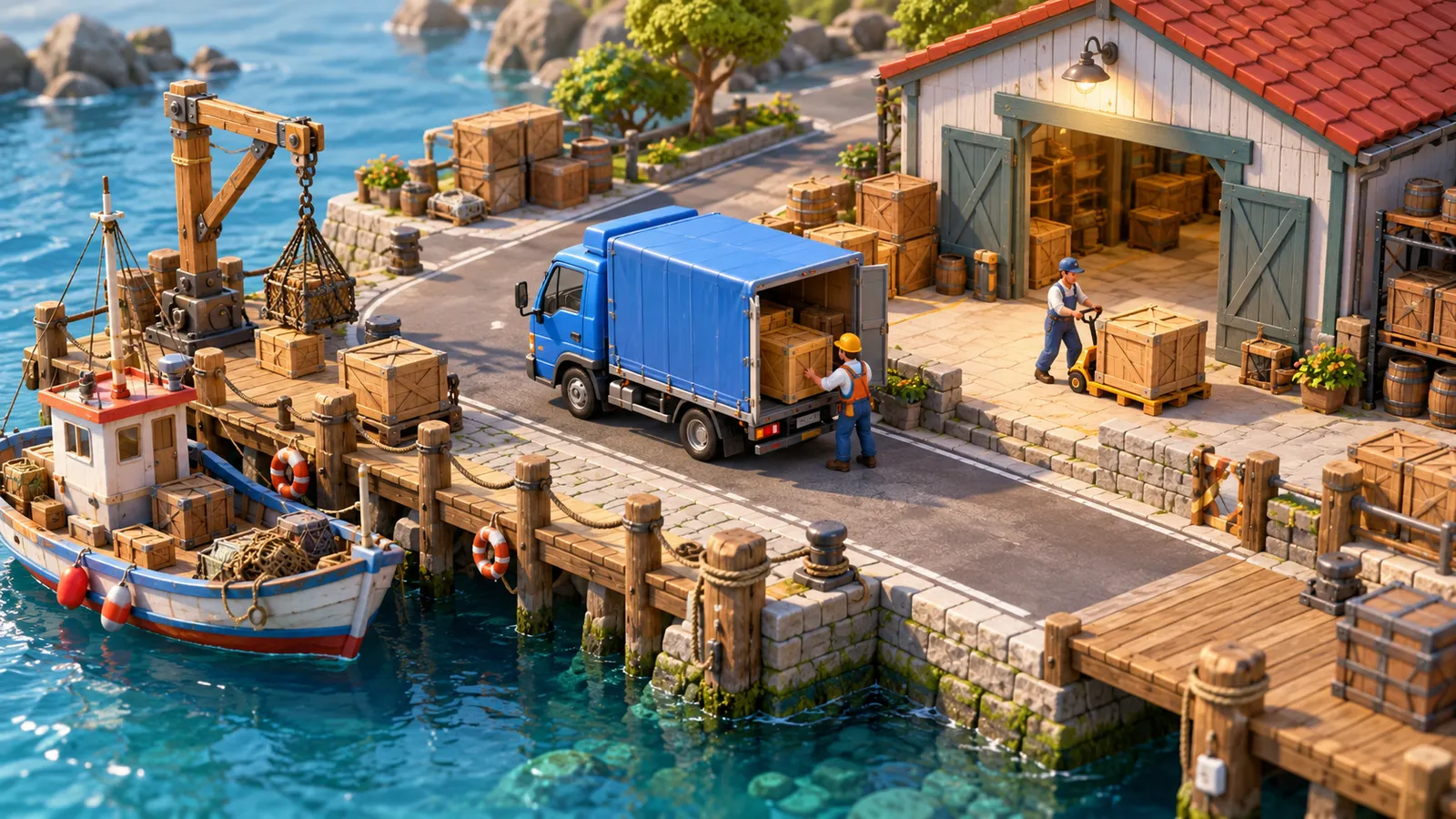
This guide is for a founder or product owner commissioning a small entertainment simulation in Unity. The aim is a playable model with deliberate simplifications, not a scientific digital twin or a certified training tool. Start with the decisions a player should make and use a scoped Unity game development engagement to turn them into reviewable behavior.
Choose the part of the world that actually matters
A shop, harbor or farm can suggest hundreds of activities. Including every real-world detail is rarely a useful first specification. Choose one relationship that creates a player decision: allocating a worker, routing a vehicle, placing a machine or deciding when to serve a customer. Name what the game tracks and what it deliberately ignores.
Consider a hypothetical harbor delivery game: one dock, one warehouse, one truck and two workers. Cargo arrives at the dock; a worker loads the truck; the truck delivers to the warehouse. The player chooses which available delivery to assign. Weather, fuel, international trade, traffic networks and online cooperation are excluded from this example. It is a proposed design exercise, not a completed customer project.
Write down the entities and their valid conditions. A crate has one location or one carrier. A truck has a task and a capacity. A worker can load, wait or become unavailable according to the agreed rules. The map should support those relationships rather than merely provide attractive scenery around an unrelated progress bar.
Define the clock before promising fast-forward
Decide whether the world advances continuously, in turns or through discrete scheduled events. Define what pause freezes, what continues for interface use, and what happens when the application loses focus. Offline progression is a separate product feature; it should not appear accidentally because someone uses elapsed wall-clock time.
In the harbor example, loading might consume simulation time while a paused world lets the player inspect an assignment. At double speed, the same approved loading rule should still apply. A change in presentation speed must not quietly create extra cargo, skip required transitions or leave an agent waiting for an event that can no longer occur.
Unity's timeScale documentation explains scaled time and effects on fixed updates and waiting coroutines. Its fixed-update guidance separates physics steps from rendered frames. These engine mechanisms inform implementation; they do not establish that every timer, animation, interface and gameplay system in your product pauses correctly. Review the agreed behavior in a build.
Give every agent an action boundary
For each action, specify the conditions for starting, what becomes reserved, when the result becomes final and how interruption is handled. Two workers should not both own the same exclusive loading job unless cooperative loading is an intentional feature. A visually idle worker may be correctly waiting, or may have lost its task; the game needs enough feedback to distinguish them.
Follow a single crate from dock to warehouse. Before loading it belongs to the dock's available stock. During loading, the agreed reservation prevents another action from claiming it. On completion it belongs to the truck's cargo. Delivery transfers it to the warehouse once. The exact implementation is the team's responsibility, but the buyer should be able to describe and observe the intended ownership.
Choose what happens if the player cancels, the destination fills or the route becomes unavailable. Does the truck wait safely, return cargo, select another approved route or report that the task cannot continue? Avoid an undefined fallback that silently deletes goods or invents success. Larger agent counts multiply these interactions, so prove a small set before ordering a crowded city.
Keep the world model separate from rewards and saving
World state answers where the truck is, who holds the crate and which operation is active. The reward economy answers what a completed delivery earns and how those earnings affect progression. They connect, but a balanced coin table does not prove that the delivery happened. Our game economy design guide owns sources, sinks, prices and progression decisions.
Likewise, deciding which state survives closing the game is a persistence commitment. A resettable review scenario need not include mid-delivery saving unless that is commissioned. The Unity save-system guide covers durable fields, recovery and update compatibility. Agree the live simulation first, then define the supported return state without assuming that every transient object must be serialized.
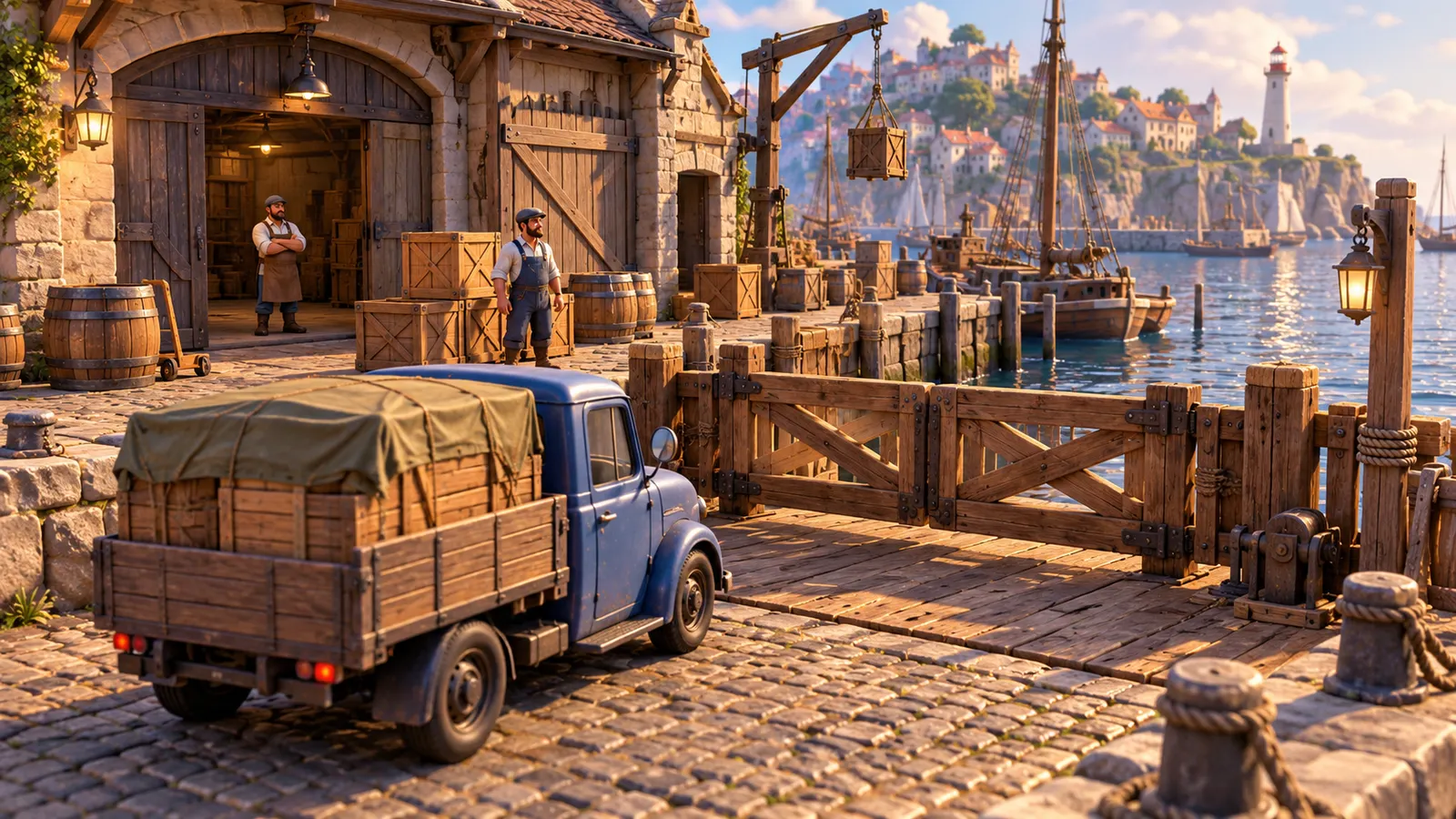
Approve a controlled scenario, then change one condition
Record the build, map revision, initial cargo locations, agent assignments and clock settings. Start the harbor with one available load, an empty truck and free warehouse capacity. Assign delivery, observe loading and travel, then confirm one transfer to the warehouse. Write the expected state changes before reviewing the result.
- Competing assignment: request the same exclusive job from two workers; verify one permitted owner and understandable feedback for the other.
- Blocked route: close the agreed passage before travel; check the defined wait or failure outcome without cargo loss.
- Full destination: remove warehouse capacity; the load must not disappear into an unavailable destination.
- Pause and resume: pause during loading and inspect the world; verify which activities remain stopped and which interface actions remain available.
- Speed change: change the supported simulation speed; check the approved final ownership and event counts.
- Reset: reload the named starting scenario; old reservations, queued actions and completion callbacks must not leak into the new run.
A controlled starting point helps reviewers compare observations. It does not automatically mean bit-for-bit deterministic replay across devices, physics settings or engine versions. If exact reproducibility is a genuine requirement, commission it explicitly, including randomness, input recording, supported environments and the evidence used to judge equivalence.
Expand only after the first model is useful
Once the delivery route works, choose the next uncertainty rather than adding every feature at once. A second vehicle tests contention and routing. A second destination tests assignment choices. More decorative buildings mostly test content production. These are different investments and should be described separately in proposals.
Ask the team to state the supported number of active agents, objects and scheduled events, along with target devices and acceptable observation conditions. Do not accept an unlimited-world promise from a small demonstration. A performance problem caused by interacting agents may require different work from a visually expensive scene; measure the representative case before changing the scope.
Receive the editable world configuration, action and interruption rules, scenario setup, source project, review build identity and known limitations. Link these decisions to the current game design reference so that a later content change does not silently alter the model being accepted.
Match the evidence to the capability being commissioned
Our in-development City Chomp 3D project describes interacting objects and rival-agent behavior. ROADFORGE demonstrates connected Unity gameplay states, progression and device validation. These are relevant implementation examples, not evidence that we have delivered a scientifically validated simulation or the hypothetical harbor above.
For an entertainment prototype, send the player's role, the world relationship you want modeled, platforms, reference material and the first scenario that would make the idea worth pursuing. If professional training accuracy is essential, separate that requirement from entertainment behavior and establish the domain expertise, validation and acceptance responsibilities before treating it as the same engagement.
Simulation game commissioning questions
What should a simulation game development proposal specify about its world model?
Specify the modeled entities, valid states, player and agent actions, time progression, interruptions, observable outcomes and explicit exclusions. Include one controlled starting scenario with acceptance checks, supported scale and a clear boundary between live world behavior, rewards and persistent progress.
Is a simulation game automatically a validated professional training simulator?
No. An entertainment simulation can simplify real-world relationships for play. A professional training simulator needs separately defined accuracy requirements, domain expertise and validation evidence. A polished Unity scene or a working entertainment prototype does not establish those qualifications.
Define your first playable simulation
Send your concept, target platforms, the player's main decision and the world behavior you want to prove first. We can discuss a bounded Unity entertainment prototype, its review scenarios and organized source handover before expanding production.
Explore game development services · Describe your simulation game project · Discuss it on WhatsApp