Game design · Implementation decisions
Game Design Document: Turn Game Rules into Buildable Decisions
A game idea says what the experience could be. A useful design document explains how that experience behaves, including the awkward cases that a short pitch leaves unanswered.
A game design document, or GDD, is a shared, evolving reference for the intended player experience, rules, systems and content. For someone commissioning a game, its value is practical: the team can discuss the same behavior, identify unresolved decisions and check a build against an agreed design version. It is not simply a longer sales brief or a promise that every idea will be implemented.
You do not need to complete a huge document before contacting a developer. Start with a project brief for the initial scope discussion. Once the project moves into design and implementation, make its important rules explicit. A scoped Unity game development engagement can include clarifying those decisions rather than treating every unanswered question as a programmer's assumption.
Separate the brief, the design and the implementation plan
The brief explains the project's purpose, audience, platforms, high-level loop, available materials and requested scope. The GDD develops what the player can do and how the game responds. Technical documentation explains how the team implements that behavior: architecture, dependencies, data structures and build procedures. These references connect, but they should not be interchangeable.
For example, “a mobile mission game with upgrades” is enough to start a discussion, but not enough to implement a reward rule. Does failing a mission grant anything? Can a completed mission be replayed for another reward? What happens if the application closes on the result screen? These are product decisions before they are coding tasks.
Unity Learn's design-document tutorial presents documentation as a tool for collaborative organization and allows different formats. It also connects design work with accessibility considerations and early player feedback. The buyer framework here focuses on turning that shared reference into decisions your development team can implement and review.
Write one system card before building a large document
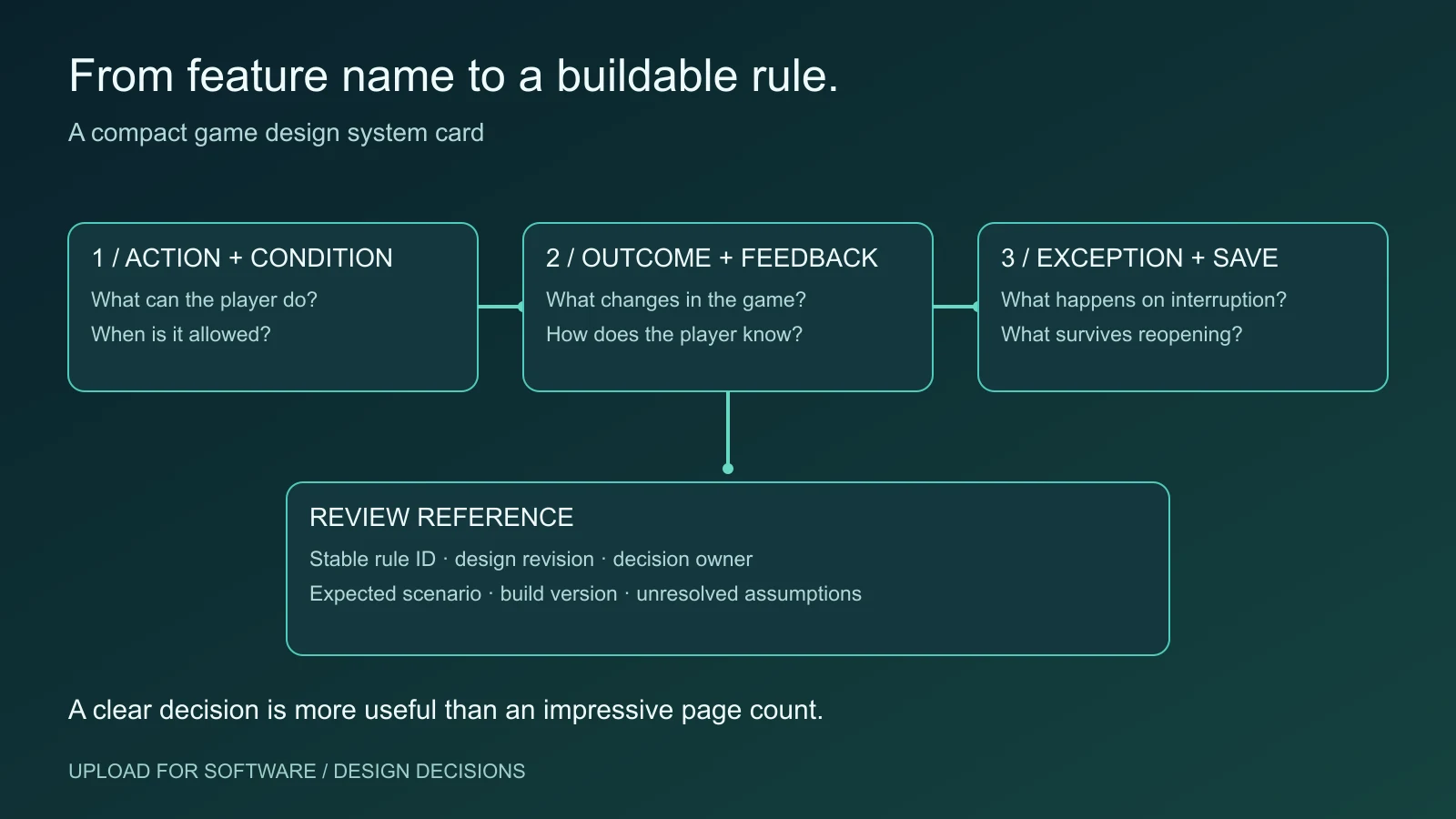
Begin with a system that matters to the first playable experience. Keep the language understandable to the person approving the product. A useful card answers what the system does, when its rules apply and how someone will recognize the intended outcome. It can live in a document, wiki or project tool; the format matters less than having a known current version.
| Field | Decision to record | Review question |
|---|---|---|
| Purpose and boundary | The player need, included behavior and exclusions. | What does this system promise, and what does it not do? |
| Actions and conditions | Allowed input and the state required for it. | Can the player trigger it before the required condition exists? |
| Result and feedback | State changes and visible, audible or tactile response. | Can the player understand what happened without guessing? |
| Exceptions and persistence | Failure, retry, interruption and what survives reopening. | Does the same rule remain coherent outside the ideal path? |
| Decision and evidence | Owner, unresolved assumptions, design revision and review scenario. | Which version and observation support approval? |
Keep design choices separate from implementation details unless a constraint changes the player experience. The GDD can specify that progress survives closing the game; the technical team selects and documents the storage approach. If a platform or service limitation affects that promise, bring it back as a design decision instead of silently changing the behavior.
Example: specify a mission reward without hidden assumptions
Consider a hypothetical single-player mission game. This example illustrates documentation; it is not a client result or a description of a particular game's implementation. The rule might be: the player earns the configured reward after meeting the mission's success condition, and the accepted outcome is reflected in saved progression.
That statement still needs decisions. Name the success condition, the point at which the outcome becomes final and the treatment of replay. Define what happens on failure or abandonment. If the player opens another screen while the result is being resolved, explain whether input is blocked, deferred or allowed. Do not label every missing answer “an edge case” and postpone it until release.
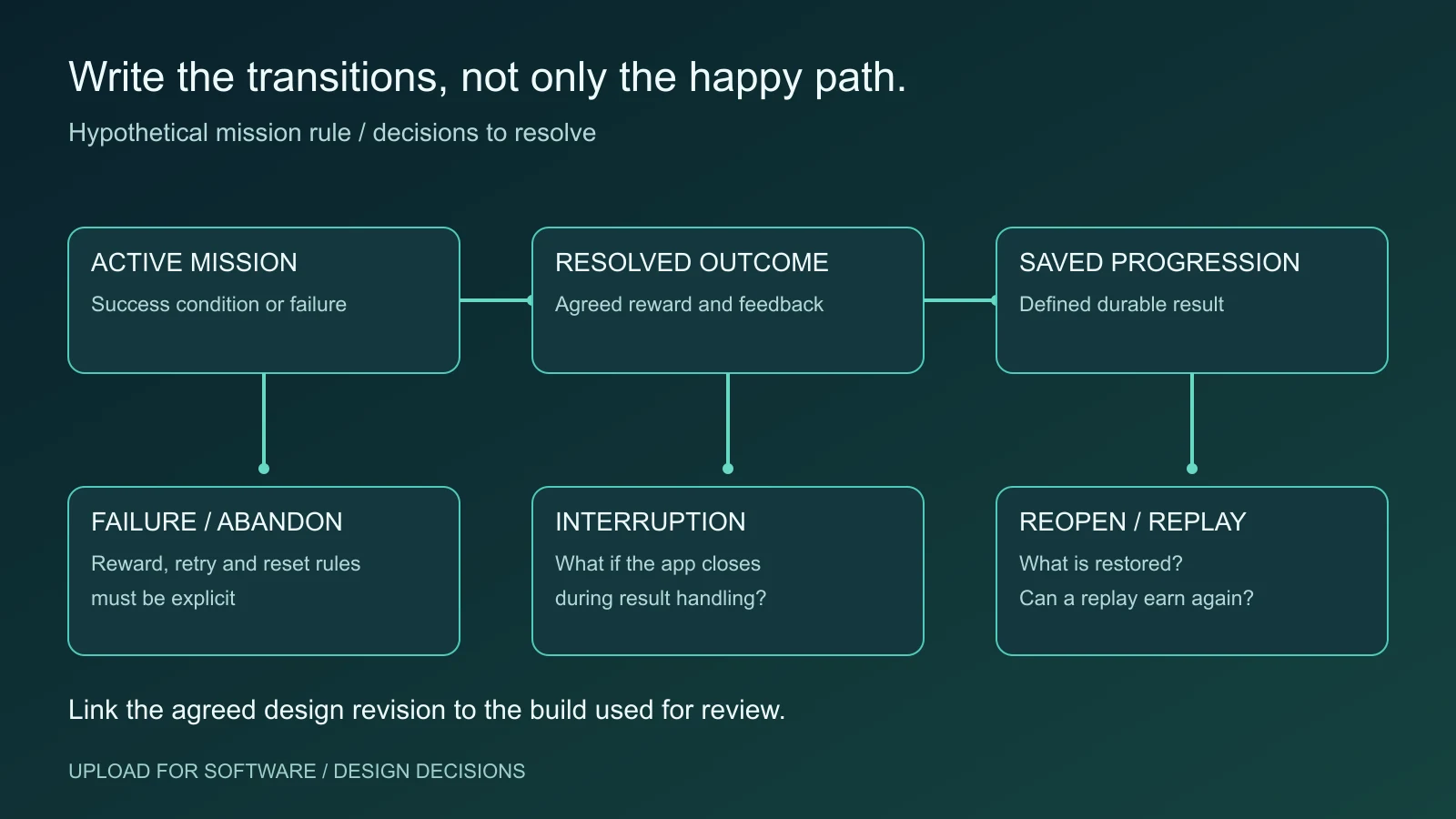
A review scenario can then follow the rule rather than a vague completion percentage: start from a known progress state, meet the success condition, observe the result, leave and reopen the game, and check the agreed persistent outcome. A separate scenario covers failure. If replay grants another reward by design, document that; if not, make the expected restriction visible. Neither choice is universally correct.
The card does not replace a complete game economy specification. That guide owns the resource and balance decisions. Here, the concern is whether the behavior connecting those decisions is sufficiently clear for implementation and review.
Describe feedback, content and accessibility in context
Rules need a presentation layer. Record what the player sees when an action is available, unavailable, accepted or unsuccessful. A color change alone may not communicate a state clearly to every player. Consider text, icons, sound, input requirements and whether essential information remains understandable when one channel is unavailable.
Identify the relevant screens, assets, animation states and audio cues rather than requesting “polished UI” as an undefined package. References should explain the intended quality or behavior, not demand copying another game's protected materials. Keep an asset list linked to the system it supports so that artists and programmers can identify the same state.
Unknowns remain legitimate. Mark an interaction as a hypothesis when it needs a playable test, and assign someone to decide what the feedback means. Accessibility planning and user testing need an agreed scope; a paragraph in a GDD does not establish that a game is fully accessible or that every player will enjoy it.
Connect design revisions to the build being reviewed
A living document should not mean an invisible moving target. Give each important rule a stable identifier and record meaningful revisions. A review build should reference the design version it implements, with exceptions or deferred decisions listed. Otherwise a reviewer can report a mismatch against yesterday's rule while the developer works from today's message.
When a rule changes, record the previous behavior, the proposed behavior, the reason and the affected systems. A reward change may touch progression, interface feedback, saved data and test cases, not only one number. Ask the team to explain that impact before treating the revision as a small visual correction.
Use scope decisions to determine what belongs in the current increment. Use the GDD to specify the behavior of what is included. A feature can be well documented and still be outside the commissioned work; design approval does not automatically authorize extra implementation.
Review decisions, not the page count
Before accepting a design increment, ask whether two people can describe the same player route and expected outcomes from it. Look for contradictions between rules, screens and content. Separate a missing design decision from an implementation defect: if the intended behavior was never agreed, resolve it; if an agreed rule does not work, record the mismatch against that rule and build.
A vertical slice can test connected production quality once representative behavior is defined. The GDD helps explain what the sample is intended to do; the playable sample supplies observations that may change the design. Neither a document nor a convincing screenshot establishes that the complete game is ready to release.
For an example of our actual Unity work and its connected gameplay and interfaces, see ROADFORGE: Tank Battle. The public case study is project evidence, not proof of the hypothetical reward rule above.
Questions about a game design document
What should be in a game design document?
Include the intended player experience, core loop, system rules, actions and conditions, outcomes, feedback, content requirements and relevant constraints. Record exceptions, persistent state, unresolved assumptions and the version used for review. The useful level of detail is enough for the team to implement and discuss the same behavior, not a fixed number of pages.
What is a game design document (GDD)?
A GDD is a shared, evolving reference describing how a game is intended to work. It develops the behavior and content beyond an initial project brief and connects design decisions with implementation and playable review. It does not replace a commercial agreement, technical build instructions or testing of the actual game.
Turn your game idea into a clear implementation discussion
Send us your concept or current brief, target platforms and the systems that still need decisions. We can discuss the design and Unity production scope, reviewable builds and agreed source-file handover before committing to execution.
Explore game development services · Discuss your game · Send the brief on WhatsApp