Unity mobile game · Android & iOS · Original IP
ROADFORGE
A complete mobile tank-combat production that combines forward driving, readable battlefield decisions, progression and support systems inside one Unity project.
Store availability
 Google PlayListing coming soon
The iOS edition is available on the official App Store. Google Play availability is shown separately and will be linked once its listing is live.
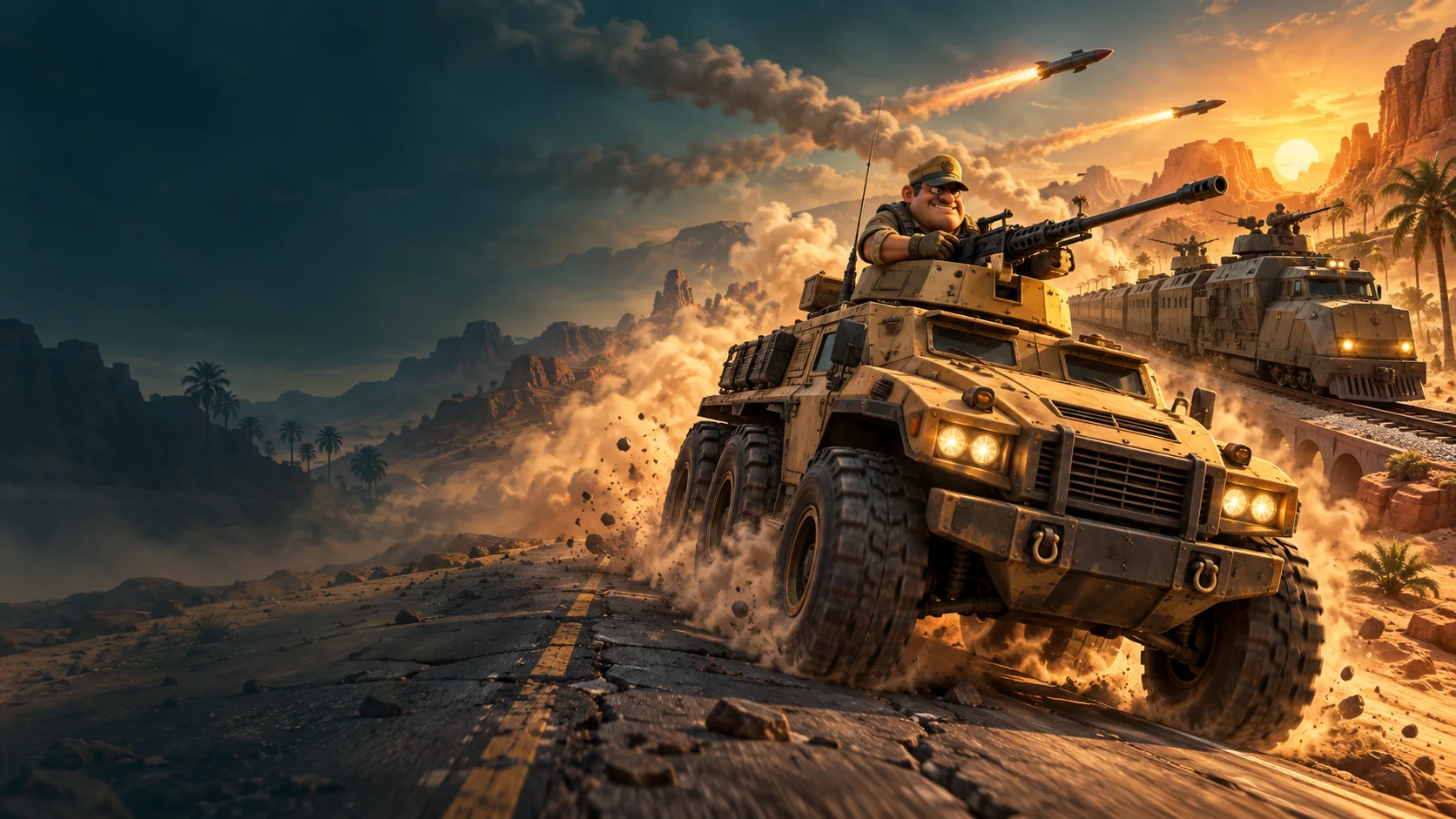
Official ROADFORGE splash art
ROADFORGE is an original Unity mobile game built around a simple promise: the road keeps moving, and every second asks the player to read the battlefield. The player steers an armored vehicle through desert routes, avoids hazards, manages limited resources, calls support and improves the wider combat squad between missions.
The project covers the complete playable path rather than a single prototype scene. Its systems include driving, automatic primary fire, special weapons, hostile vehicles and infantry, airstrikes, terrain response, campaign progression, a workshop economy, support-unit combat views, interface work, save persistence and Android build validation.
Genre and platform
Single-player arcade vehicle combat developed in Unity 6 with a stylized military-cartoon art direction. The iOS edition is on the App Store; the device validation evidence below documents the Android build.
Production scope
Gameplay engineering, game-ready 3D integration, UI, progression, effects, optimization, testing and organized source continuity.
Player objective
Survive moving road encounters, complete mission objectives, defeat milestone bosses and strengthen the squad for later stages.
Design priority
Keep decisions readable on a phone while preserving speed, impact and meaningful control over the vehicle.
The primary weapon handles routine fire. The player handles the decisions that change the run.
A vehicle game can quickly become awkward on a touchscreen if steering, aiming, firing and camera control all compete for the same fingers. ROADFORGE separates those responsibilities. The main weapon fires automatically when its combat conditions are met, while the player focuses on steering, acceleration, braking, positioning and the timing of limited abilities.
Movement still matters
The road is divided into three readable lanes, but the player is not trapped inside them. Moving onto the shoulder or into sand can create an escape route at the cost of speed or handling. Water, barriers, trees and other surfaces have their own consequences, so leaving the asphalt is a tactical choice rather than decorative freedom.
Threats announce a decision
Airstrike zones, enemy fire, traffic pressure and environmental obstacles create different forms of danger. The interface prioritizes health, the current objective and immediate controls while marked threats give the player enough information to react. Special weapons and support are limited resources, which prevents every encounter from being solved with the same button.
Combat feedback follows the weapon
Tank, train, drone, squad and hostile weapon paths share a bounded muzzle-effect system. Muzzle flashes follow translation, aiming and recoil, while rockets use their own wider pulse and existing smoke path. This keeps the visual response tied to the actual firing source without creating duplicate effects for the same shot.
Campaign and pacing
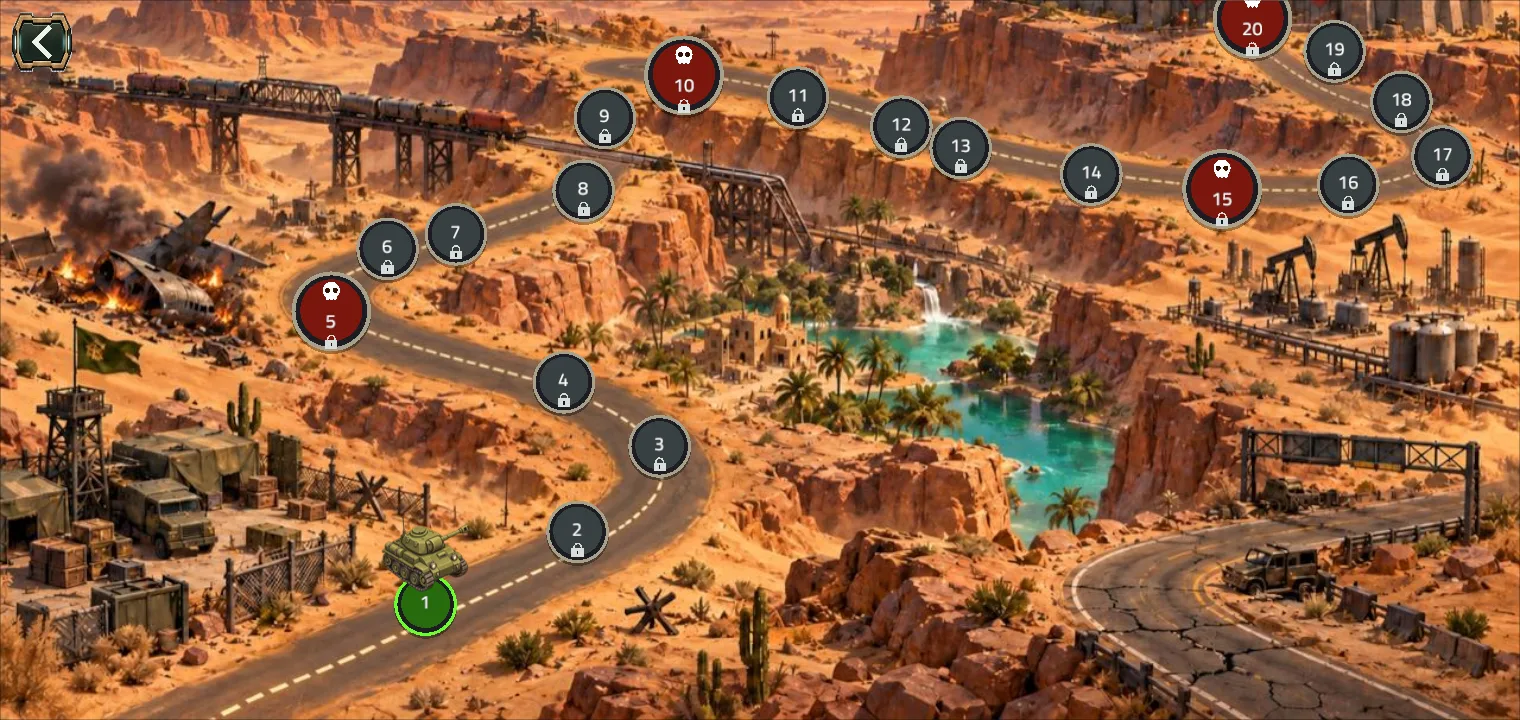
A 20-stage journey with visible milestones.
The campaign map turns progression into a route the player can understand at a glance. Standard missions build pressure between boss stages at 5, 10, 15 and 20, while replayable unlocked stages provide a way to earn more upgrade currency.
| Layer | What changes | Why it matters |
|---|---|---|
| Mission objective | Patrols, pursuits, hazards and stage-specific combat pressure. | The player reads a clear goal instead of only driving until a hidden finish point. |
| Enemy pressure | Health, damage and additional enemy density rise within controlled caps. | Upgrades remain useful without turning every later stage into an uncontrolled spike. |
| Boss milestones | Every fifth stage closes a campaign segment with a major encounter. | The route has visible peaks and short-term goals rather than one flat sequence. |
| Replay value | Unlocked missions can be repeated for reduced rewards. | A spent reward does not permanently block the next required workshop decision. |
Road combat
Touch steering and pedals control the vehicle while automatic primary fire, rockets, nitro, airstrikes, enemies and terrain response build moment-to-moment pressure. Ordinary collisions and boss damage follow different rules so high-speed abilities feel powerful without bypassing milestone encounters.
Train and drone support
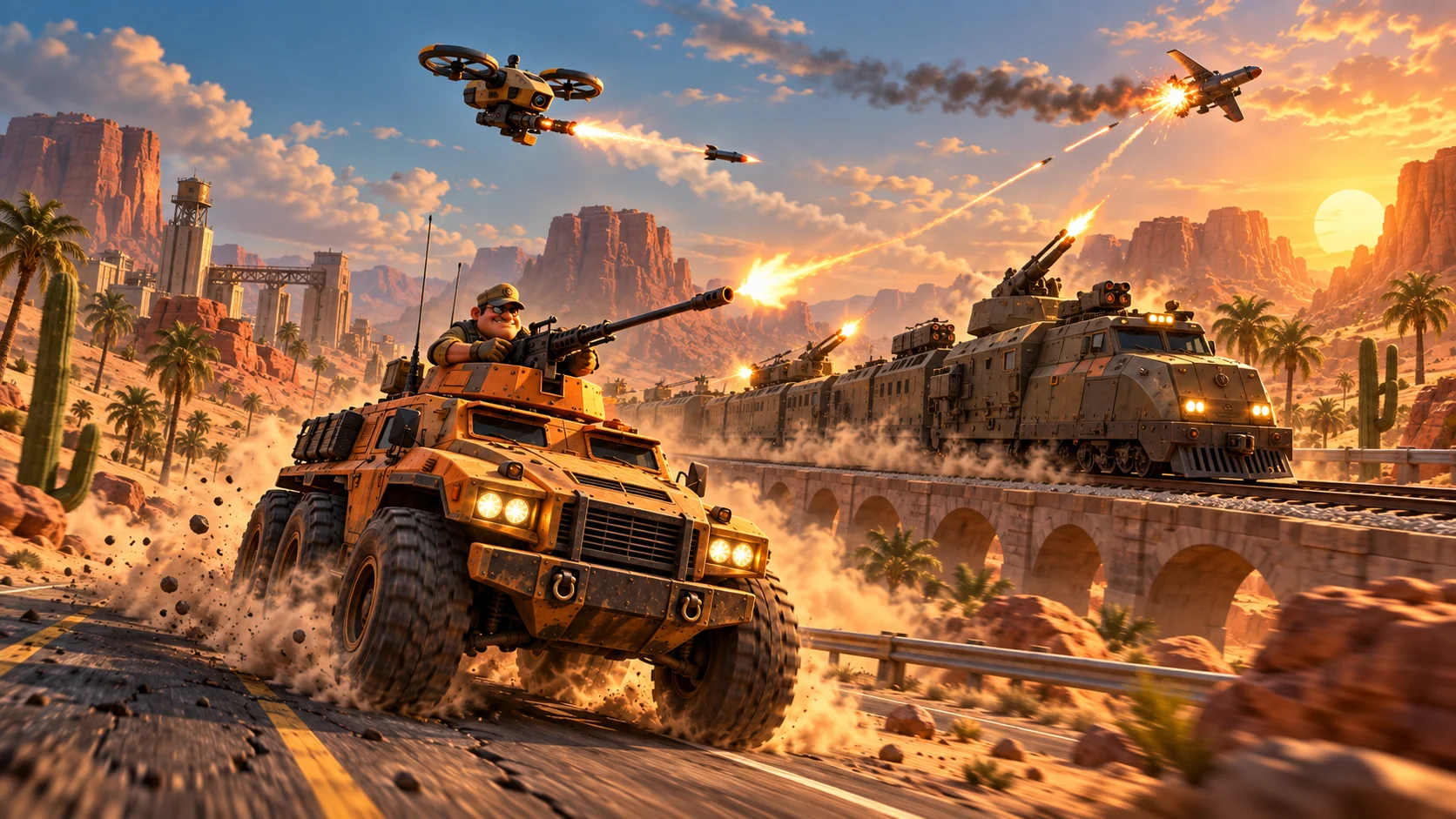
Support pickups can move the player into a train or drone combat view. Drag aiming controls the active weapon, firing remains automatic, and the player can return to the tank before the support window ends. The train follows the vehicle's pace; the drone combines its cannon with its existing rocket pods.
Squad and crew
Support is presented as a broader combat squad instead of disconnected power-ups. The workshop lets the player inspect the tank, drone, train, squad and crew as parts of one progression system.
Shared economy
Gold collected on the road is committed to the same saved wallet used for purchases and upgrades. Repeated collection is rejected, the HUD reflects the saved balance, and a failed profile write cannot publish a false charge or rank change.
Visual workshop
The workshop places a live 3D unit at the center, with selectable parts, ranks, stat changes, prices and equipment options arranged around it. The player can rotate the model, move between units and understand what an upgrade changes before committing coins.
Combat, support and progression
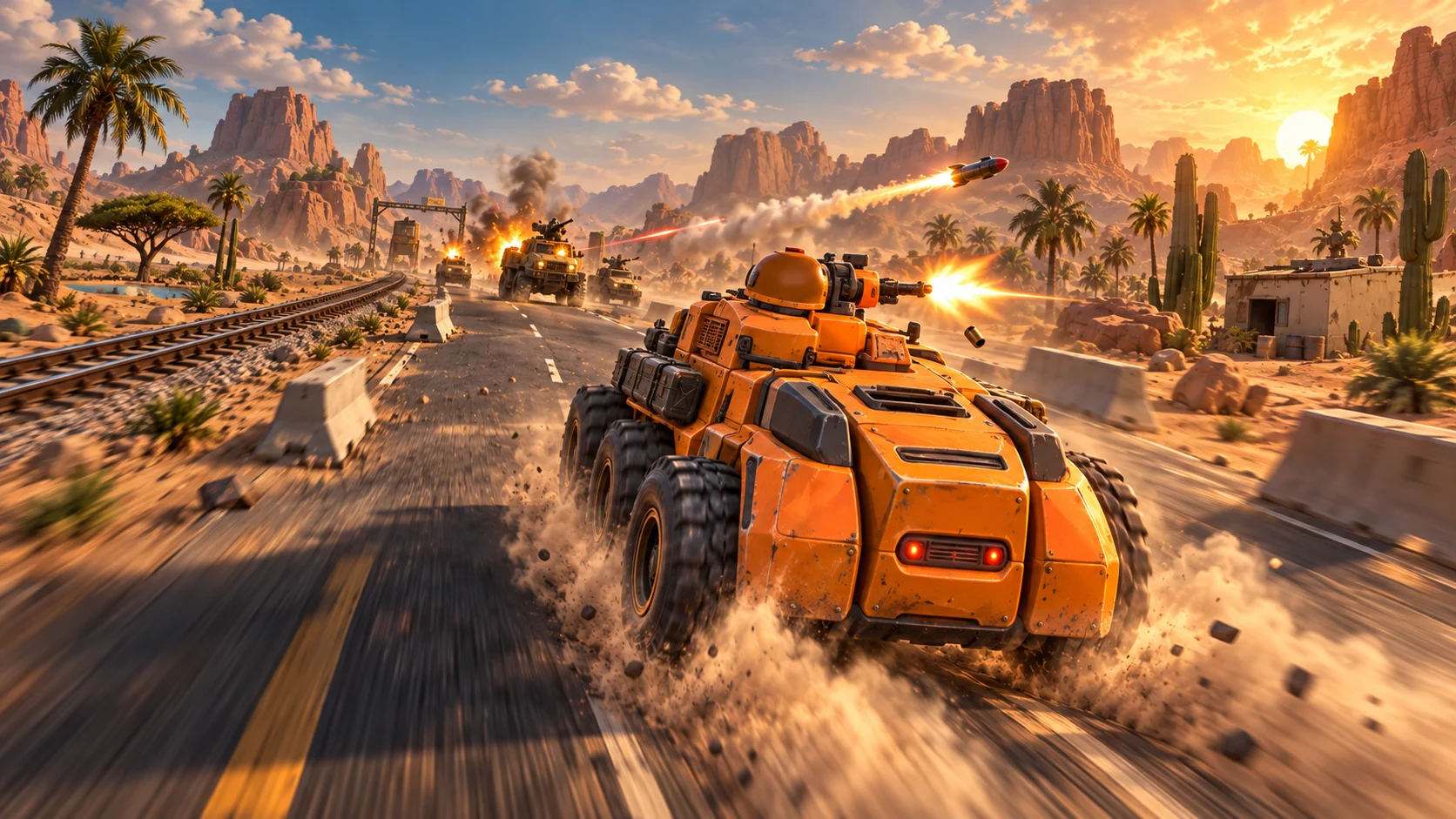
Three visual pillars, one production identity.
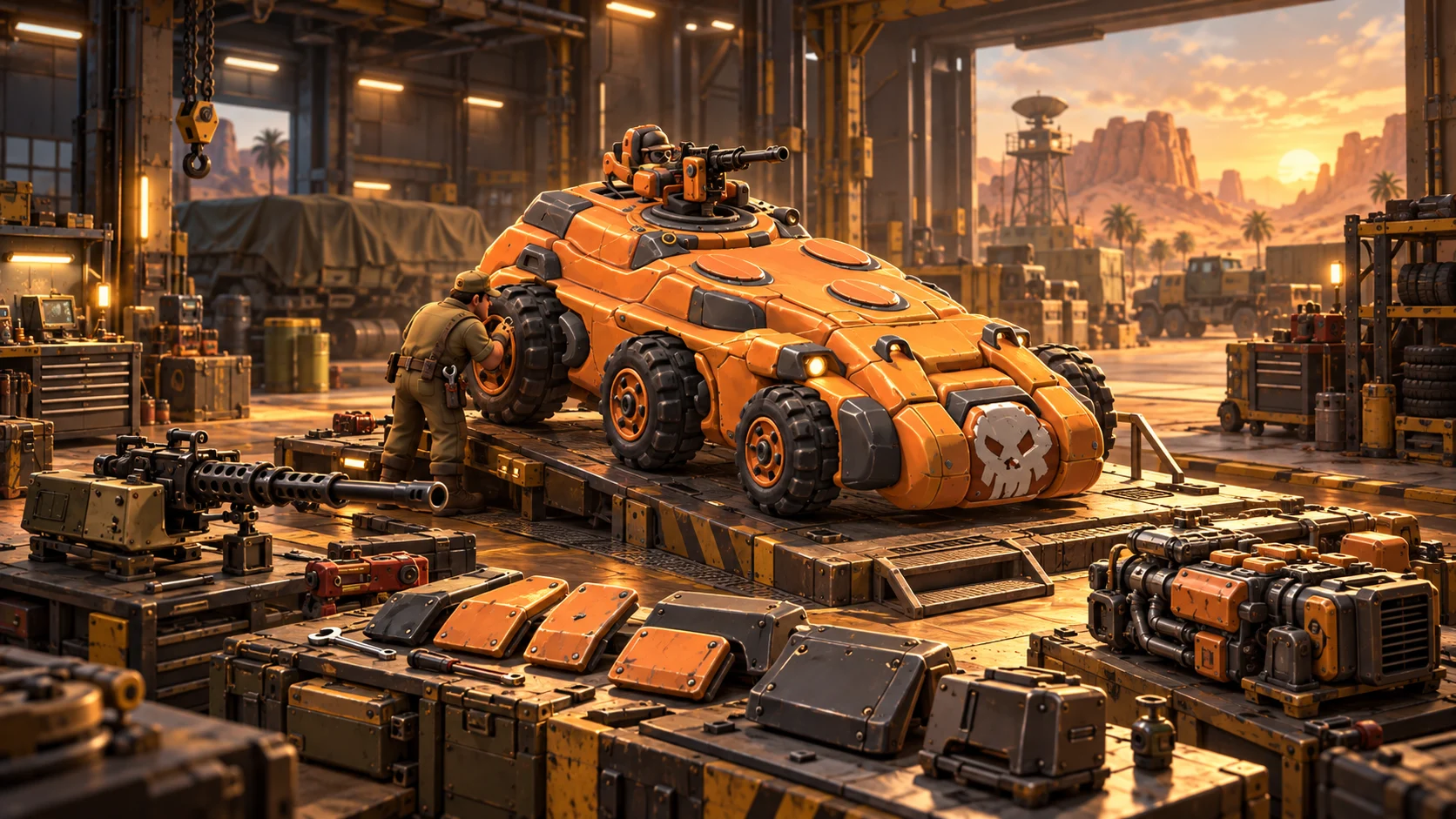
The presentation keeps the orange armored vehicle, desert route, battle train, drone support and industrial workshop inside one consistent ROADFORGE world.
Touch controls were tested as a complete screen
A support-aiming area initially overlapped the pause control on the physical device. The input region was reduced, and pause plus return-to-tank were checked through real touch paths rather than callback-only tests. The lesson is practical: each control may work independently and still fail when screen regions compete.
Weapon timing was made frame-rate aware
A support weapon cadence that behaved correctly in the editor slowed on the target phone. Scheduling was adjusted so train and drone shots retain their intended timing across lower frame rates instead of waiting for an extra rendered frame. Damage was not inflated to force the result.
Progression protects the player from a dead end
The first win funds an available upgrade or purchase, while replay rewards provide another route if currency was spent elsewhere. Enemy strength grows within capped multipliers and more slowly than the player's equipment value. This turns the workshop into part of the campaign design, not a menu attached after combat.
Safe-area and viewport checks shaped the workshop
The workshop was captured across 16:9, 16:10 and 4:3 layouts. Callouts track the rotating model, crowded projections separate, and the camera refits the selected unit. The design was also verified on the target phone after correcting equipment placement and touch behavior.
Performance work used bounded reusable systems
Muzzle effects use reusable slots and shared materials instead of creating a new object for every shot. Workshop preview rendering is demand-driven and capped while the model moves. Adaptive rendering can reduce load under pressure on the low-end test device. These choices protect gameplay continuity while keeping the visual response readable.
Focused Android checks exercised tank combat, train and drone aiming, repeated support use, return-to-tank behavior, nitro, damage, coins, workshop progression and enemy attack paths. The installed production package was compared by hash with the build output, and normal save data was preserved during the review flow.
A one-hour stability run kept the same application process active while loading stages 1, 5, 10, 15 and 20 repeatedly. It covered 29 stage loads and almost fifty thousand rendered frames without a managed exception or application restart. The run was performed on low-end hardware configured around a 15 FPS target, so it is stability evidence—not a claim of 30 or 60 FPS performance across all devices.
That distinction matters in commissioned mobile game development. A useful test report should identify the device, build, scenario and limit of the result. It should not turn one successful session into a universal performance promise.
For commissioning a focused performance iteration on an existing build, read our Unity game optimization acceptance guide. It separates measured improvement, visual tradeoffs and stability evidence.
ROADFORGE demonstrates the ability to connect gameplay, UI, 3D content, progression, persistence, device builds and focused validation inside a maintainable Unity production. The iOS edition now has an official App Store listing. Wider device coverage and the Google Play release remain separate gates.
For a new game project
What should be defined before production starts?
ROADFORGE grew through connected decisions. A new project becomes easier to estimate and review when those decisions are made explicit before full production.
Playable core
Define the player action, camera, controls, failure state and the shortest loop that proves the game is fun.
Content structure
Define stage count, enemy families, milestone encounters, progression gates and which content can be reused safely.
Art pipeline
Define the visual direction, model responsibilities, materials, animation, effects, LOD needs and engine handover format.
Acceptance evidence
Define target devices, measurable checks, build identity, save protection and what a milestone must demonstrate before approval.
A serious estimate should connect those four layers. If the gameplay, content, art and acceptance plan are priced separately without shared assumptions, integration risk appears late—when it is most expensive to change.
Have a game in mind?
Turn the idea into a playable Unity production.
Send the platform, gameplay direction, visual reference and the result you need. We can define the scope, build the playable core, produce the game systems and deliver organized source files.
Request a project quoteWhatsApp us