Game production · Playable level acceptance
Game Level Design: Accept Goals, Decisions and Encounter Pacing
Before ordering a campaign of finished stages, agree what players must understand, choose and overcome in one level—and how you will review it in a build.
Game level design arranges a game's spaces, objectives, interactions and challenges into a playable experience. For a founder or producer commissioning levels, the useful deliverable is not only an attractive map. It is a route with understandable goals, meaningful decisions, workable encounter pacing and explicit completion and failure rules that can be reviewed in the intended game.
Include level work as a named part of your Unity game development scope. Clarify whether the engagement includes layouts, encounter scripting, objective logic, playable iteration or finished environment art. These may work together, but agreeing to one does not silently commission all of them. A batch of beautiful scenes can still leave the player experience undefined.
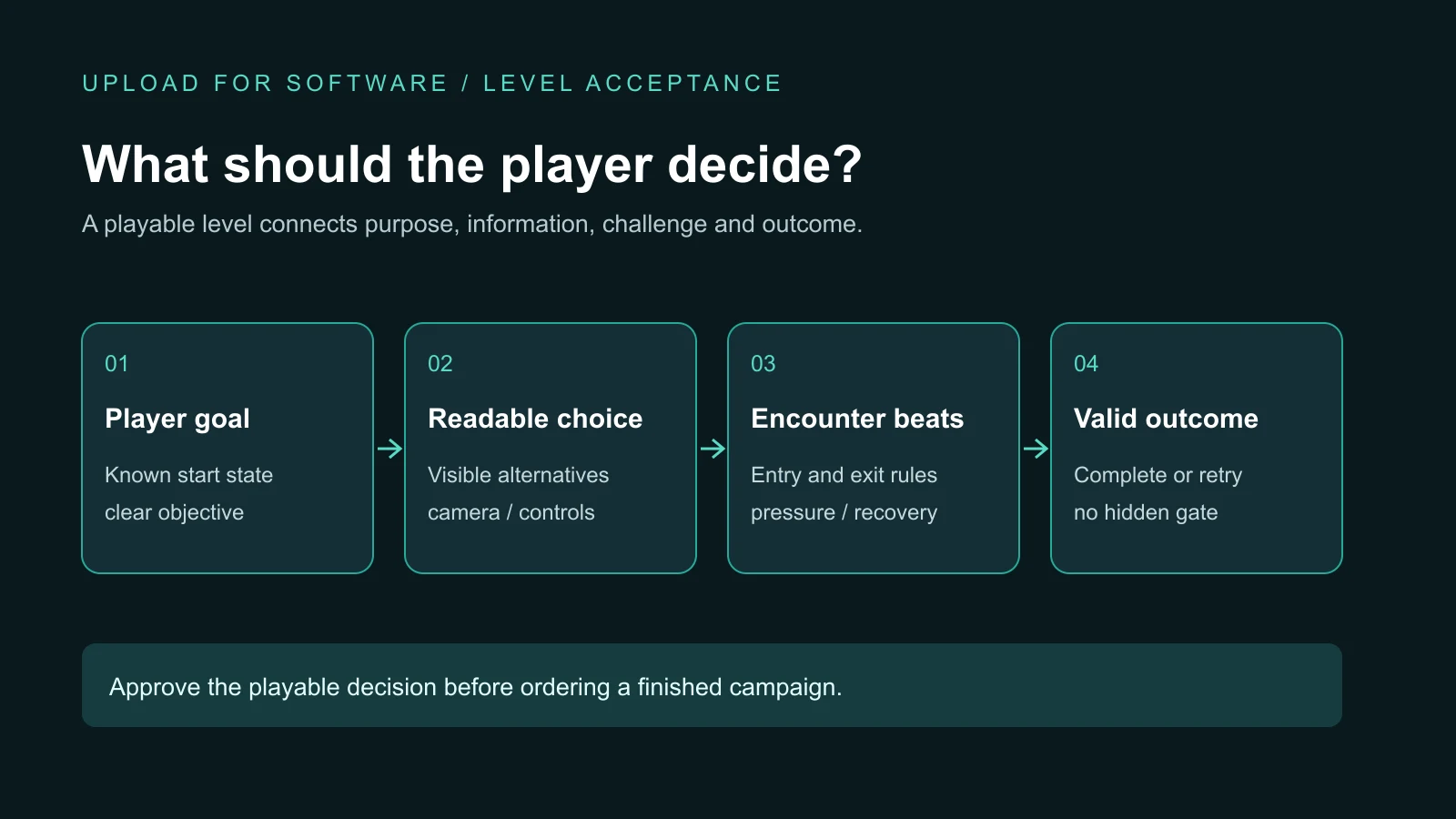
Write the level's purpose before counting its assets
Give each commissioned level a purpose within the player's experience. It might introduce a mechanic, combine familiar actions, ask the player to prioritize threats or offer a quieter recovery segment. “Another desert stage” describes a setting, not the behavior that makes the stage different from its neighbors.
Turn that purpose into an observable decision. A hypothetical driving-combat level might ask the player to move between exposed ground and a protected lane while choosing which threat to handle first. The review question is whether the available information supports that choice, not whether the scene contains a prescribed number of enemies.
The game design document supplies the shared rules. This per-level brief identifies where and in which sequence the player encounters them. Record assumptions about prior abilities, available equipment and already learned actions. If the level requires an ability that the campaign has not introduced, an otherwise valid layout may fail its intended purpose.
Separate spatial delivery from the playable route
Our game environment design guide covers spatial and visual production constraints. Level acceptance adds the sequence of objectives, player choices, encounter triggers and outcomes. A readable environment supports the route; it does not by itself establish that the objective can be completed or that a restart restores the correct conditions.
Unity's level design introduction includes player pathing and gameplay beats alongside early layout iteration. It also explains why simple geometry helps teams change a layout before investing in detailed art. For a buyer, that supports reviewing the playable decision before requesting final scenery.
Keep the current camera and controls in that review. A route that is easy to read from a free editor camera may be confusing from the player's fixed view. Ask the team to identify the cue for the next action, what remains visible during movement and where feedback confirms that the objective has changed. Avoid treating an annotated screenshot as equivalent to playing the route.
Define goal, completion and failure as separate states
Write the player's goal in plain language, then specify the conditions that make it complete. “Reach the exit” may require crossing a boundary, clearing a threat, activating an object or surviving until a transition. State which conditions are necessary together and what happens if the player approaches them in a different order.
| Decision | Agreed behavior | Review observation |
|---|---|---|
| Purpose | Choose a safer route while a threat is active. | The player can identify the competing options from the gameplay camera. |
| Completion | Reach the marked endpoint after resolving the required threat. | Reaching it early does not incorrectly finish the stage. |
| Failure | A defeated player retries from the agreed start state. | Previous triggers do not leave the retry impossible or already complete. |
| Optional action | A side route offers a choice, not a hidden mandatory requirement. | The main objective remains achievable without taking the detour. |
This is a hypothetical specification, not a passed test or ROADFORGE configuration. Each row needs a named level version and expected outcome. Reward amounts and upgrade affordability belong in the economy model; the level card should reference approved assumptions without silently rewriting them.
Make encounter pacing a sequence of beats
Map the route as a sequence: orient, introduce a choice, apply pressure, resolve and recover. The exact structure depends on the game. A puzzle stage may need time to inspect information; a vehicle-action stage may alternate steering attention with threat handling. Continuous intensity is not automatically better pacing.
For each beat, name its entry condition, the action it asks of the player, the information available and its exit condition. Separate distance-driven, objective-driven and time-driven events. If progress depends on travel, waiting still should not advance the encounter unless the design explicitly allows it. If an event requires a defeated enemy, an unrelated timer should not silently substitute for that condition.
Review overlapping demands. A new control instruction, a fast turn and an unfamiliar threat arriving together may overload the first-time player. That does not prove any particular difficulty target is wrong; it identifies a testable question about the ordering and information. Change one relevant condition, replay and compare the observations rather than increasing every enemy's health.
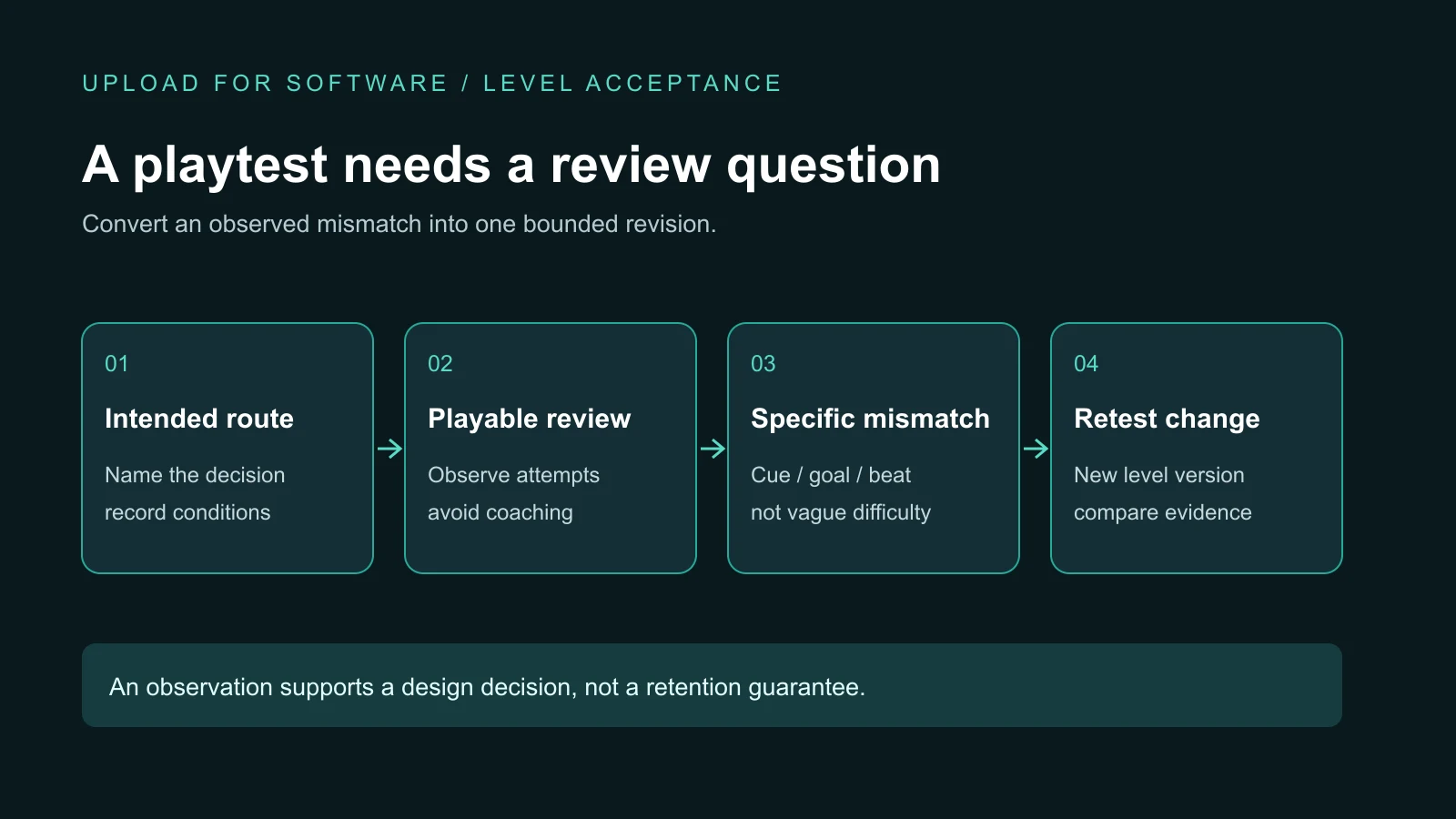
Observe a playtest without supplying the answer
Before the session, state what you need to learn: whether the next objective is understood, whether the intended choice is noticed or whether a retry remains playable. Let the participant try the agreed route without constant guidance. Record where they hesitate, what they try and what the build does. Distinguish an observation from your explanation of it.
For example, “the player drove past the turn twice” is an observation. “The level is too difficult” is a broader interpretation that may not identify the cause. The cue could be hidden by the camera, the objective could be unclear or the turn could require an unintroduced control. A useful revision addresses the plausible cause and checks it again.
The GDC Invisible Intuition session description discusses natural flow and playable feedback when checking layout changes. Our acceptance approach translates that into a review record: intended behavior, observed mismatch, proposed change and retest result. A small playtest is design evidence, not proof of universal enjoyment or retention.
Accept the revised level before multiplying the campaign
Keep findings tied to a build, level revision, input method and relevant starting state. Sort issues into objective logic, readability, encounter ordering, restart behavior and production limitations. A client preference for a different mood is not the same as a completion trigger firing incorrectly; both deserve a clear decision, but they require different work.
Our ROADFORGE case study shows a Unity campaign with twenty stages and four boss milestones. It provides concrete production context for connected objectives, combat and progression. It is not evidence that this article's hypothetical acceptance card has been tested, or a guarantee that a different game should use the same stage count.
Before approving a batch, request the reviewed playable route, level cards, objective and encounter configuration, known limitations and the changes resulting from review. Use the vertical slice guide for the broader connected production decision. Level acceptance is one input to that decision, not a replacement for performance, integration or release checks.
Game level design questions
What is level design in a game?
Level design arranges playable spaces, objectives, interactions and challenges into an experience. It defines how players move through a level, understand goals, make choices and reach outcomes. Environment art supports those decisions, but a finished-looking scene alone does not establish a working playable level.
How should a buyer accept game level design?
Agree the level purpose, starting assumptions, objective and failure conditions, decision route and encounter beats. Review a named playable version with the intended camera and controls, record observations without guiding every action, then retest specific revisions. Receive the level configuration and known limitations before approving a larger content batch.
Commission levels with a reviewable player experience
Send your concept or current Unity build, target platforms and the campaign or mission work you need. We can discuss a scoped level-production engagement with playable routes, objective logic, review checkpoints and agreed source handover.
Explore game development services · Discuss your game · Send the brief on WhatsApp