Tactical prototypes · Commissioning decisions
Strategy Game Development: Approve Commands Before Expanding the Map
Define what a unit may do, what the player can preview and when an order becomes final before commissioning more maps or factions.
A strategy game development prototype should prove a complete decision: select a unit, understand its permitted orders, preview a choice, commit it once and see the agreed turn result. Start with a small known scenario and explicit command rules. An attractive map and moving units do not establish that cancellation, movement costs, occupied destinations and end-of-turn behavior work together.
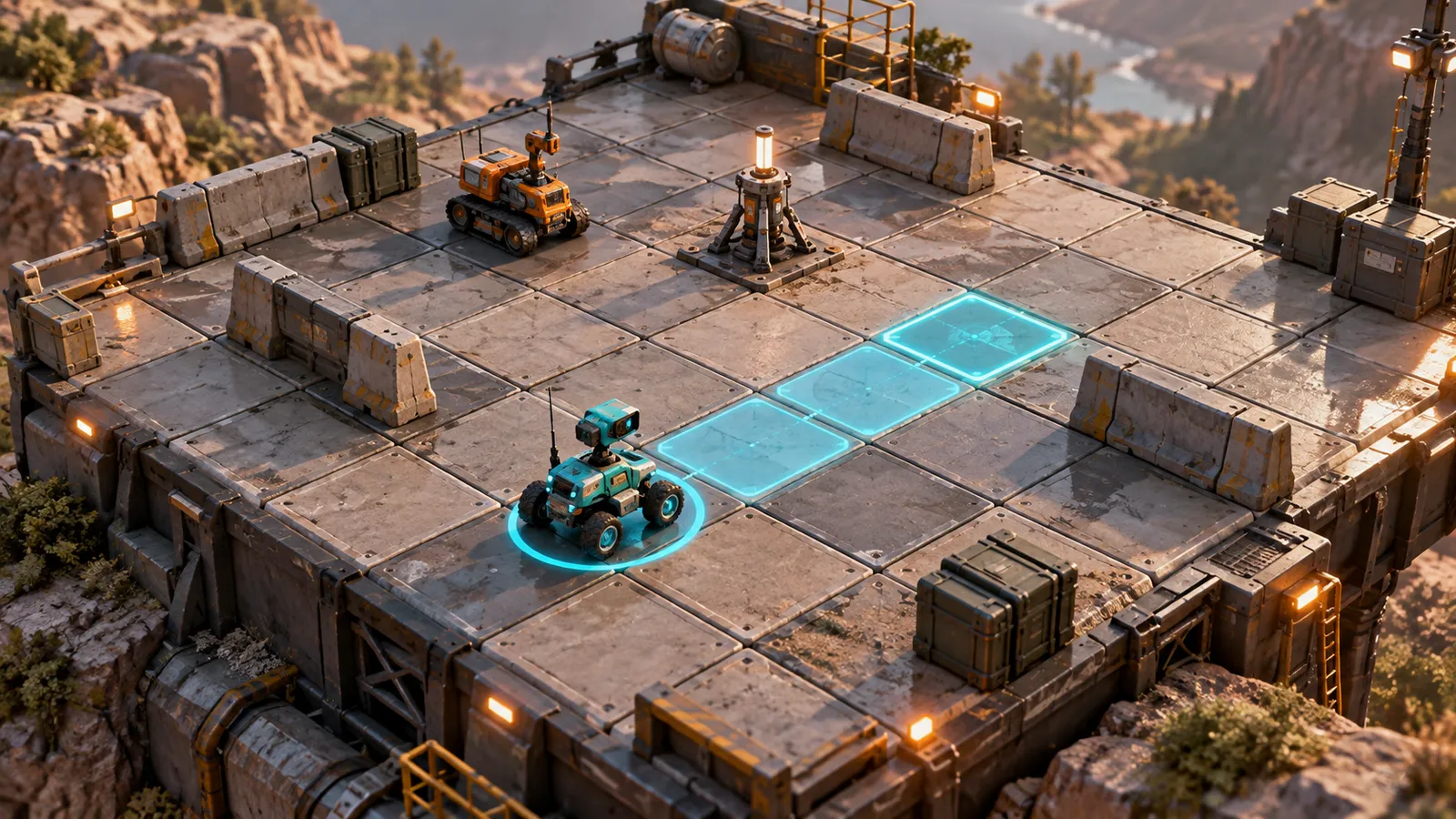
This guide is for an owner commissioning a bounded local tactical prototype in Unity. The first milestone needs client-approved rules and observable acceptance cases. It does not silently include a large 4X world, a capable computer opponent or ranked online play. Use a scoped Unity game development engagement to identify the exact playable decision you need before expanding production.
Choose a decision small enough to review completely
“A strategy game with several factions” describes an ambition, not a first deliverable. Choose one objective, a limited play area and a small unit set that reveals the main trade-off. Decide whether play advances in turns or continuously. A local turn-based sample can expose command ownership and commitment without also requiring online synchronization or a real-time simulation.
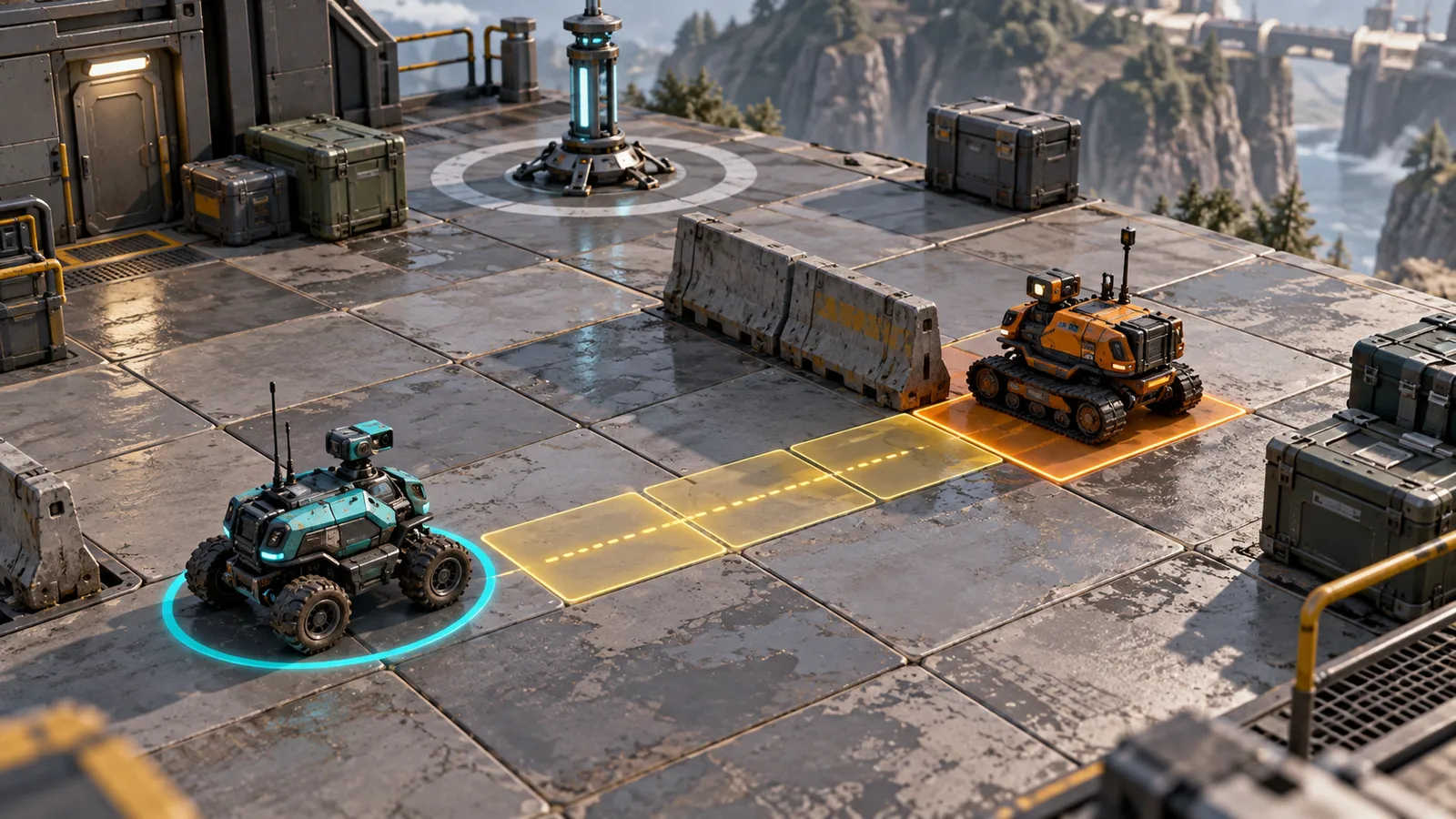
Consider an illustrative Outpost Relay scenario: a scout and a support rover share a compact board with one capture point. A selected unit has an agreed movement allowance. The player previews a vacant destination, cancels without spending, then commits a permitted move. A tile occupied by another unit is not a valid endpoint. These are hypothetical rules for discussing scope, not a completed client title or a passed prototype test.
Agree what the objective requires. Reaching the capture tile, remaining there until turn end and spending an action to activate it are three different rules. The prototype should implement the chosen one and communicate its result. More map decoration cannot settle that ambiguity.
Make selection and command permission unambiguous
List which units the player may select and which state makes each command available. Include the active side, selected unit, remaining allowance, destination occupancy and any rule that prevents acting. An unavailable order needs understandable feedback; leaving a highlighted button that silently does nothing makes a rules decision look like broken input.
Specify the selection transition too. If the player previews a scout move and then selects the support rover, does the preview disappear? Does tapping empty ground deselect, choose a destination or inspect the board? For mobile controls, agree what a first tap, second tap and cancel action mean. Do not rely on a mouse-hover interaction that the intended phone input cannot reproduce.
Keep this command layer distinct from individual attack acceptance. That guide owns cues, commitment and hit outcomes for an attack. Here the commissioning question is which tactical order the selected unit may issue and what its acceptance changes in the turn.
Separate preview, cancellation and commitment
A preview lets the player inspect a proposed action before the game accepts it. Define whether it shows a route, cost, destination or expected range. It should match the actual rule used on commitment. A route that appears affordable but is rejected by unrelated hidden logic undermines the decision the preview was meant to support.
For Outpost Relay, cancellation before confirmation should leave position and allowance unchanged. On confirmation, the system rechecks the chosen unit and destination, applies one accepted order and charges the agreed cost once. Repeated confirmation during movement must not create another move or another charge. Decide whether input is temporarily locked, queued or rejected while an order resolves.
Specify what happens if the proposed destination is no longer permitted at confirmation. A simple local sample may reject the order and retain the starting state. More complex reservation or simultaneous-order rules are separate design choices. Do not assume that a visual movement animation establishes which moment is authoritative.
Agree what the player is allowed to know
Define whether the prototype shows the whole board or hides information. If all positions are visible, state that as an intentional first scope. If information is hidden, specify what becomes visible, when it changes and whether an order may reveal something before it is committed. A translucent overlay alone does not establish those rules.
Likewise, a known movement cost is different from a forecast of an uncertain result. Label a preview according to what it actually promises. Avoid showing a guaranteed capture or attack outcome when another resolution rule can change it. Secure online hidden information requires an authority model beyond a local presentation prototype.
Review turn resolution from a known board state
Write what ends the turn, when allowances refresh and how pending movement is handled. Can the player end the turn while an order is resolving? Does the objective check happen before or after the refresh? A prototype needs one agreed sequence, even if the final game may later use a different one.
The following fixture is a proposed review plan. Record the build, board revision, selected side, unit positions and starting allowances. Expected results are requirements; leave actual observations pending until someone reviews the build.
| Starting condition | Attempt | Expected result to agree |
|---|---|---|
| Scout selected, sufficient allowance | Preview a permitted vacant tile | Route and cost are shown without changing position or spending. |
| Preview active | Cancel or switch selection | Preview clears; no accepted order or cost remains. |
| Support occupies the endpoint | Confirm a move to that tile | Order is rejected under the agreed occupancy rule; state stays unchanged. |
| Valid order resolving | Confirm repeatedly | One accepted movement and one cost; no duplicated queued order. |
| Allowance exhausted | Request another paid move | Unavailability is explained; no movement or negative allowance. |
| Agreed turn boundary reached | End turn, then reset sample | Turn events follow the approved sequence; reset restores the named starting board. |
Change one condition after the baseline: move the support rover onto the proposed endpoint, reduce the scout allowance or change which side is active. Check that preview and commitment still agree. This is more useful than expanding to many units before the first command boundary is reliable.
Keep the command system separate from adjacent work
The simulation guide covers world entities, clocks and agent action consistency. The economy guide covers earned rewards, sinks and progression. Tactical allowance in this sample is a turn constraint, not evidence of a balanced long-term economy. And adapting a physical board is a different product decision from commissioning this small native tactical system.
Ask for editable unit and order definitions with stable identifiers. Unity's ScriptableObject documentation describes assets that can hold shared authored data. Such assets can support configuration, but they do not themselves prove valid command resolution or saved-match recovery. Request the configuration format and the runtime behavior as separate, connected deliverables.
AI, online sessions, pathfinding scale, simultaneous turns and additional factions should each have explicit scope. A developer-controlled opposing unit can help review a rule, but it is not evidence of a strong AI opponent. A local sample does not prove cheating resistance or fair resolution between remote players.
Receive the first milestone before expanding the map
Request the approved order rules, unit configuration, scenario setup, build identity, observations, known limitations and agreed source handover. Ask the team to change one supported cost or unit allowance and replay the fixture. That establishes whether the delivered setup is maintainable without claiming that every future feature can be added through configuration.
Our ROADFORGE case study provides evidence of connected Unity gameplay, limited resources, visible threat decisions and mobile production. It is an action game, not a shipped strategy title. The tactical prototype proposed here should demonstrate its own command rules rather than borrowing genre proof from another project.
Strategy game development questions
What should a strategy game development prototype prove?
It should prove a bounded player decision from unit selection through permitted-order preview, cancellation, commitment and turn resolution. Use a known board state, explicit action costs, occupied-destination rules and reset instructions. Review a normal order and changed conditions before expanding units, maps or factions.
Does a strategy game development quote automatically include AI and online play?
No. AI opponents, online sessions, authority, hidden information, simultaneous orders and supported unit scale need explicit requirements and acceptance evidence. A local tactical prototype can establish command behavior without delivering those additional systems. Compare quotes against the same included and excluded responsibilities.
Scope your first tactical decision
Send your concept, platforms, turn model, unit actions, objective and reference material. Identify the smallest scenario that would make the game worth developing further. We can discuss a bounded Unity prototype, playable review checkpoints and organized source delivery before committing to wider production.
Explore game development services · Discuss your strategy game · Send the brief on WhatsApp