Puzzle production · Commissioning decisions
Puzzle Game Development: Agree the Move Rules Before Ordering More Levels
A colorful board is only the beginning. Define valid moves, board resolution and success conditions in one playable sample before commissioning a content library.
Short answer: a puzzle game development scope should specify the board, legal player actions, how each move changes its contents, and when the game decides success or failure. Review those rules against known starting boards before approving more levels. A working animation or an attractive tile set does not establish a consistent puzzle.
This guide is for a founder or producer commissioning a bounded grid-based puzzle in Unity. Matching, sliding and merging games do not share one universal rule set; choose the actual mechanic before comparing proposals. A scoped game development engagement should name what the first build proves and what remains outside that increment.
Describe the board before describing fifty levels
Start with the information the game must track: board dimensions, occupied cells, tile types, blocked spaces, goals and remaining moves. Decide which parts are fixed by authored content and which are chosen at runtime. These choices determine the review sample more precisely than a request for a particular number of screens.
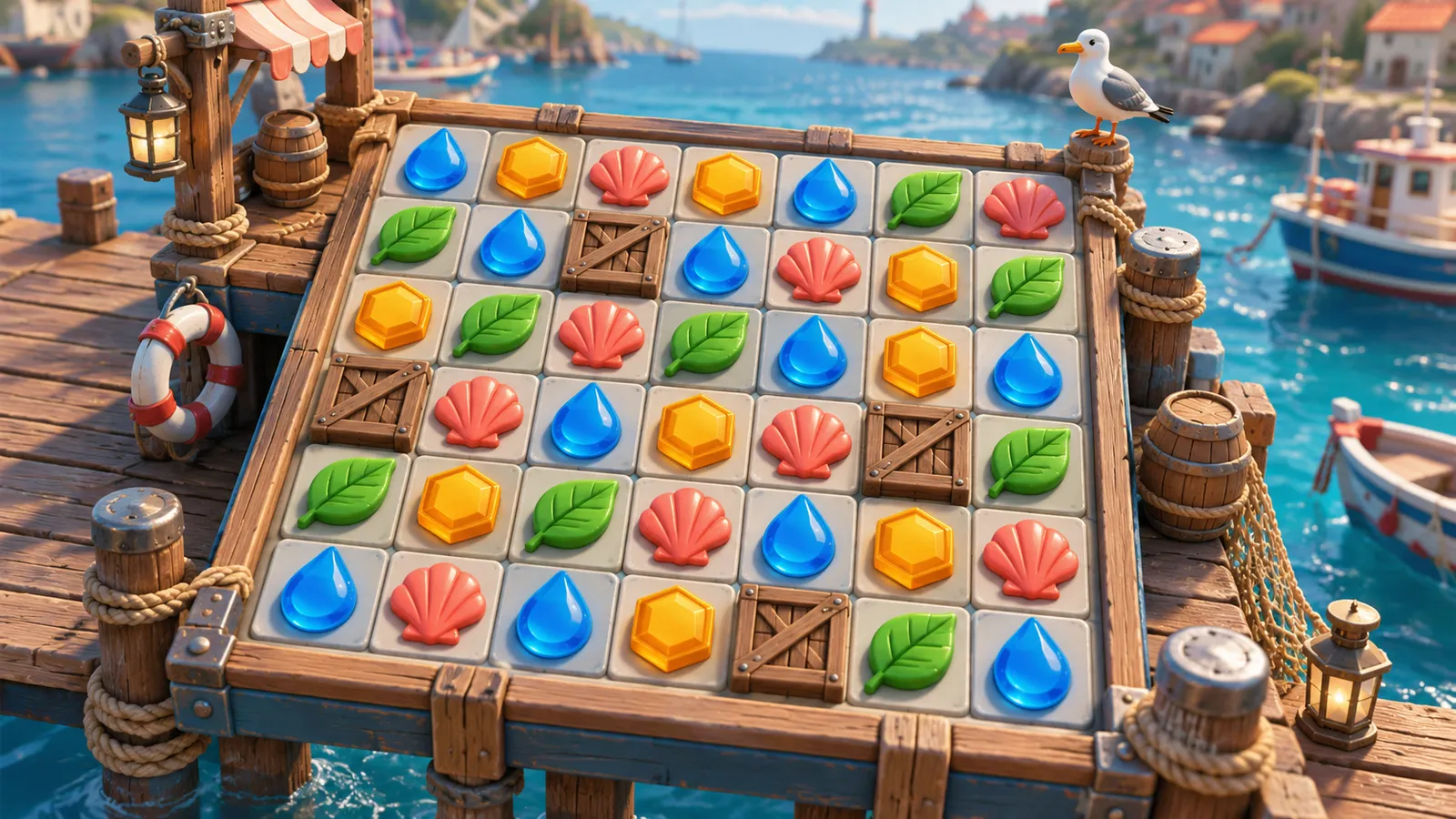
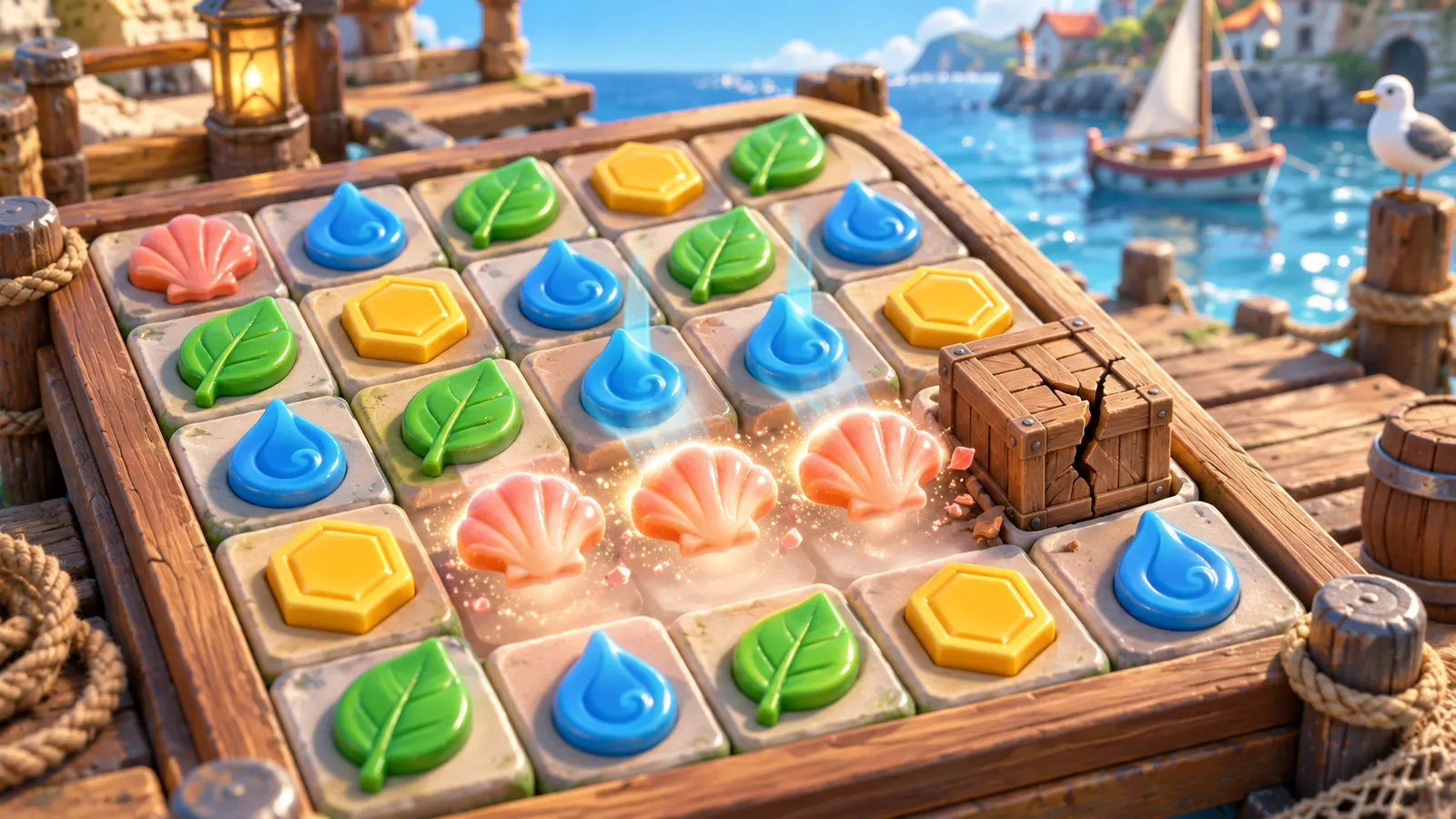
Consider a hypothetical project called Harbor Tiles. Its first sample uses a small grid of distinct-shaped tokens and a crate-clearing goal. The player swaps adjacent tokens; a valid match removes tokens, affected crates change according to the agreed rule, remaining tokens settle and empty spaces refill. This example is a proposed scope, not an existing client project or a passed test.
Agree the crate rule rather than leaving it implied by the picture. Does a neighboring match damage it once per move or once per clearing event? Can a crate occupy a tile cell? Does a crate block movement, matching, falling or all three? Different answers produce different games and different implementation work.
Define what counts as one move
A drag gesture, an attempted swap and an accepted move are not necessarily the same event. Specify which cells can exchange places, what happens when the gesture crosses the board boundary and whether a swap that creates no match is reversed. Then state exactly when a move is deducted.
For the Harbor Tiles sample, the proposed rule could be that an adjacent swap consumes one move only if it produces a valid match. A rejected swap returns both tokens without charging the player. That is a client choice for this example, not a requirement every puzzle game must follow.
Test two quick gestures during the same animation. The second must not silently operate on cells that have already moved. Choose whether input is ignored, queued or otherwise handled while the board resolves, and make that choice visible in the review notes. An animation finishing successfully is not sufficient if the internal board accepts another action against an outdated arrangement.
Catlike Coding's original Match 3 prototype tutorial separates game logic from its visual presentation and gates input while the board is busy. The buyer implication is to review the rule outcome separately from the polish of the transition, not to prescribe that tutorial's code or Unity version for your production.
Agree the whole resolution, not only the first match
A move can start a sequence: detect matches, remove affected tokens, update blockers, settle pieces, refill cells and check whether another match appears. Write the intended order. If several matches share a token, decide how the overlap is resolved and how many times that token contributes to the objective.
Keep the review small enough to explain. Start with ordinary matches and a single blocker type before adding boosters, chained explosions, portals or asymmetric gravity. Each additional rule creates interactions with the existing ones. A longer feature list without named precedence is not a more complete specification.
Distinguish board progress from the wider game economy. Clearing a crate is a puzzle-state change; awarding currency or unlocking an upgrade is a separate rule. This article owns the board decision, not shop balancing, ad rewards or purchase restoration.
Decide what happens on the last available move
A common specification gap appears when the final allowed move also clears the final goal. If the game checks the move counter before resolving the board, the player can see a loss even though the action meets the objective. Agree the precedence instead of discovering it through a contradictory result screen.
For Harbor Tiles, a sensible proposed rule is to finish the accepted move and its cascades, then check the goal, then decide failure if the goal is incomplete and no moves remain. If a different experience requires immediate failure or excludes cascade progress, record that explicitly. The important point is a single rule shared by implementation and review.
The visible counter, objective state and result screen should describe the same outcome. Ask the reviewer to repeat the final move from the same starting board and record the expected result. Do not accept a claim such as “the win screen is done” without the board condition that permits it.
Handle no-move boards without promising universal solvability
A board can have no currently legal move, or it can allow moves without a route to the required goal. Those are different situations. Decide whether the game reshuffles, offers a restart, treats the level as failed or prevents that configuration from being used.
For a refill-based game, state the limits of any validation claim. A known opening with one legal move does not prove every later refill remains solvable. A demonstrated solution route proves that route for the reviewed rules and board; it does not establish an appropriate difficulty or guaranteed enjoyment for every player.
Require authored level data to identify its rule version and intended goal. A content change that adds a blocker can invalidate a previously demonstrated route. The level design guide covers broader player decisions and pacing; this narrower review checks whether the puzzle configuration can behave consistently under its specific move rules.
Use known-board fixtures before approving a large batch
Ask for a way to load selected review boards rather than relying only on a fresh random opening. Record the build, level configuration and input sequence. The following checklist is a proposed acceptance fixture with observations still to be recorded, not evidence of tests already performed.
- Rejected swap: two adjacent tokens produce no match; confirm their return and the agreed unchanged move count.
- Shared match: crossing matches share a token; confirm objective contributions follow the overlap rule.
- Busy board: input arrives while pieces settle; confirm no action changes an outdated arrangement.
- Final move: the last accepted move completes the objective; confirm the agreed success-versus-failure precedence.
- No legal action: a prepared board has no available match; confirm the chosen recovery route rather than a frozen session.
- Restart: repeat the fixture and confirm board, blockers, goals and move budget return to the intended state.
Only then expand the content sample. Request configurations that deliberately exercise different rule interactions, not merely more colors and backgrounds. Keep observed defects separate from difficulty feedback: an incorrect move deduction is an implementation mismatch, while a puzzle feeling too obvious is a design-review finding.
Keep the commissioned boundary clear
The casual game production guide covers the larger decision to scale a loop, progression and content workflow. Here the purchasing decision is narrower: accept a coherent grid-puzzle rule system before ordering a level library. Likewise, an adventure interaction chain connects hotspots and useful objects; it does not specify simultaneous tile matches or board settlement.
Our City Chomp 3D project illustrates our Unity mobile production and readable object interactions. It is an arcade project in development, not proof of a completed matching-game portfolio. Any commissioned puzzle sample must establish its own rules and acceptance evidence.
Before expansion, agree ownership of level design, artwork, configuration tools, review builds, source delivery and known limitations. Backend services, monetization, automated solvers and ongoing content production belong in the proposal only when explicitly included. A bounded first milestone is useful because its result can be reviewed—not because a genre name makes the remaining work predictable.
Puzzle game development questions
What should a puzzle game development sample prove?
It should prove a defined board model, legal moves, move charging, complete board resolution and consistent success or failure. Review rejected actions, overlapping effects, final-move outcomes, no-move recovery and restart using known starting boards. Agree what is excluded before commissioning a larger level library.
When should a puzzle game decide success on the final move?
Use the order agreed for that game's rules. In a common matching-game scope, the accepted move and its cascades resolve before the goal is checked, with failure considered only if the goal remains incomplete and no moves remain. Confirm the chosen order in a known-board review rather than leaving it to screen timing.
Turn your puzzle idea into a reviewable Unity scope
Send the puzzle mechanic, target platforms, board examples, move and goal rules, visual references and available assets. We can discuss a bounded playable sample with explicit acceptance cases, content responsibilities and agreed source handover.
Explore game development services · Discuss your game · Send the brief on WhatsApp