Mobile game production · Release decisions
Game Soft Launch: What to Validate Before a Wider Release
A game soft launch is a controlled release to a limited audience so the team can learn from real play before expanding distribution. The useful question is not “Did we publish?” but “What evidence would make a wider release responsible?”
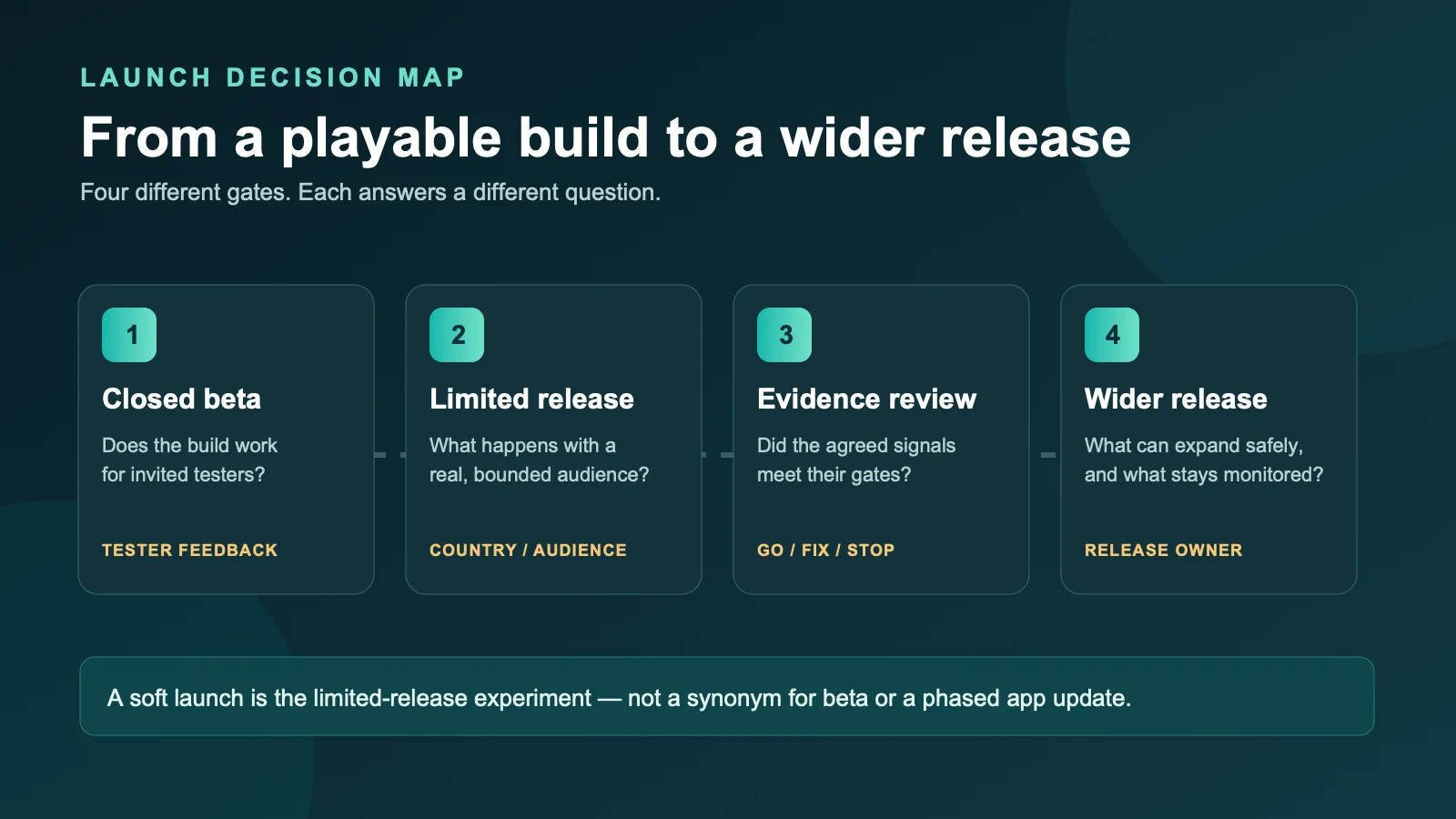
A game soft launch exposes a playable product to a bounded real audience before a wider launch. For a commissioned mobile game, the owner and development team should agree on the audience, the build, the observation window and the decision rule beforehand. Otherwise a small release can generate activity without answering whether the game is ready to grow.
This guide starts after a build has passed its agreed pre-release QA gate. QA asks whether known behavior works on target devices; a soft launch asks what happens when actual players encounter the game without a tester guiding them. Our live-ops guide covers the ongoing controls and ownership after launch. Here the narrower decision is whether to expand beyond the initial audience, fix and repeat the test, or change the plan.
Choose the release path before measuring it
“Soft launch” is sometimes used loosely for any limited access. That can hide important differences. An invited beta is useful for finding bugs and collecting directed feedback, but its participants may behave differently from ordinary store users. A limited-country production release can reveal a more natural first session, store discovery and support load, but it also creates a real public product obligation. A phased update exposes an existing app version to users gradually; it is not the same as a first-time soft launch.
| Path | Question it can answer | What it cannot prove alone |
|---|---|---|
| Closed beta or TestFlight | Can invited people install, play and report problems? | Natural store acquisition or behavior of a broader audience. |
| Limited-market release | Do real users complete the intended journey under bounded exposure? | That the same result will repeat in every region or at scale. |
| Staged version update | Does a changed build behave safely for a percentage of existing users? | First-release product demand. |
Apple describes TestFlight as beta distribution with tester feedback. Google Play documents country targeting for testing and production tracks. Both Google Play staged rollouts and Apple phased release concern version updates; do not promise a first-launch percentage rollout using either update feature. Store controls and eligibility should be checked for the specific app account before making a release commitment.
Write one launch hypothesis that the build can test
Start with a product question, not a country list. For example: can a new player understand the objective, complete the first playable session and return without a developer explaining the interface? A second question might be whether a purchase or rewarded-ad event delivers its promised result exactly once. Record which build, platform, audience and distribution route will answer each question. If the first-session flow is still changing every day, a broader test may be premature because the result will be difficult to interpret.
Agree on the observation window and the release owner before traffic begins. The owner should know which issues stop the test, who can deploy a corrective build, how incidents are escalated and which changes require a new comparison window. The development team can deliver instrumentation and a testable build, but it should not imply that it can manufacture retention or revenue by shipping more code.
Collect an evidence pack, not a single headline metric
A useful pack combines build health and player behavior. Name the events that represent entering a session, understanding an objective, completing or abandoning it, returning later and encountering a failure. On devices, watch crashes, freezes, long loads and network interruptions with the affected build and device class. If the game includes ads or in-app purchases, reconcile the displayed outcome with the callback or entitlement actually granted. An event count with a broken trigger can look like a player problem when it is a measurement problem.
Set the analytics environment and consent behavior deliberately. Unity's environment documentation explains that events are sent to the environment used when the SDK initializes; teams should verify their dev/test and production event paths rather than treating every dashboard graph as clean launch evidence. The existing Unity analytics acceptance guide goes deeper on event contracts, environments and validation. Keep private user data out of public launch reports and collect only what the product and applicable privacy requirements justify.
Do not adopt an industry percentage as an automatic pass mark. A small test can be noisy, acquisition quality can vary, and different game loops create different session patterns. Before the release, agree on your own threshold or qualitative decision rule for each critical signal. Label missing or unreliable data as a measurement gap rather than interpreting it as success or failure.
Make the limited audience genuinely useful
Select the market or audience because it can answer the launch hypothesis, not because another studio used it. Check language, device mix, store availability, payment methods, support capacity and whether the creative promises the same game the first build delivers. If the product is intended for Arabic-speaking users, an English-only limited audience cannot settle the usability of Arabic text and right-to-left interfaces. If a store listing targets a region, verify the approved country settings and actual availability before assuming people can install.
For a hypothetical action game, imagine a limited release that asks whether players can recognize incoming threats and finish an early mission on mid-range phones. The team would record the exact build, supported devices, start/completion events, relevant crash traces and a short sample of observed feedback. If a player exits because an objective marker is unreadable, the decision may be a UI correction and retest. This is an illustrative decision, not a claim that ROADFORGE or another Upload project ran this soft-launch experiment.
Review the evidence and make one of three decisions
A soft launch is complete only when someone makes a documented decision. Continue when the agreed core path and safety gates hold and the evidence is reliable enough to justify the next bounded audience. Fix and retest when a specific issue or measurement fault can be corrected while keeping the hypothesis intact. Stop or rescope when the core loop, safety or product premise is not supported by the observed evidence. Record the decision, owner, date, build and next test; do not quietly expand exposure while calling the problems “known.”
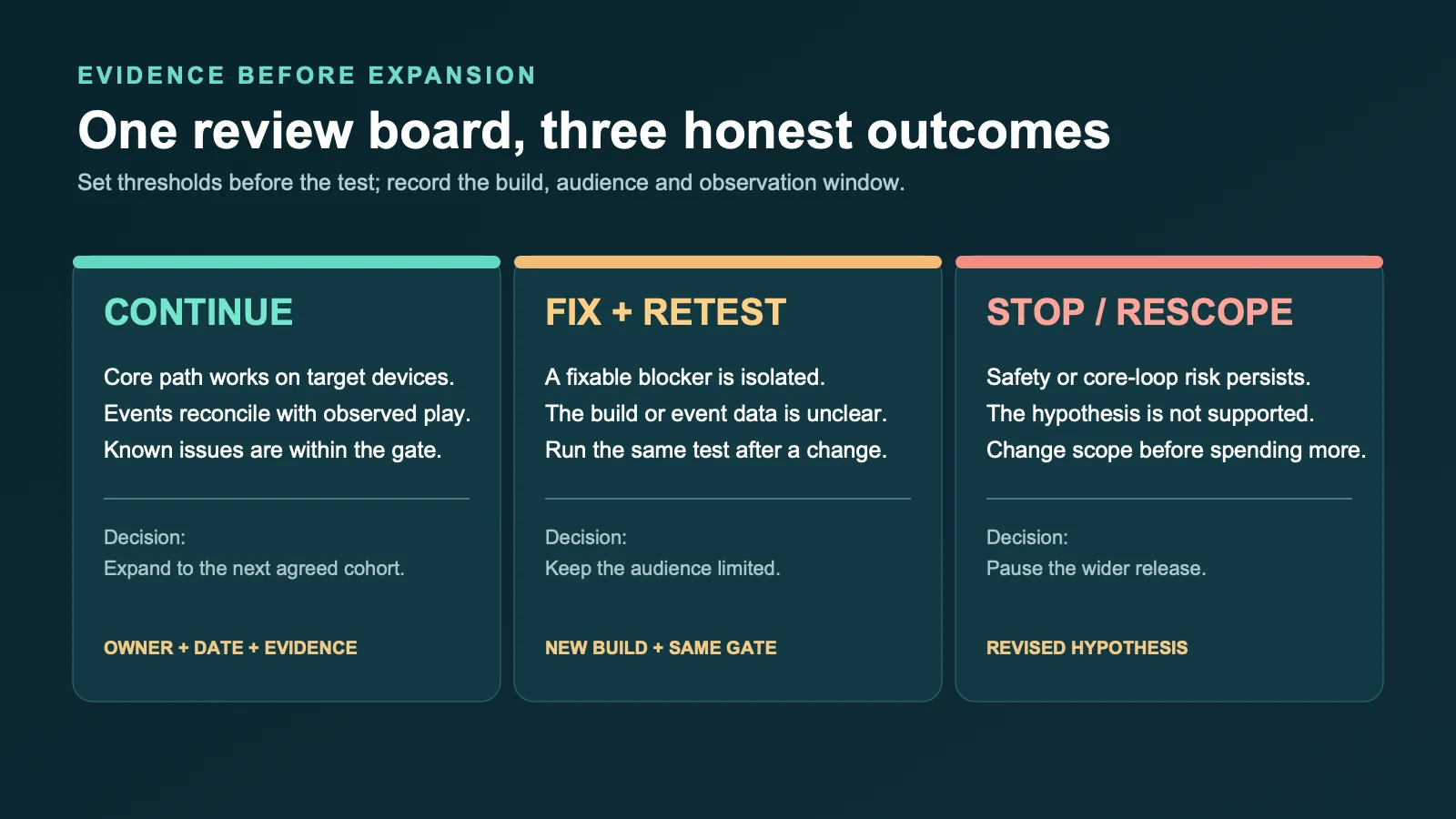
There is no single universal day count for a valid test. Duration should be long enough for the specific question, acquisition pattern and player journey, while still small enough to limit risk. If the build changes during the window, separate the data by version. If only a tiny or unrepresentative group played, state that limitation. If the game is not ready for a public cohort, return to targeted beta or the release-candidate milestone instead of presenting a restricted build as market validation.
What to ask the game-development team for
Before paying for a soft-launch phase, request a build and version identifier, target device and region list, a small event contract mapped to the questions above, a way to see crashes and support reports, a privacy/consent check, named release and incident owners, and a written expansion decision gate. The handover should include what can be changed remotely, what requires a new store build, and how to recover from a bad update. These are scoped production deliverables, not a promise of app-store approval or acquisition results.
If you are commissioning the game itself, the soft-launch plan belongs alongside the production brief and acceptance gates. A developer can build the game, implement instrumentation and prepare a release candidate, while marketing spend, customer support, account ownership and final publishing authority must be assigned explicitly. Link each responsibility to evidence you can inspect before the next commitment.
Questions buyers ask
What is a soft launch of a game?
It is a deliberately limited release used to learn from actual players before a broader distribution decision. The team defines the audience, build, observation window, signals and go/fix/stop rule in advance. An invited beta can precede it, but a beta is not automatically a public soft launch.
Is it better to hard launch or soft launch?
Neither is automatically better. Use a soft launch when a bounded real-audience test can answer a consequential unknown and the team can monitor and respond to what it learns. A wider launch is more defensible when the core path, stability, measurement and support gates have already passed. The right choice depends on the game's risks and distribution plan, not a generic schedule.
Build the release evidence into your game scope
Tell us the platform, current build stage, target players and the launch decision you need to make. We can scope the playable build, instrumentation, QA evidence and handover needed for a responsible next step.