Game production · Buyer decisions
Game Development Milestones: What Each Stage Should Prove
A milestone is useful when a buyer can inspect a playable result, compare it with an agreed acceptance rule, and make a clear release or revision decision. A date or invoice percentage alone does not prove the game is ready to move forward.

Game development milestones should connect scope, payment and evidence. For a commissioned game, agree what the team will deliver at each gate, how the buyer will test it, what counts as acceptance, and what happens if it misses the agreed result. This is a production framework, not a legal contract template or a claim that every game needs the same number of stages.
The game development brief helps define the inputs before a quote. This guide begins after the direction is agreed and asks a narrower question: what proof should unlock the next production commitment? The answer depends on risk. A multiplayer backend, mobile monetization and a single-player level will not share identical tests, but all should have inspectable outputs.
Start with discovery outputs the buyer can approve
Discovery should close the largest unknowns before production expands. Its output might include a concise scope, core loop, target devices, platform constraints, art direction, technical assumptions, dependencies and a ranked risk list. If a prototype is needed to validate controls or performance, name that decision now. A mood board alone does not settle whether a touch-control scheme works, and a task list alone does not settle who supplies characters, accounts or store credentials.
The acceptance rule should say which assumptions are confirmed, which remain open, and who approves the next experiment. Record exclusions and a change path. If the buyer adds a platform or major feature after the scope gate, treat that as a deliberate scope decision rather than silently calling the original milestone late.
Use a prototype to retire one specific risk
A prototype is not a miniature finished game. It is a cheap test of a critical question: does the movement feel readable on a phone, can a battle support the planned number of actors, or does the proposed interaction survive an actual device? State the question, target device, build link and success criteria before the test. Screenshots and a demo video can help reviewers, but the playable build is the primary evidence when interaction is the risk.
For example, a tank-combat prototype might be accepted when a player can steer, aim, shoot and understand incoming damage on the target handset without tutorial narration. That does not imply final art, balance, progression or store readiness. Defining the boundary keeps both sides from treating a successful prototype as a production-complete deliverable.
Make the vertical slice a quality benchmark
The vertical slice proves that representative systems work together at a chosen quality bar. It could contain one complete level or match, representative art, sound, UI, save behavior and a measurement pass on target hardware. A slice should answer whether the intended experience can be produced repeatedly, not simply showcase a beautiful screen. Identify what is deliberately absent, such as full content volume, localization or final economy tuning.
Acceptance evidence can include the playable build, a short walkthrough, known-issues list, target-device results and links to the assets and source snapshot used. For Unity work, a version-control changeset is one way to identify the reviewed state. The buyer does not need a particular tool, but does need a reproducible version reference. If performance is a condition, specify the device and test scene rather than a vague claim that the game is “optimized.”
Split production into playable increments
After the slice, schedule increments around usable content or systems: perhaps a level batch, progression path, enemy family or multiplayer match flow. Each increment should state the dependency it assumes and what can be tested without the next increment. “70% of development complete” is hard to verify; “three levels playable from start to finish with saves retained across restart” is testable.
| Gate | Inspectable delivery | Acceptance decision |
|---|---|---|
| Discovery | Approved scope, risk list, platform assumptions and exclusions | Are the biggest unknowns named and owned? |
| Prototype | Playable experiment on a target device | Did the chosen interaction or technical risk pass its test? |
| Vertical slice | Representative end-to-end experience and source snapshot | Is the quality bar credible and repeatable? |
| Production increment | Named systems or content playable together | Does the increment meet its specific tests without blocking defects? |
| Release candidate | Build, test evidence, known issues and handover inputs | Is it ready for the defined release path? |
This matrix is a starting example. The actual gates should reflect the project's technical risk and business decision, not a fixed template copied into every proposal. Our scope and budget guide covers how to keep the feature set affordable; the milestone rule here is how to prove that agreed scope is arriving.
Separate alpha, beta and release-candidate evidence
An alpha gate can demonstrate feature completeness for the agreed scope while openly listing rough edges. A beta gate shifts attention to external play, device coverage, stability and fixes. A release candidate is a specific build proposed for distribution, with a clear issue threshold and release checklist. These names only help if the team defines its own testable exit rule. They are not automatic promises about store approval or commercial results.
For iOS, TestFlight can distribute beta builds and collect tester feedback; for a cross-platform project, the acceptance pack should identify the actual build and channel on each platform. If a device performance target is part of the gate, attach a reproducible capture or profiler result from target hardware. Unity documents profiling an application on a device; a desktop-only observation does not settle mobile performance.
Package the evidence so review is possible
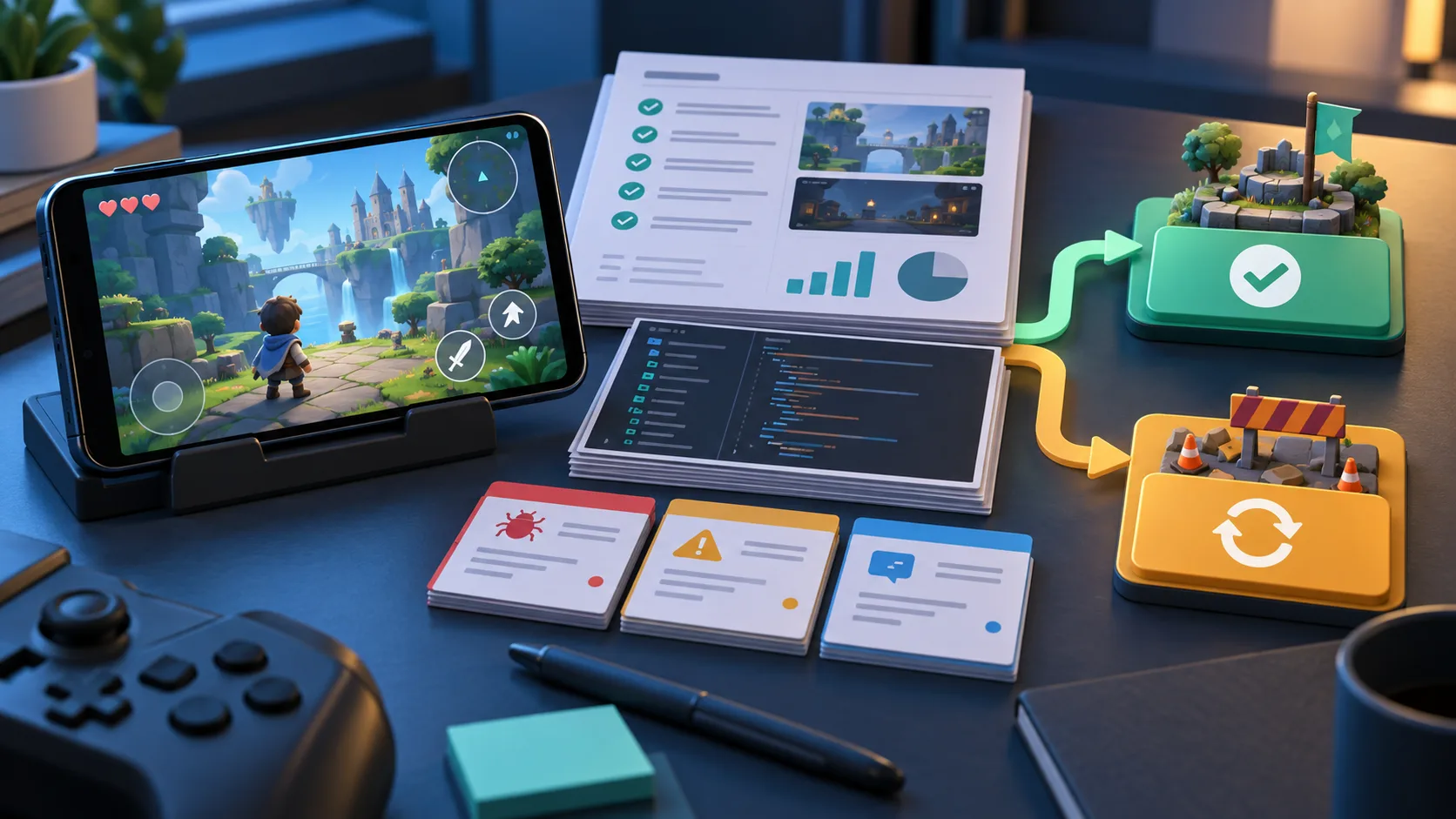
Every reviewable milestone needs more than an email saying “done.” Provide the build and version identifier, install instructions, test credentials where appropriate, a concise checklist mapped to agreed criteria, a known-issues list, target-device observations and the source or asset snapshot required at that point. Agree who may access the build and how long the review window lasts. Keep private credentials in a secure channel, not in a public article or loose attachment.
The final project transfer is a separate decision. Our handover-files guide covers source, licenses, accounts and documentation in detail. At interim gates, specify what snapshot or access is required to verify progress without pretending every checkpoint is the final handover.
Keep defect resolution distinct from a change request
During the review window, record each finding against the agreed acceptance rule. If the delivered build fails a committed criterion, it is a defect or unmet deliverable to fix under the agreed process. If the buyer asks for a new character, platform or behavior beyond the approved scope, it is a change request to estimate and schedule. Some findings are ambiguous; resolve those against the written scope, not the loudest meeting.
Define who can mark a gate accepted, how many review cycles are included, what happens when a blocker remains and whether a partial acceptance is allowed. Avoid silent acceptance by default unless the parties have deliberately agreed to that rule. A clear decision record protects both buyer and producer: it lets the team continue after a real approval and prevents payment debates from replacing product review.
Link payment and the next commitment to verified delivery
Payment dates can support cash flow, but the buyer should know the artifact and decision attached to each invoice. The project agreement should identify the acceptance owner, review period, evidence package and what happens if the gate is not met. A source snapshot or repository tag at a milestone helps establish what was reviewed; it does not by itself transfer ownership or replace the final handover terms. For legal rights and payment wording, use qualified legal advice.
Before approving the next increment, ask: what did we learn, which risk remains, and does the next scope still serve the game? A prototype may justify changing direction; a vertical slice may justify reducing content volume to preserve quality. Good milestones create a place for those decisions before more money is committed.
Questions buyers ask about game milestones
What are practical milestones for a commissioned game project?
Typical gates are discovery, a risk-focused prototype, a representative vertical slice, playable production increments, alpha or beta testing, a release candidate and final handover. Adjust the number and order to the project's risks; each gate needs its own inspectable output and acceptance rule.
What evidence should be delivered at each game milestone?
At minimum, provide the agreed artifact, a build or document version, a checklist mapped to acceptance criteria, known issues and the relevant target-device test results. Add a source snapshot or other reproducible reference when it matters to the gate.
How should milestone acceptance and change requests be separated?
Compare findings with the scope approved for that gate. A failed agreed criterion is a defect or unmet delivery; a newly requested feature or platform is a change to estimate separately. Record the decision, owner and next review date in writing.
Plan milestones around your game, not a generic percentage
Tell us the platform, core loop, current assets and biggest production unknown. We can help define a game-development scope with reviewable builds, acceptance evidence and a realistic handover path.