Game production · Buyer planning
Game Development Timeline: Plan Dependencies and Client Reviews
A useful game development timeline shows more than stages and a launch date. It connects each work package to the input it needs, the person who approves it and the next task that depends on that decision.
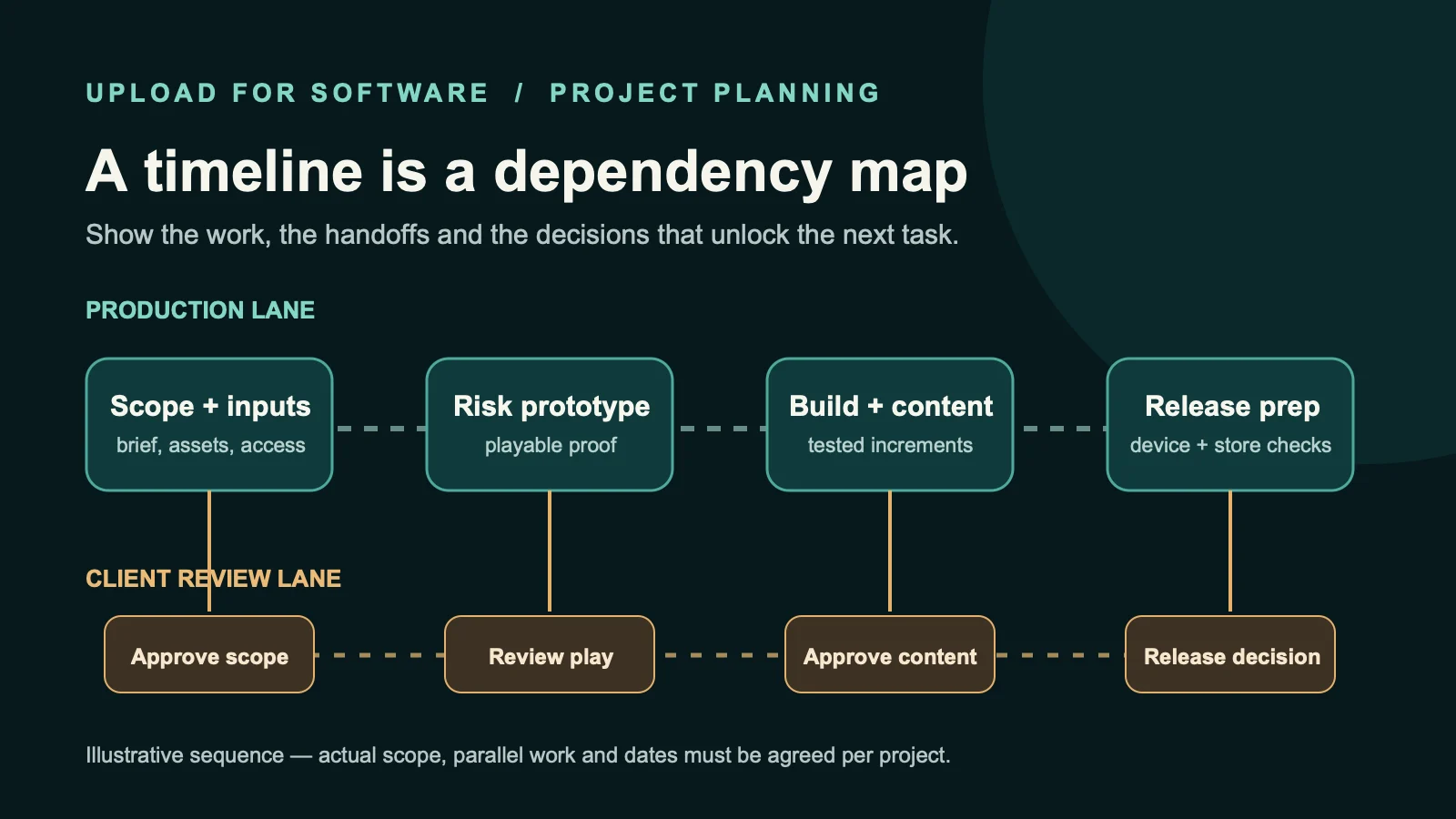
A game development timeline is a working schedule for a defined build, not a generic claim that all games take a set number of months. Before commissioning a studio, ask which inputs unlock work, which tasks can run together, which reviews stop dependent work, and what evidence will cause the schedule to be revised. That turns a target release window into something both sides can inspect.
This guide addresses the calendar between an agreed scope and release preparation. Our milestone guide explains what a playable gate should prove before acceptance or payment. Our mobile-game duration guide explains why project lengths differ. Here we focus on a different buyer decision: how to schedule dependencies and client approvals so a promised date has visible assumptions.
Start with a defined deliverable, not a date
A calendar is premature if “the game” still means different things to the buyer and development team. Identify the first deliverable: a risk-focused prototype, a vertical slice, a content-complete build or a release candidate. List target platforms, core interaction, content quantity, supplied assets, integrations and device expectations. Mark what is excluded. The game brief is the place to gather these inputs; the timeline starts when the team can turn them into work packages.
Keep the estimate tied to this version of the scope. A new multiplayer mode, a different art direction or an additional platform is not a minor change to the same schedule. It can add upstream design, assets, integration and QA work. Ask for the effect on dependencies before approving the change, rather than asking the team to keep an unchanged launch date by removing unspoken tests.
Map work packages and their predecessors
For each package, record four fields: the input needed, the team output, the reviewer or approver, and the next package it unlocks. A designer can explore controls while a placeholder character is in use; final animation integration cannot be assumed complete before the approved rig exists. Parallel work is helpful only where the interfaces between tasks are stable.
The following is an illustrative small mobile-game planning example, not a client case study or a promised production duration. “Slot” means an order in the plan, not a fixed number of days or weeks.
| Planning slot | Work and output | Needed first | Buyer action |
|---|---|---|---|
| A | Agree one core loop, target devices and asset list | Brief, references and account ownership | Approve scope and exclusions |
| B | Build a playable control and combat prototype | Scope A; placeholders are acceptable | Test on target device and choose changes |
| C | Approve a representative visual and UI direction | References from A; may overlap B | Approve art and interface direction |
| D | Produce and integrate final assets and level content | Prototype B and approved direction C | Review integrated build, not images alone |
| E | Run device QA and resolve agreed blockers | Named integrated build D | Confirm acceptance rule and remaining issues |
| F | Prepare store or handover package | QA evidence E plus account access | Approve submission or handover decision |
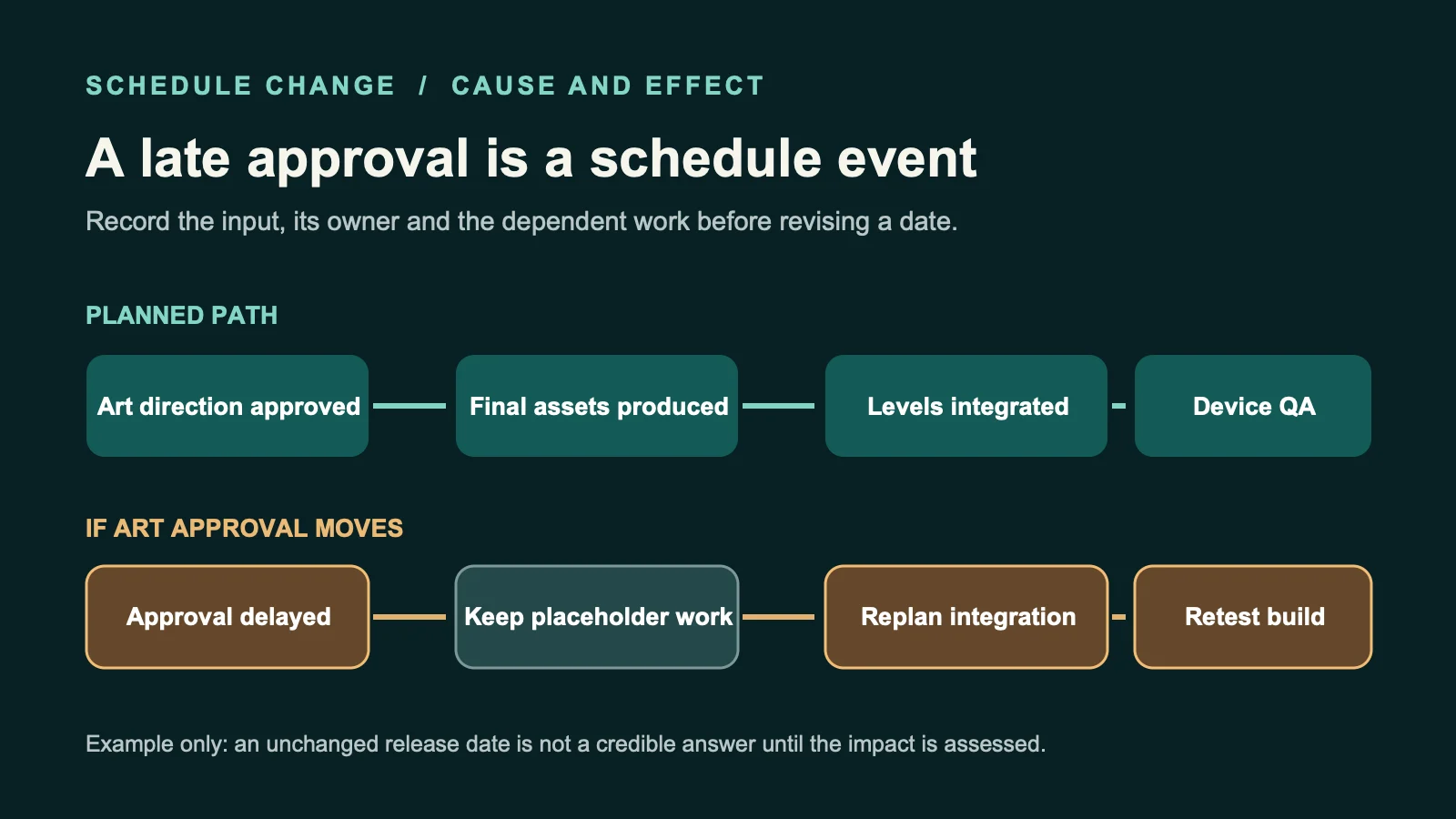
The important line is that D depends on both B and C. If art approval C is late, not all work must stop: the team may refine prototype code or prepare test cases. But the integrated build and its dependent QA cannot honestly be declared unaffected without checking the actual plan.
Reserve review time on the client side
A production schedule often includes a team deadline but no time for the buyer to install a build, gather feedback or make a decision. Name the review owner and backup reviewer, the exact build or document they receive, the agreed feedback format and the date by which a decision is needed. A screenshot sent on Friday is not the same as a build approved on Friday.
Separate working time from elapsed time. A developer may finish an asset package while the decision required to integrate it remains open. If approval is delayed, record when the review material was supplied, what remained undecided and which downstream tasks moved. This avoids both blaming every slip on “development” and assuming the client's review is instantaneous.
Keep the release path separate from build completion
A feature-complete build is not automatically a release-ready package. Schedule a named QA build, target-device checks, store assets, account access and any distribution-specific review. For an iOS beta, Apple's TestFlight documentation explains that an external beta build may require review before testing can begin. Treat that as an external dependency rather than a development task with a guaranteed turnaround. If Android and iOS are both in scope, show each platform's build, test and submission path instead of drawing one undifferentiated “launch” bar.
Use the mobile-game testing checklist to define the release-candidate evidence, then decide whether the next step is a private beta, a bounded soft launch or broader distribution. Those choices need different owners and checks. Do not place marketing acquisition, app-store approval or third-party SDK support inside the studio's guaranteed delivery date unless responsibility and contingencies are specifically agreed.
Ask for a range and a change rule
At proposal stage, request an estimate with assumptions and an uncertainty range, not just a single attractive date. The plan should identify what has been proven, what still needs a short technical test, and which client inputs have not arrived. For each uncertain item, ask: what is the earliest responsible decision, and how will its result change the remaining schedule?
When a change arrives, keep the original baseline and issue a revised version. Record the scope change, affected predecessors, impact on the critical path, trade-offs and the person who approved the revision. A buyer can then decide to reduce content, move the target release window or fund additional work. “We will catch up later” is not a recovery plan unless the team explains how quality and capacity remain credible.
What to request before signing off the timeline
- A scoped first deliverable and explicit exclusions.
- Work packages with predecessor links and parallel-work assumptions.
- Buyer-supplied assets, access and approvals, each with an owner and needed date.
- A reviewable build or artifact at each decision point.
- Dedicated device QA and release-preparation activities.
- A range for uncertain work and a written replan rule when assumptions change.
This is not a legal template. The written project quote should still define deliverables, milestones, payment and ownership terms. A dependency-aware plan simply makes the production assumptions visible before money and time are committed.
Questions buyers ask
How do client approvals affect a game development timeline?
An approval can unlock dependent work such as final asset integration or release submission. Give each review a named owner, review material and decision date. If the approval moves, identify which tasks can continue and revise the dependent dates explicitly; do not assume the original release date stays valid.
What should be scheduled before full game production?
Schedule scope and asset inputs, a test of the highest-risk interaction or technical assumption, an approved visual direction, target-device expectations and the buyer's review capacity. Full production is easier to plan after these inputs have a named owner and a result the team can build from.
Plan the work around your actual game
Tell us the platform, current assets, core loop and the first playable result you need. We can define the Unity build scope, dependencies, review points and handover package before giving you a project-specific quote.