Gameplay decisions · Difficulty tuning
Game Balancing: What to Change Before Making Your Game Easier
Identify the player problem, compare tuning alternatives and decide what to investigate before changing the whole game.
Game balancing adjusts the relationships between a game's rules, values and available choices to support the intended player experience. Before commissioning a balancing pass, identify the experience that needs to change. An opponent that takes too long to defeat, an attack that gives no usable warning and an upgrade that removes every meaningful choice are different problems. Reducing damage across the game may hide one of them while leaving the others unresolved.
For a founder or producer, the useful first deliverable is a small, explainable comparison: what players struggled with, which change the team proposes, what it could affect and what happened when the revised version was played. That work can be scoped within an existing Unity game or prototype engagement. It should not begin with a promise to make every player happy or to deliver a particular retention rate.
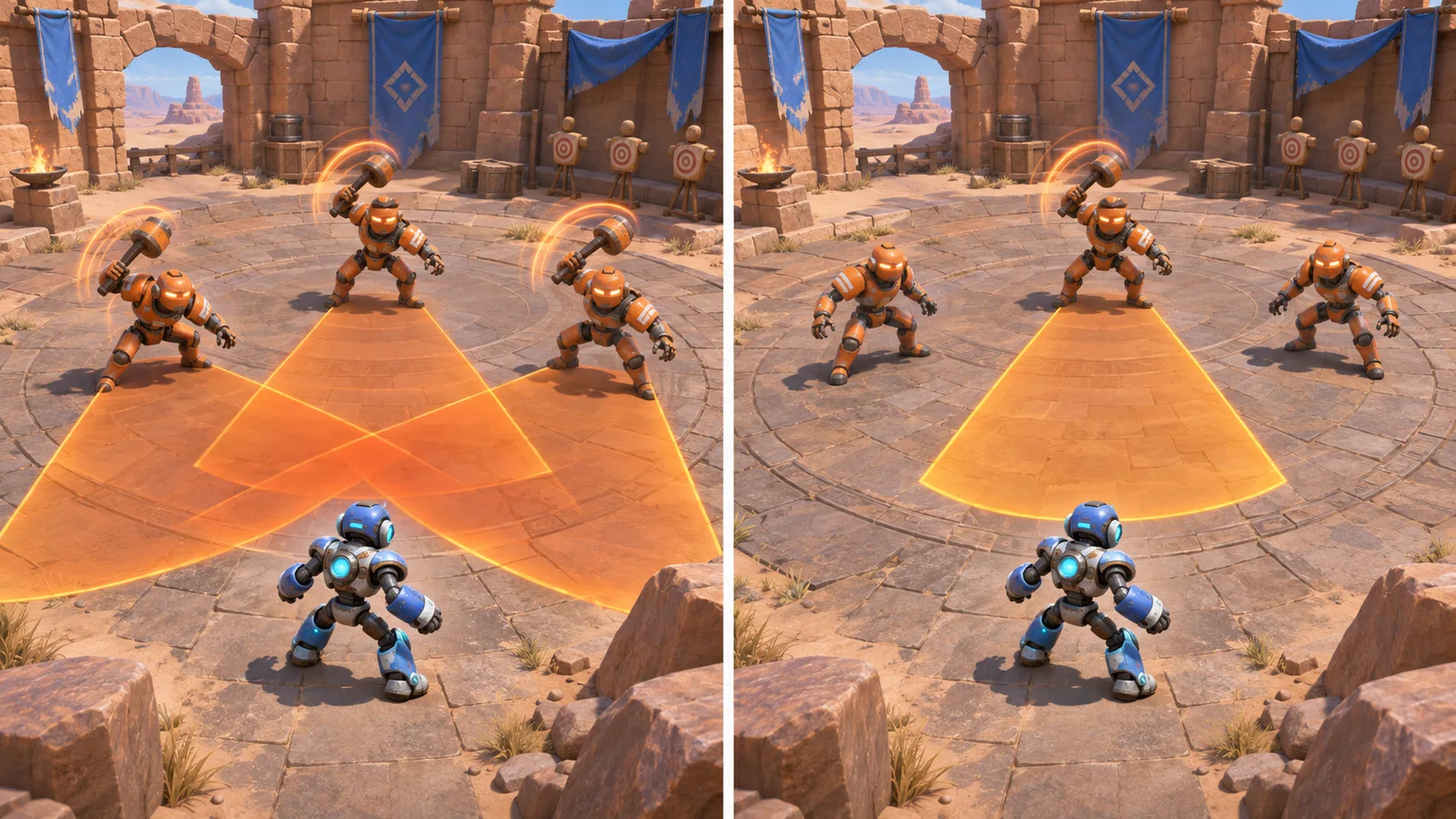
An imagined arena with the same participants but different attack overlap. A timing change asks a different design question from a damage reduction.
Name the experience you want to improve
“Too hard” is a useful starting report, but it is not yet a change request. Ask what happened. Did the player understand the objective? Notice the warning? Have enough space to respond? Choose equipment that made the situation unusually difficult? Lose because an agreed rule failed?
Describe the intended experience just as clearly. Perhaps a first encounter should let a newcomer recognize a threat and recover from a mistake. A later encounter might ask an experienced player to prioritize several threats. Both can involve the same opponents without needing the same pressure or margin for error.
Choose the audience and starting conditions before interpreting the result. A developer who knows every attack pattern, a new player and a returning player with upgraded equipment do not provide interchangeable evidence. Record what each person already knows and which version they played. Avoid turning a colleague's quick opinion into a claim about the entire market.
Unity's playtesting guidance treats playtesting as structured collection of information about particular parts of a design. For a commissioned project, turn that into a focused question the next playable revision can answer.
Separate a tuning problem from a broken rule
First establish whether the build follows the agreed rules. An attack applying damage twice, a retry retaining a defeated enemy or a purchase failing to grant equipment needs diagnosis. Increasing player health to compensate would mix a defect with a design preference.
Our combat design guide covers attack permissions, hit behavior, cues and recovery. Once those rules work as intended, balancing asks whether their relationships create the experience you want. Correct behavior can still produce an unsatisfying encounter; a satisfying moment does not prove that the underlying rules are correct.
Readability deserves its own check. If the warning is hidden behind another effect, a smaller damage value does not explain the hit. If the player never understands the objective, reducing enemy health may simply shorten a confusing encounter. The level design guide helps keep objective routes and encounter placement distinct from the values being tuned.
Compare the changes that could solve the problem
Consider a hypothetical arena with three opponents. Each has a readable attack when played alone, but their attacks can begin together. A newcomer repeatedly loses while trying to identify a safe route. No version of this example has been tested; it illustrates the choices a development brief should expose.
| Candidate change | What it tries to change | What else to investigate |
|---|---|---|
| Reduce incoming damage | Give the player more mistakes before defeat | Does the player learn the response, or simply survive without understanding it? |
| Reduce opponent health | Shorten the time threats remain active | Does the encounter end before the intended decision becomes useful? |
| Stagger attack starts | Reduce simultaneous response demands | Does waiting make opponents feel inactive or remove the need to prioritize? |
| Clarify the warning | Make the intended response easier to perceive | Is the response actually possible once the warning is understood? |
These are alternatives to investigate, not a ranking that fits every game. A deliberately chaotic encounter may depend on overlapping attacks. A brief teaching encounter may need room to recognize one pattern first. The choice follows the intended experience rather than a universal definition of “fair.”
A useful proposal names the suspected cause and the tradeoff: “We will first compare staggered attacks because overlapping warnings appear to hide the escape choice.” That is easier to review than “we will improve the balance.” If the observation does not support the hypothesis, the team should reconsider it rather than continue adjusting unrelated values.
Keep the comparison understandable
Keep the build, encounter, controls and starting equipment identifiable. Preserve a reference version or configuration so the team can compare the proposed change and restore it during development. Choose a bounded change where possible; changing health, attack speed, rewards and enemy count together makes the cause of any difference harder to explain.
Observe what people do before supplying the answer. Record a hesitation, missed warning, repeated strategy or unexpected route separately from your explanation of it. Then ask questions that clarify the experience. “What did you think would happen?” often reveals a different issue from “Was that too difficult?”
For the arena example, review whether the player notices the active threat, finds a response and still has a meaningful choice after the change. Also revisit an experienced player's route: a revision that helps newcomers might remove an intentional challenge later. The outcome may be a different introductory configuration rather than a global reduction in difficulty.
Receive the observation and its limits. A small playtest can identify something worth changing, but it cannot establish that every player prefers the revision. A spreadsheet or simulated encounter can help inspect assumptions; it does not replace observing the experience those assumptions are meant to produce.
Keep progression and evidence in their proper places
Equipment and progression affect the comparison. If one version starts with a stronger weapon, a quicker victory cannot be attributed only to the encounter change. Identify the loadout, unlocked abilities and any consumables or assistance used during the session.
The game economy guide covers resource sources, prices, upgrades and affordable progression routes. A balancing review can reveal that an assumed equipment state is unrealistic, but that should become an explicit economy decision. Do not silently change prices to repair an encounter and leave the progression model describing another game.
For a live product with suitable measurement and enough participants, a controlled experiment can compare a particular change against a reference. Unity's A/B testing documentation recommends a defined goal, control and variant groups, sufficient participants and a single change when investigating its effect. This is different from letting a few colleagues play two versions and calling the result statistically significant.
If traffic or instrumentation is insufficient, scope a smaller observational review and state what it can tell you. Do not invent a sample size, promise an improvement or run a production experiment merely because a dashboard supports one. Our analytics implementation guide covers whether the events themselves represent the intended actions; balancing still needs a reasoned interpretation of the evidence.
Scope an iteration you can actually receive
When discussing work with a development team, send the current build or prototype, target audience, platform and the situations that prompted the request. Include the rules that should remain unchanged and any version, save or live-configuration constraints. A tuning pass on a working encounter is a different engagement from repairing its implementation or designing a new combat system.
Ask the proposal to identify the first question, the comparison to be made, the configurable values or behavior involved, the review route and the person who decides what to keep. Agree how additional changes are handled if the first hypothesis is unsupported. The development team can implement and investigate a change; it cannot honestly guarantee enjoyment across all audiences.
The handover should leave you with the reviewed build, the relevant configuration, an account of what changed, the observations used in the decision and unresolved limitations. Keep deferred ideas separate from approved changes. That makes the next iteration a continuation of an understood decision rather than another round of unexplained number changes.
Game balancing questions
Is game balancing the same as making a game easier?
No. Balancing may increase or reduce pressure, preserve several useful choices or distinguish introductory and advanced situations. Start with the intended experience and the observed problem. Making every opponent weaker can remove the decision the encounter was supposed to teach.
Should we change damage before testing the encounter?
Only when there is a clear reason to investigate damage. First distinguish a broken rule, an unclear cue, simultaneous response demands and an equipment mismatch. Choose a bounded change that addresses the suspected cause, then review both its benefit and its downside in a comparable playable version.
Does a small playtest prove that the balance is right?
A small playtest can reveal specific misunderstandings and suggest revisions. It does not prove universal preference, a retention improvement or statistical significance. Record who played, the conditions, the observations and what remains uncertain before deciding whether wider investigation is needed.
Discuss a difficulty change
Send the current Unity build or a concise prototype brief, the intended player and an example of the situation you want to improve. We can discuss a focused implementation and review scope before expanding the work across the game.
Explore game development services · Discuss your project · Ask on WhatsApp