Commissioning an original game for a brand
Branded Game Development: Commission an Original Playable Brand Experience
Define what the player does for the brand before approving how the game looks.
Branded game development creates a playable experience around an approved brand purpose, interaction and identity. Before commissioning a team, define the player action, the brand meaning it should express, the materials you can supply and the people who approve each part. Review an original playable sample before expanding production; a branded loading screen alone does not establish that the interaction fits your brief.
This guide is for a business commissioning an original Unity mobile game, not buying advertising reach, a browser campaign platform or a catalogue of ready-made games. Our Unity game development services provide the implementation route. Marketing distribution, reward fulfilment and ongoing campaign operations need their own named responsibilities rather than an assumption that they come with a game build.
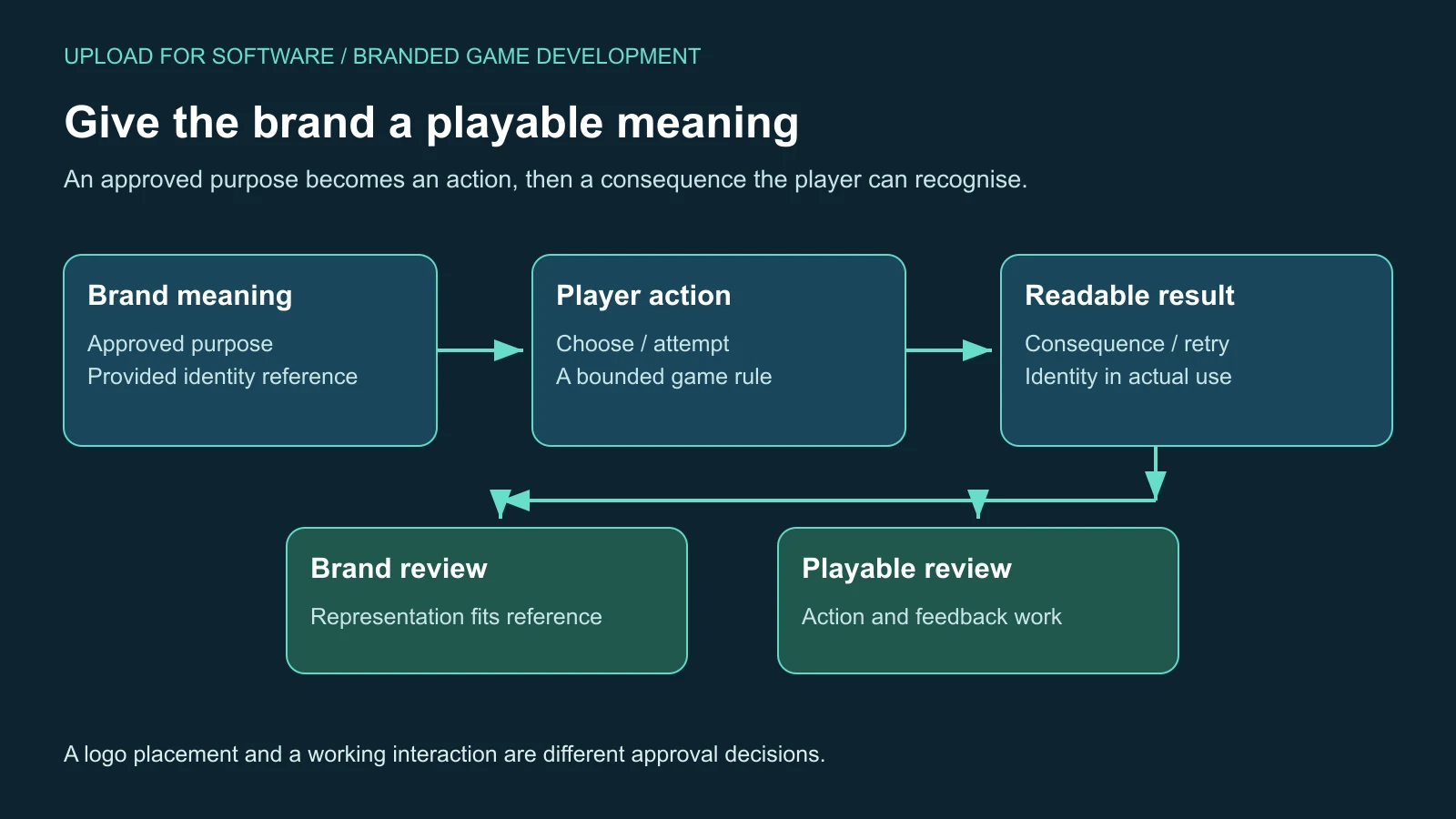
Start with the interaction, not the logo placement
“Make a game with our branding” leaves the important product decision unresolved. What should the player choose, attempt or understand? Where does the brand belong in that action? A transport brand might explore route choices; a product with configurable parts might invite assembly. Those are starting hypotheses, not claims that a genre automatically improves brand recognition.
Write one sentence joining purpose and action: “The player chooses a configuration, sees its effect and completes a short challenge using it.” Then describe why that action belongs to this brand. If the only connection is a logo in the corner, decide whether that limited connection is intentional or whether the concept needs another iteration. Do not disguise an unresolved experience decision as a request for more polished artwork.
Choose original development or an existing-game change
An original game can establish its rules and presentation around the approved experience. A visual replacement starts from a game that already works and names the behaviour that must remain unchanged. Neither route is universally better; the available source, intended interaction and approved change boundary determine the scope.
If you own an authorized source project and only need its appearance changed, use our game reskinning scope guide. If the brand idea requires new player decisions, new rules or a different loop, identify those as design and implementation work. A supplier should not quote “branding” while silently assuming a ready-made game answers all of those decisions.
Use a small example to expose the decisions
Consider a hypothetical outdoor-equipment brand commissioning a short native mobile game. The player selects equipment for a route, sees how the choice affects an obstacle and reaches a finish state. This is a planning example, not a client project, a product-performance demonstration or a campaign result.
The initial sample could contain one equipment choice, one obstacle and one outcome screen. The brand owner supplies the approved identity and decides what the equipment is allowed to represent. The product owner decides whether the choice is understandable and the consequence supports the intended experience. The implementation team builds the agreed interaction rather than inventing claims about the real product.
| Decision | What to define | What the sample shows |
|---|---|---|
| Brand meaning | The message or relationship the interaction may express | The choice has an approved reason, not just a decorated button |
| Player action | The available selection and the consequence of that selection | A complete choose–attempt–observe sequence |
| Identity | Approved visual references, labels and permitted variations | The identity remains readable in the actual game view |
| Review ownership | Who resolves brand comments and who approves the playable result | Two explicit decisions tied to the same sample revision |
Separate brand approval from playable approval
A brand reviewer can approve a character or colour treatment while the interaction remains confusing. A product reviewer can enjoy the sample while a label misrepresents the intended identity. Record these as separate review responsibilities, even when the same person holds both roles. One approval should not be silently treated as the other.
Ask stakeholders to resolve conflicting feedback before sending the next instruction. “Make it more premium” and “make the choice more obvious” may describe different problems. Attach each note to the screen, action and revision it concerns. Decide whether it corrects an agreed requirement or changes the direction; changing the approved interaction can affect more than the artwork.
Supply an identity package that can be implemented
Prepare the approved logos, colours, typography references, product representations, interface labels and any character or environment references. Name the owner who can approve variations. Identify materials you are authorized to provide and unresolved permissions before production; do not assume that every reference image is a deliverable the team may reproduce.
Distinguish a mandatory identity requirement from a visual preference. A supplied brand font, for example, needs an agreed use and suitable delivery files; a screenshot of a font does not give the team everything needed for implementation. If materials are incomplete, agree which temporary references the first sample may use and what must be replaced before acceptance.
Review the brand inside the player journey
Inspect a complete short route rather than approving disconnected screens. Start the game, understand the choice, act, observe the result and return or retry. Check whether instructions compete with the identity, whether important feedback stays readable and whether the player can recognise the consequence without a reviewer explaining it.
Unity Learn’s design-document tutorial connects feature priorities with the intended experience and early player feedback. For this commissioning decision, use that principle to ask whether the brand interaction works as an experience, not merely whether every item on an asset list is present. Any audience testing needs an agreed scope; a stakeholder review is not evidence of campaign effectiveness.
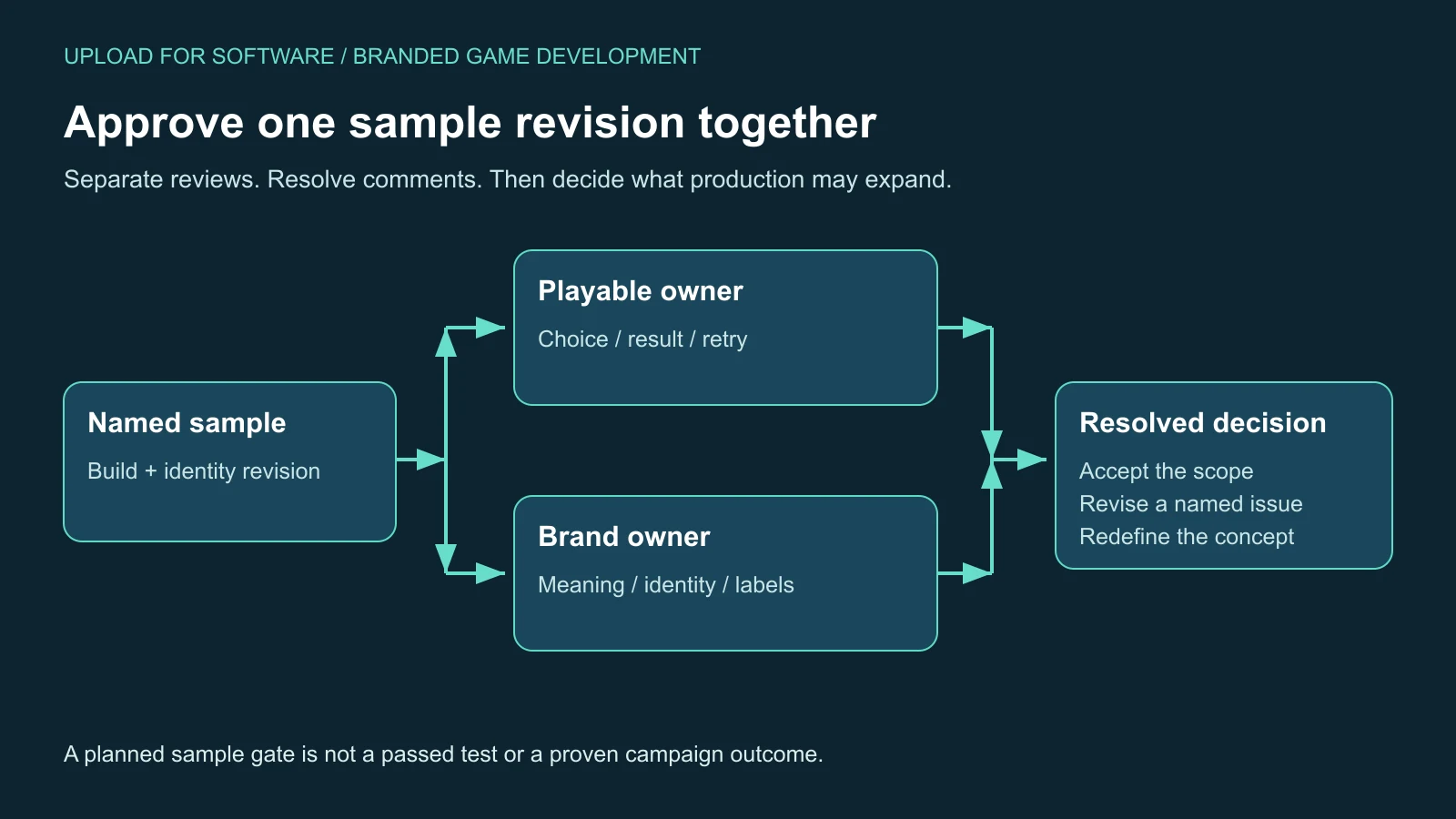
Define the sample gate before commissioning the full game
Write the included interaction, identity materials, target platform, review route and excluded features. Agree what happens after the sample: accept the direction, revise a specific issue or stop and redefine the concept. Do not turn a convincing sample into automatic authorization for a larger content library.
For the illustrative equipment game, an acceptance note could say that the available choice is understandable, the agreed consequence appears, the brand presentation matches its approved reference and the retry route works in the named build. Record observed results separately from that planned criterion. Our game design document guide develops the shared behaviour reference; this guide owns the connection between brand meaning, interaction and approval.
Keep game delivery separate from campaign operations
A native build does not automatically include media buying, hosting a campaign, publishing under your store accounts, administering prizes or managing customer information. If the concept includes registration, connected rewards or external systems, name the intended flow and the responsible parties before it enters the implementation estimate.
Ask for the agreed Unity source, supplied and produced assets, build instructions, approved identity revision and known limitations in the handover. Store accounts and third-party services remain explicit parts of the scope. Avoid treating launch approval, retention or return on investment as guaranteed consequences of accepting a game milestone.
Our ROADFORGE case study demonstrates connected Unity mobile production, interfaces, progression and focused device validation. It is an original game, not a branded-client campaign case. A commissioned brand experience still needs its own approved concept, materials and acceptance evidence.
Questions before commissioning branded game development
What should a branded game development brief approve before production?
Approve the brand purpose, player action, intended consequence, identity materials and review owners. Define a representative native sample, its acceptance route and the features or campaign operations outside that sample. Resolve missing content and conflicting approvals before expanding production.
Is branded game development the same as reskinning an existing game?
No. Original branded development can shape the player interaction and rules around an approved brand purpose. Reskinning changes the presentation of an existing authorized game while preserving specified behaviour. If the desired brand experience changes the rules, identify that additional design and implementation work explicitly.
Commission a playable brand idea with a clear first milestone
Send your brand purpose, audience, intended player interaction, target platforms, available identity materials and the person responsible for approval. Tell us whether you need an original game or already have source material to review. We can discuss a scoped Unity sample and its approval evidence before estimating a wider production.
Explore Unity development services · Discuss your branded game · Send the scope on WhatsApp