Tabletop adaptation planning
Board Game Development Services: Digital Adaptation or Companion App?
Decide what leaves the table—and what stays there—before asking a team to turn your board game into an app.
Short answer: commission a full digital adaptation when players should complete the game without physical components. Choose a companion app when the real board, cards or player decisions remain essential and the app handles a defined supporting task. Before comparing proposals, assign every action and piece of information to the app, the table or a player.
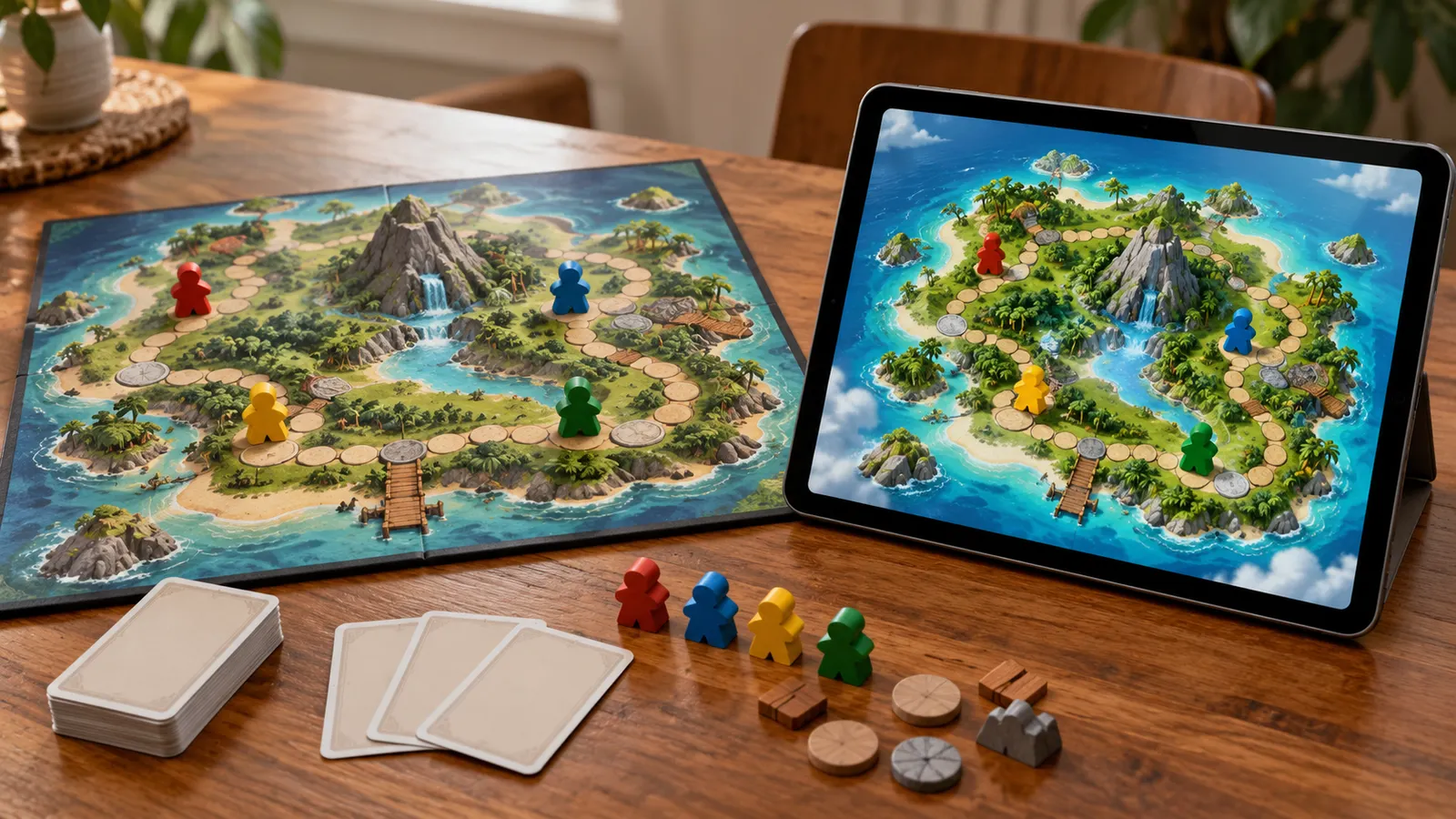
This guide is for a game owner commissioning a native app around an original or appropriately licensed tabletop game. It is not about manufacturing boards, printing cards, finding a publisher or cloning an existing title. The useful starting point for board game development services is not “make it digital.” It is a precise description of the experience that must still work after the physical components change.
Start with the reason the app should exist
A physical game can depend on conversation, handling pieces, reading a shared board and keeping a secret card close to the player. Moving it to a screen can change those interactions. Write down which benefit you need: play without the box, assistance with bookkeeping, guided setup, event narration, or a structured turn sequence. These outcomes lead to different work even when the artwork and rulebook are identical.
If the promise is “play anywhere without the box,” a scoring utility does not fulfill it. If the promise is “keep everyone around the real table,” recreating every component on a shared phone may remove the quality you wanted to preserve. Approve the intended session before debating online rooms, computer opponents or a large content catalogue.
Compare responsibilities, not a list of screens
For each component, ask who creates it, who may inspect it, who changes it and who decides that the change is valid. Include setup, play, a disputed or mistaken action, and the end of the session. A screen list can look complete while nobody owns the state that those screens display.
| Responsibility | Full digital adaptation | Companion app |
|---|---|---|
| Board and pieces | The app stores positions and lets players perform the agreed legal actions. | The physical board remains the position record; the app does not silently pretend to know it. |
| Events and randomness | The app draws and resolves events within the approved rules. | The app may reveal an event while players apply its physical effect and confirm completion. |
| Private information | The device/session design controls which player can inspect each item. | Cards may remain physically private; a shared screen must not expose them accidentally. |
| End of round | The app validates the ending and records the result. | A player may confirm the ending; the scope must say what the app checks rather than trusts. |
| Resume | The app restores the supported digital state. | The saved app state must be reconciled with the board still on the table. |
Mark each row as automated, manually entered, player-confirmed or outside the app. Manual confirmation is not inherently a defect in a companion. It becomes a defect when the product promises automatic verification but depends on a player entering a fact the app cannot observe.
Use one representative round to expose the difference
Consider a hypothetical cooperative island expedition. Two players move explorers, spend supply tokens, reveal one event and complete a shared objective. This is a planning example, not a completed customer project. Keep the same round and rules while comparing the two scopes; otherwise the estimates will be answering different questions.
In the full adaptation, the build must know the explorer positions, supplies, event order, legal choices and objective conditions. Selecting a route consumes the approved resources, moves the token, resolves the event and determines whether the objective is complete. The reviewer should not need physical pieces to finish that sequence.
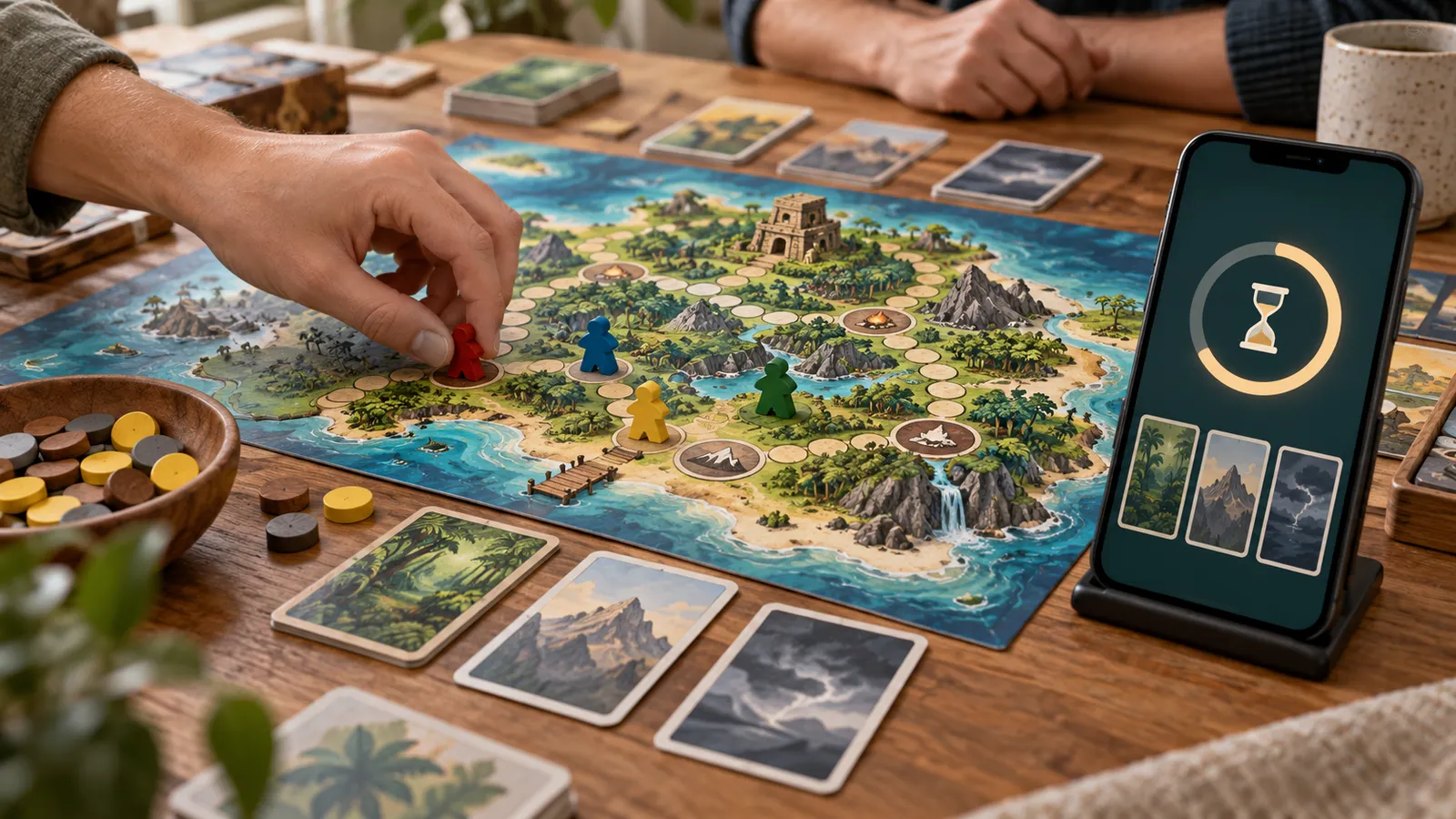
In the companion version, players move explorers and spend tokens on the real board. The phone reveals an event and waits for confirmation. Does it also track supplies? If yes, who enters the spend and corrects a mistaken entry? If not, its interface should not claim that a route is affordable or that the objective has been independently verified. These boundaries belong in the initial proposal.
Resolve hidden information before choosing the device setup
A shared tablet, pass-and-play phone and separate player devices are not interchangeable. If a hand or objective must remain secret, explain how the intended player opens it, how it is concealed before passing the device and what appears when the app returns from the background. A larger board graphic does not solve this interaction.
Keep the decision proportionate. An offline companion that times a shared round may need no accounts or online infrastructure. Separate remote players introduce a different session and trust model. Use the multiplayer architecture guide for that scope; do not let “digital board game” quietly include a managed online platform.
If the game is primarily a card system, the card rules and hidden-state guide covers zones and effect precedence. For Ludo-style room and turn recovery, the Ludo match-rules guide (Arabic) owns that decision. Those details support an adaptation after its responsibilities are agreed; they do not decide which physical actions should disappear.
Specify recovery when the phone and table disagree
Companions create a particular recovery problem: the phone can remember one point while the table has moved beyond it. Define the checkpoint, the person allowed to correct it, the fields that can change and the confirmation required. For the island example, a player might have moved a token after reading an event but closed the app before confirming. Reopening must not automatically apply the event twice.
A practical first scope can show the last confirmed event, ask whether it was applied and let the designated player reconcile the round. A fully automated adaptation needs its own defined interrupted-action outcome instead. Test the chosen behavior with a known starting state; neither a generic save button nor a successful animation proves recovery.
Approve a playable boundary before expanding the catalogue
Ask for one complete representative sequence, including a normal action and a boundary case that could invalidate the product. For the island example, use the same named setup, event and resource amounts in every review. The following are acceptance proposals to adapt to the owner's rules, not claims of tests already performed.
- Full adaptation: complete setup through round result without physical components, and reject an action lacking the required supply.
- Companion: reveal the chosen event, preserve the physical player's responsibility and require the specified confirmation before advancing.
- Interruption: close during the pending event, reopen and reconcile without consuming or revealing it twice.
- Private choice: pass the shared device and verify that the previous player's private information is no longer visible.
- Content edit: update one approved event definition and verify that the agreed behavior remains consistent with its rulebook version.
Unity's ScriptableObject documentation describes project assets used as data stores. That can support authored component definitions. It does not, by itself, establish a match-save, recovery or content-validation system; ask the team to document those boundaries separately.
Send a request a development team can scope honestly
Supply the current rulebook version, component inventory, representative setup and end conditions, approved visual references, target devices and languages, and a statement of which adaptation rights and materials you can provide. Identify who answers rule ambiguities and approves changes. Rights clearance is an input for the appropriate owner or adviser, not something a development estimate can assume.
Request separate included and excluded responsibilities for the app and physical players, the first playable sequence, content quantity, offline and online scope, correction flow, acceptance evidence and source handover. A companion is not automatically cheap: narration, large event libraries, accessibility needs and complex manual reconciliation can be substantial. Compare the actual deliverables rather than attaching a price to the label.
For a broader keep/simplify/defer decision, use our first-version scope guide (Arabic). For evidence of connected Unity production, review ROADFORGE; it demonstrates general game-system delivery, not a previously completed tabletop adaptation.
Board game app commissioning questions
What should I supply before commissioning board game development services?
Supply a versioned rulebook, component inventory, example setup and complete round, adaptation-rights information, target devices and languages, and the intended division of responsibilities between the app and physical players. Name the person who resolves rule ambiguities and approves the first playable sequence.
When is a companion app more appropriate than a full digital board game?
A companion is appropriate when the physical board, cards or social table interaction should remain essential and the app has a bounded supporting role, such as events or timing. Choose a full adaptation when the promised experience must be playable without those physical components. Confirm the distinction with a complete representative round.
Define what your board game app must replace
Send the rulebook, component list and one representative round, with the physical actions you want to retain. We can review a bounded Unity adaptation or companion scope and agree what the first playable build must demonstrate.
Explore game development services · Describe your board game project · Discuss it on WhatsApp