Multiplayer project planning
Hiring a Multiplayer Game Development Company: What to Define First
Define authority, session flow, failure rules, and test evidence before a multiplayer estimate becomes a production commitment.
Prepared and reviewed by Upload For Software. Last reviewed 13 September 2026. The examples and generated images are editorial concepts, not client-project evidence. Official technical references are linked below.

Short answer: before hiring a multiplayer game development company, define who owns the game state, how players discover and join a session, what happens when a host or client disconnects, which actions need server validation, and how every failure case will be accepted in a playable build. “Add multiplayer” is not a complete scope. The architecture changes the build, testing, hosting, security, and long-term operating responsibilities.
This guide is for a buyer commissioning a Unity game, not for a player looking for a public server or a developer tutorial. If you already have a project and need an outside team to enter its repository, first review our co-development handoff guide. Here, the decision comes earlier: what multiplayer product are you actually asking a team to build?
Start with the match, not the networking brand
A proposal should describe the player experience before naming a service. Write down the maximum players per match, whether play is real-time or turn-based, how a room is found, whether friends can join by code, when a match starts, what data persists after it ends, and whether late join or spectators are allowed. These product rules determine the technical work.
For example, a private two-player session with short matches and no persistent ranking is not the same system as a public competitive game with matchmaking, parties, leaderboards, inventory, moderation, and season data. Both can be called multiplayer, but they require different acceptance evidence and operating plans.
Choose where authority lives
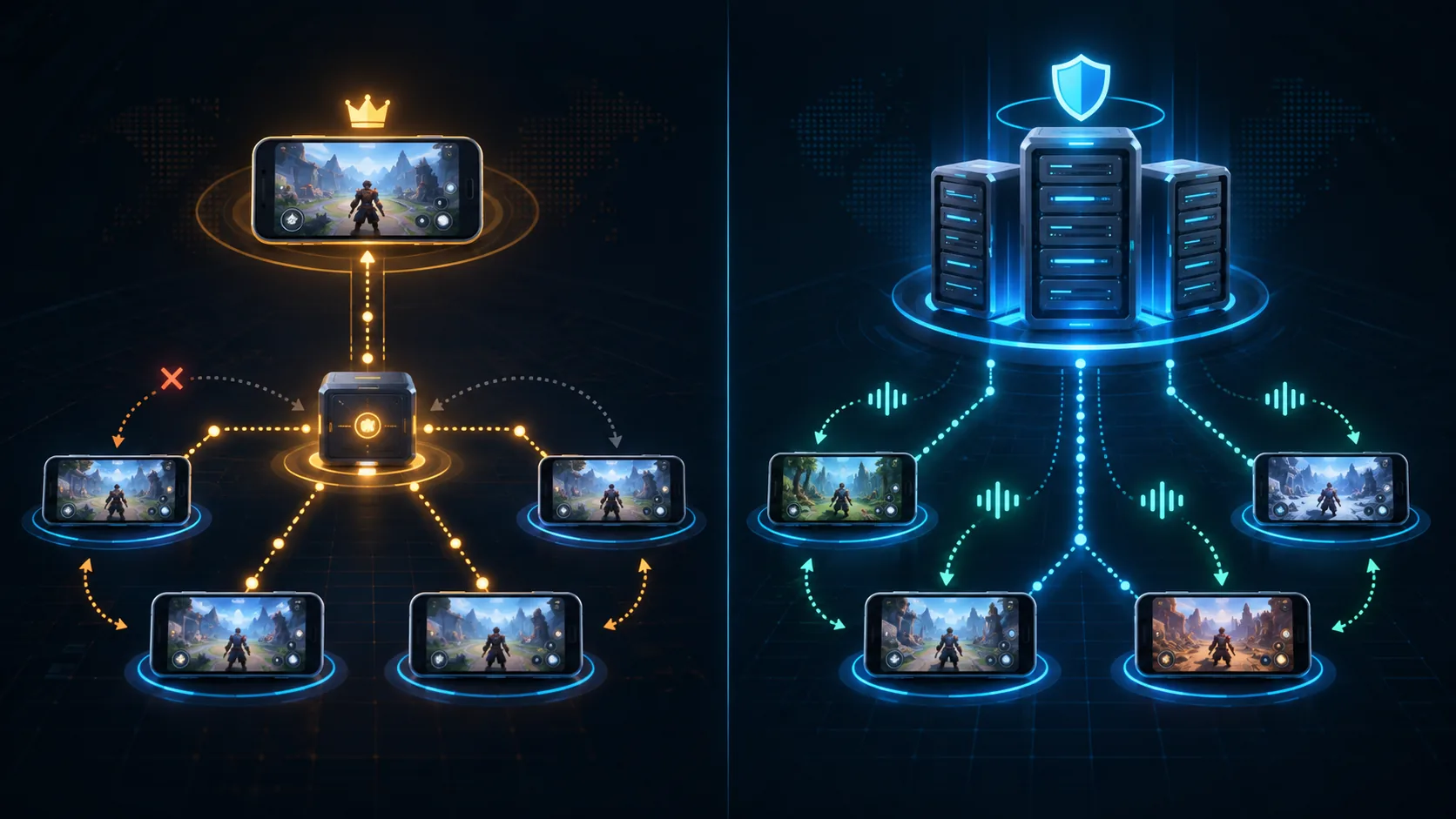
Authority answers a practical question: when devices disagree, which result wins? A client-hosted model may be appropriate for a focused prototype or a lower-risk cooperative experience. A dedicated authoritative server can validate critical actions and continue independently of one player’s device, but it introduces server deployment, monitoring, scaling, and ongoing cost. A relay helps connect players without exposing a host directly, but it is not automatically a complete authoritative game server.
Unity’s current Multiplayer documentation separates the connected experience into sessions, Lobby, Matchmaker, Relay, hosting, and netcode choices. Its Multiplayer Services sessions guide explains that a session can coordinate player grouping and connection types, including relay-based and dedicated-server routes. These are option references, not a claim that one stack fits every game.
| Decision | Client-hosted or relay route | Dedicated authority route |
|---|---|---|
| Best fit to investigate | Focused prototype, private room, cooperative or lower-risk match. | Competitive rules, persistent match state, stronger validation or host independence. |
| Authority | One player device may own important state unless extra validation exists. | A server process can own and validate the canonical match state. |
| Host loss | Requires an explicit stop, migration, or recovery rule. | Match continuity is not tied to a player acting as host. |
| Operations | Still needs connection monitoring, service limits, logs, and support decisions. | Adds server builds, deployment, capacity, observability, and incident ownership. |
| Acceptance evidence | Join, reconnect, host exit, migration/termination, and state resync tests. | Deployment, authentication, validation, load assumptions, failure recovery, and logs. |
Specify the complete session journey
Draw the session as states: signed out, authenticated, in a party or lobby, searching, allocated, connecting, ready, playing, reconnecting, completed, and returned to the menu. For each transition, define the trigger, timeout, player message, and recovery route. This exposes missing work that a single “Play Online” button hides.
Ask who can create a room, whether a join code expires, whether a full room accepts a replacement, how duplicate joins are handled, and what happens when matchmaking succeeds but one client never connects. If the first production milestone only proves a perfect happy path, it has not yet proved the risks that usually reshape the multiplayer scope.
Turn disconnects into product rules
“Reconnect supported” needs a measurable definition. Decide how long a player remains eligible to return, whether their character pauses or continues, what other players see, whether the match result changes after the window closes, and which state is restored. A reconnect must use the canonical state—not whichever stale snapshot happens to remain on the phone.
Unity documents that sessions can manage player connections and host-election behavior, while Relay connects players without requiring dedicated servers. Your implementation still needs game-specific rules for ownership, migration, state recovery, and match outcomes. Ask the team to show these rules in a controlled test rather than treating an SDK feature name as proof of completed behavior.
Define security and fairness boundaries
List the actions that affect another player or a valuable result: damage, movement limits, turn order, score, rewards, purchases, inventory, ranking, and match completion. Decide which actions are merely displayed by the client and which are validated by an authority. Do not accept vague promises that cheating is “prevented”; request a threat list, validation boundary, rate-limit behavior, and logs appropriate to the game’s risk.
This does not mean every prototype needs a full anti-cheat platform. It means the prototype should not silently establish unsafe trust assumptions that become expensive to replace after the economy or competitive mode is built.
Use milestones that produce playable evidence
- Offline core: prove the controls and game loop without hiding design problems behind networking.
- Two-client slice: connect real devices and synchronize only the smallest meaningful match.
- Session flow: create, join, reject, start, complete, and leave a room.
- Failure slice: simulate latency, connection loss, app backgrounding, host exit, duplicate actions, and return.
- Authority proof: demonstrate which process accepts or rejects a critical action.
- Operations proof: show the logs, configuration, environments, and ownership needed to run the chosen services.
Each milestone should identify supported platforms and devices, a reproducible test script, expected results, known limitations, and the exact build or source revision reviewed. “Multiplayer works” is not an acceptance criterion.
What should the proposal and handover include?
Send the team a brief containing the match type, player count, platforms, regions, session journey, authority decision, persistence requirements, failure rules, launch assumptions, and first-version exclusions. Ask the proposal to separate initial production from third-party service usage, hosting, monitoring, moderation, live operations, and post-launch support.
The handover should identify the Unity project and version, packages and licenses, server or service configuration, deployment steps, environment variables without exposing secrets, test accounts, dashboards, logs, runbooks, build instructions, known limits, and ownership of provider accounts. If a service is created under the vendor’s account without a transfer plan, the technical build may work while the business handover remains incomplete.
Scope the multiplayer risk before full production
Send us the match type, player count, platforms, authority preference, room flow, reconnect rules, and launch assumptions. We can turn them into a focused Unity prototype and acceptance plan before estimating the full build.
Explore our game development service — describe your project — discuss it on WhatsApp
Questions to ask a multiplayer game development company
What should I define before hiring a multiplayer game development company?
Define the match type, player count, platforms, room and matchmaking flow, authority model, persistent data, disconnect and reconnect rules, security boundaries, first-version exclusions, and playable acceptance tests. Without those decisions, proposals may be based on different products.
Do all multiplayer games need dedicated servers?
No. The choice depends on competition, authority, persistence, host-loss tolerance, scale, security, and operating budget. A client-hosted or relay route can suit some focused experiences, while dedicated authority can suit higher-risk competitive or persistent matches. Validate the decision in a technical slice.
How do I compare multiplayer development proposals?
Compare assumptions, authority, supported session states, failure handling, acceptance builds, service and hosting ownership, security boundaries, QA coverage, source handover, and ongoing operational responsibilities. A feature list without test evidence is not enough.