Card game project planning
Card Game Development: Define the Rules Before You Hire
Turn the card idea into a testable rules system before artwork, online rooms, and production estimates lock the wrong assumptions in place.
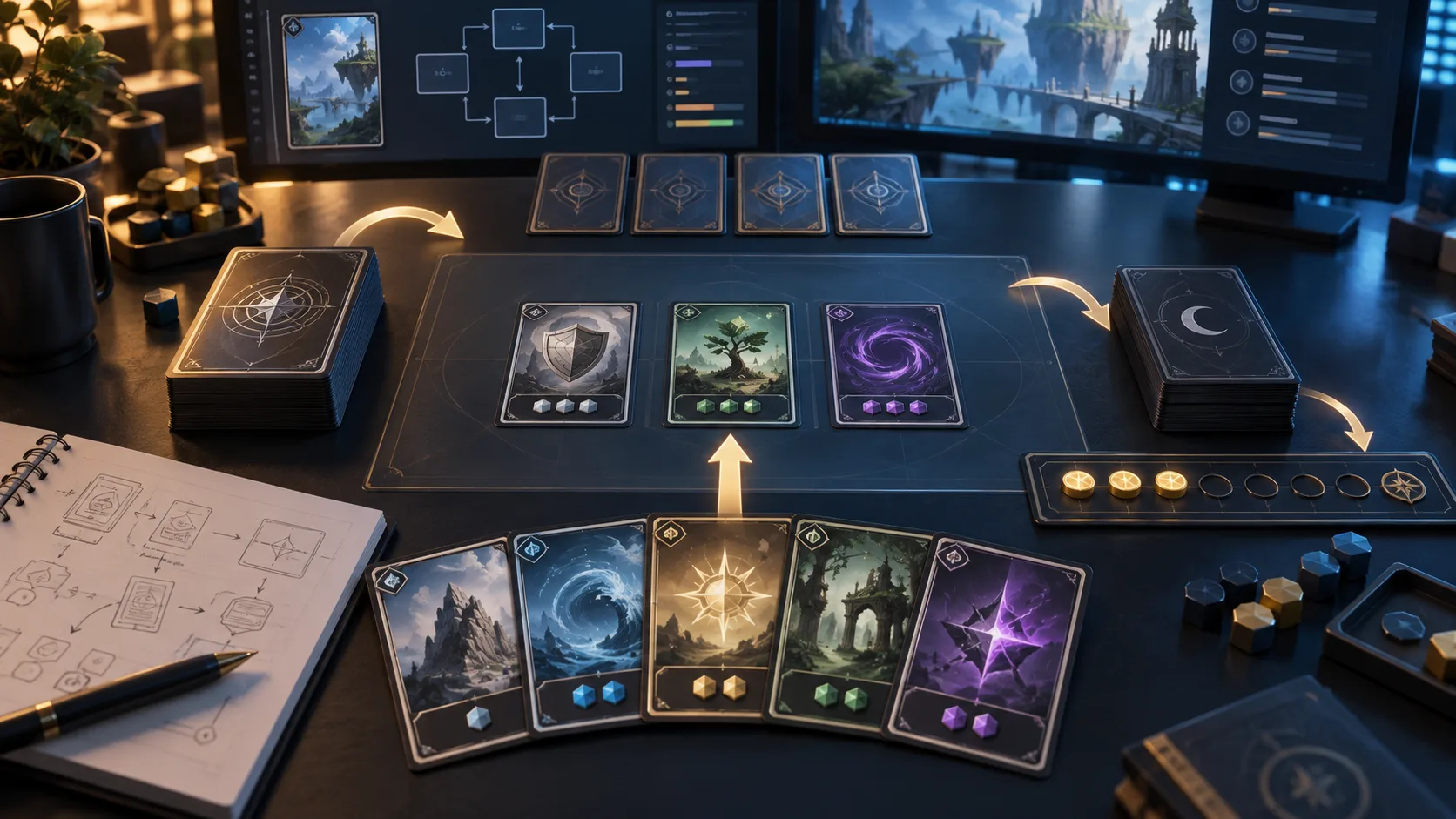
Short answer: before hiring a card game development team, approve a rules model that names every card zone, legal action, turn step, hidden-information boundary, conflict rule, end condition, and recovery case. Then attach those rules to playable acceptance tests. A list such as “deck, multiplayer, shop, rewards” is not enough to estimate the product reliably.
This guide is for an owner commissioning an original digital card game. It does not cover physical printing, real-money casino operations, or copying a known title. For the wider decision about session hosting and authority, read our multiplayer architecture guide. Here we focus on the card system the architecture must protect.
Describe one complete match in plain language
Start with the smallest legal match. State the player count, starting hand, deck construction rule, first-player rule, turn phases, actions available in each phase, cost system, targeting rules, response windows, win and draw conditions, and what happens when no card can be drawn. If a reviewer cannot replay the same match from the description, the specification still contains hidden decisions.
Separate first-version rules from future ideas. Spectators, trading, clans, seasons, tournaments, complex AI, and large card collections can change the data model and operations, but they should not silently enter the first estimate. Mark each as included, excluded, or dependent on a successful prototype.
Name every zone and who can see it
A digital card does not simply sit “on the table.” It moves through defined zones such as collection, deck list, draw pile, hand, play area, reserve, discard, exile, reward, or temporary reveal. For each zone, specify ownership, order, capacity, visibility, valid entry and exit routes, and whether its contents persist after a match.
| Area | Decision to approve | Acceptance evidence |
|---|---|---|
| Deck and draw | Deck size, duplicates, shuffle seed, empty-deck behavior. | A fixed test deck produces the expected draw and end state. |
| Hand and hidden data | Who sees card identity, count, previews, and reveal history. | Each client receives only permitted information. |
| Turn and priority | Phases, timers, responses, passes, simultaneous effects. | The event log resolves the same sequence every run. |
| Effects | Target eligibility, cost timing, cancellation, stacking, precedence. | Legal actions succeed and illegal actions return a defined result. |
| End state | Win, loss, draw, surrender, disconnect, reward eligibility. | Only one canonical result is stored and displayed. |
Write rule precedence before edge cases collide
Card effects often conflict: one rule grants an action while another blocks it; damage and defeat may occur together; a copied effect can target a card that has moved; two triggers may share a timestamp. Define a precedence model and an event order. Avoid resolving these cases by whichever animation happens to finish first.
A useful specification gives every action a request, validation, state change, emitted events, and visual response. The presentation can animate later, but the accepted state should already be determined. This makes bugs reproducible and reduces disputes between the written rule, server result, and screen.
Separate card definitions from the rules engine
The project needs a documented boundary between stable rules and tunable content. Card names, artwork references, tags, costs, stats, rarity, and effect parameters can live in validated structured data. Core legality, event ordering, security checks, and complex effect execution normally need tested implementation logic. Do not let arbitrary content fields quietly become executable behavior without review.
Unity’s ScriptableObject documentation describes assets that store data independently of GameObjects. That can support a card-definition workflow, but the team still needs schema validation, stable identifiers, migration rules, and tests. The tool choice does not replace a content contract.
Protect hidden information and authoritative results
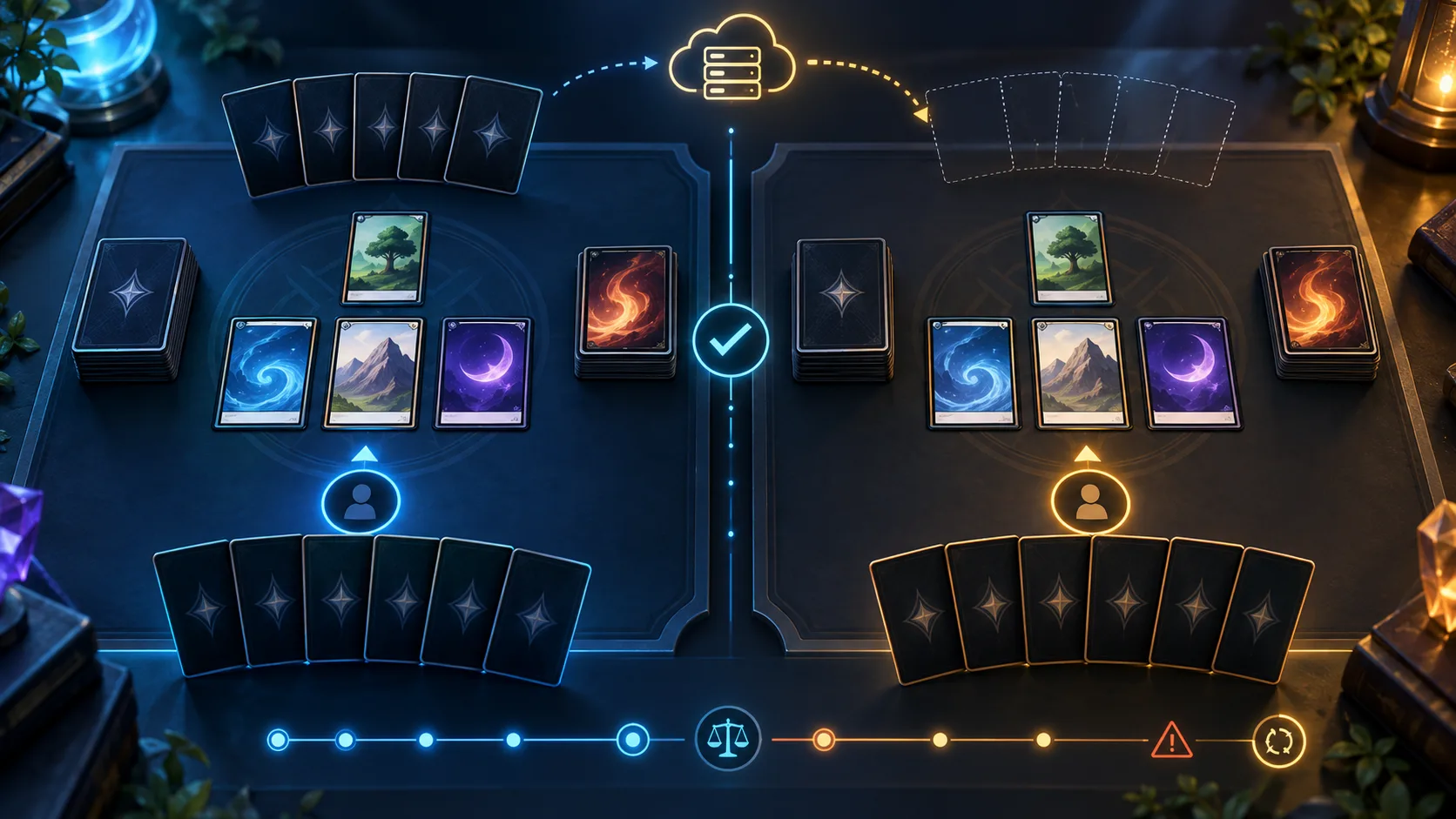
Do not send every player the full match state and rely on the interface to hide the opponent’s hand. Specify which process owns the canonical deck order and validates draw, play, target, cost, reward, and match-completion actions. A client can present a request; it should not invent a valuable result.
This boundary matters even in a friendly game because reconnects, replays, analytics, and dispute diagnosis all need one trusted sequence. It does not mean every prototype needs a large dedicated-server platform. It means the trust assumption and its limitations must be explicit.
Make disconnect and reconnect part of the rules
Define when a disconnected player remains in the match, whether a timer continues, when control passes to AI, when a surrender is recorded, and what state is restored on return. The reconnecting client may need the current public board, its private hand, remaining time, pending choice, and event position without receiving another player’s hidden data.
Unity’s current Multiplayer sessions documentation includes join and reconnect flows. That supports connection handling, while your card rules still define what the player is allowed to resume and how the match outcome changes after the recovery window.
Prototype the risky rule, not the biggest card set
The first playable slice can use temporary art and a small deck. It should prove the hardest interaction: chained effects, hidden choices, a response window, deck exhaustion, or reconnect during a pending action. Ten well-chosen cards that exercise the engine are more useful than a hundred decorative cards that all perform the same simple action.
Ask for a deterministic test setup: fixed decks, known identifiers, a named random seed where relevant, and an event log. A reviewer should be able to reproduce the sequence and compare the expected result with the build.
Use a card-game acceptance matrix
- Normal turn: draw, pay, target, resolve, discard, and end turn.
- Illegal action: wrong phase, invalid target, insufficient cost, duplicate request.
- Conflicting effects: prevention, replacement, copied effect, simultaneous defeat.
- Hidden information: opponent, spectator, replay, log, and reconnect visibility.
- End conditions: win, draw, surrender, timeout, empty deck, disconnected player.
- Content validation: missing art, duplicate ID, invalid value, incompatible version.
- Recovery: background app, reconnect during choice, stale client, interrupted animation.
For every case, record setup, actions, expected authoritative state, expected presentation, supported device, build number, and source revision. “It worked in our demo” is weaker than a repeatable acceptance case.
What belongs in the proposal and handover?
The proposal should identify the rule-set version, prototype card count, final content count, platform, offline/online modes, AI scope, session and authority assumptions, backend and account work, art and animation scope, localization, accessibility, analytics, testing devices, exclusions, and change process. Separate production work from third-party hosting or service usage.
The handover should include the Unity project and version, source history, card schema and IDs, rules document, effect catalogue, content-import instructions, test decks, automated and manual cases, build instructions, service configuration without exposed secrets, licenses, known limitations, and ownership of provider accounts. This is how the buyer can maintain the game instead of receiving only an installable build.
Turn your card idea into a testable first build
Send us the match rules, example cards, target devices, online/offline modes, and the hardest interaction you need to prove. We can shape them into a focused Unity prototype and acceptance plan.
Explore our game development service — describe your project — discuss it on WhatsApp
Card game development questions
What should I define before hiring a card game development team?
Define the card set, zones, legal actions, turn sequence, hidden information, rule precedence, win and draw conditions, reconnect behavior, content pipeline, first-version exclusions, and playable acceptance cases.
Should card rules live in code or data?
Stable engine rules usually belong in tested code, while card definitions and tunable values can use validated structured data. Document and version the boundary so a content edit cannot silently change core legality.
How do I test a digital card game before accepting it?
Use fixed decks and repeatable cases for normal turns, illegal actions, conflicting effects, end states, reconnects, hidden-information visibility, and invalid content. Record expected authoritative and visual results against a named build and source revision.