Arcade sports production
Football Game Development: Scope a Playable Arcade Match Before Production
Agree who owns the ball, what a pass or shot commits to, and how play restarts before ordering teams, stadiums and a season of content.
Short answer: a football game development brief should define a complete playable match, not just movement and a kicking animation. Specify possession, receiving and interception, shot outcomes, scoring, restarts and the final whistle. Prove those transitions in a small arcade scope before commissioning more teams, modes or polished assets.
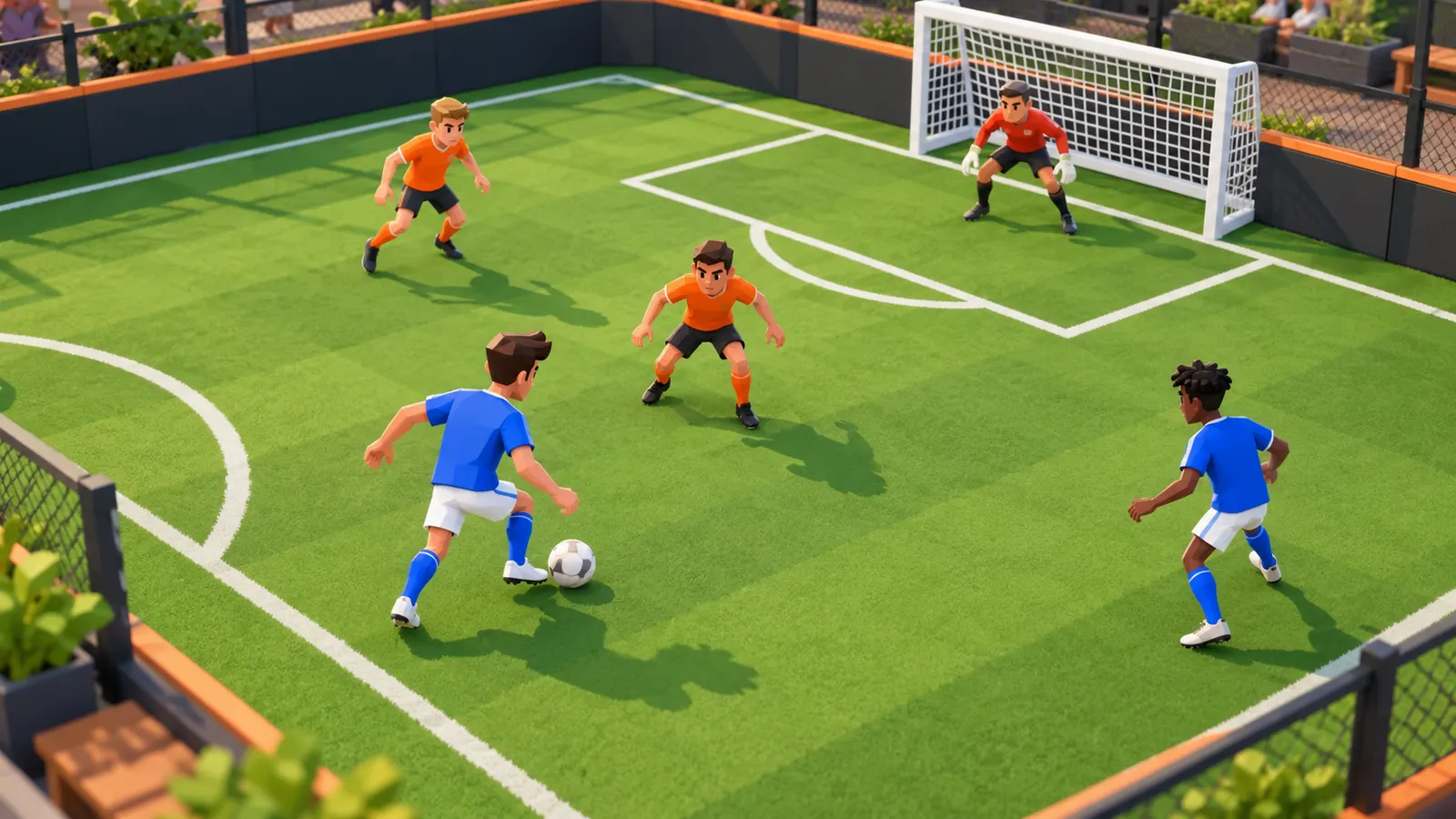
This guide is for an owner commissioning an original, bounded football game in Unity. It is not a tutorial, a downloadable template or a promise to reproduce a major licensed sports franchise. The practical question is what one match must demonstrate before you approve a larger production budget.
Choose the match you are actually buying
“A football game” could mean a penalty challenge, a small-sided arcade match, a management game or a detailed simulation. These are different products. Start with the player's responsibility: direct one athlete, switch between teammates, aim passes, choose a shot direction or make tactical decisions. State which tasks the game handles automatically.
For a hypothetical first version, consider an offline three-versus-three arcade match on one compact pitch, using original teams and a fixed camera. The player controls the active blue athlete; teammates and orange opponents follow a limited, agreed behavior set. One match has a clear start, a scoring route, a restart and an ending. This example is a proposed scope, not an existing customer project or a universal recommendation.
Write the exclusions next to that promise: no licensed clubs, online ranking, career season, commentary library or realistic full-team simulation in this increment. If one is essential, price and accept it explicitly. Our first-version scope guide (Arabic) covers the broader keep, simplify and defer decision.
Give possession one understandable meaning
Specify what controlling the ball permits and what ends that control. Is the ball attached to a dribble target, physically free between touches, or governed by a hybrid rule? The buyer need not choose every implementation detail, but must approve the visible result: when a player can pass, when a defender can intercept, and what happens after a loose-ball collision.
Separate the selected athlete from the ball owner. Switching control should not transfer possession merely because the highlighted character changed. Likewise, an athlete reaching the receiving position does not establish that the ball arrived. Ask the team to show possession feedback that remains readable during movement, overlap and camera changes.
In the three-versus-three example, blue A begins with possession. Blue B moves into space. A pass releases the ball; B only becomes the owner when the approved receiving condition occurs. If an orange defender intercepts first, the result should follow the interception rule rather than a preselected animation promising B the ball.
Describe the commitment of each pass and shot
For a pass, agree how the receiver is chosen, whether direction can change after release, the interception window and what happens when the target is no longer available. An assisted pass and a manually aimed pass require different review conditions. Do not compare estimates that silently assume different player input.
For a shot, distinguish the requested action from its outcome. A button press may begin a wind-up, release a ball, fail because possession was lost or be rejected because play has stopped. Name the point of commitment and whether cancellation remains possible. Prevent a queued input from firing later after the state that justified it has disappeared.
Our combat behavior guide explains action permission and commitment in another genre. Football adds a shared ball and possession transfer: a correct kicking animation alone does not prove that the right athlete owned the ball or that the resulting score was valid.
Keep scoring separate from celebration
Approve the goal condition for your arcade rules: which boundary must be crossed, which direction counts, whether the ball must be live, and how a single crossing is recorded once. Specify the outcome when the ball overlaps the scoring area across several updates or rebounds through it. Visual celebration should respond to an accepted score, not become a second scoring source.
Boundary cases matter more than another stadium skin. Decide whether a ball released before time expires may still score afterward, what takes priority if a goal and the ending occur together, and whether an own goal is supported. These are product decisions for this particular game, not claims about official competition rules.
Unity's collision detection guidance describes accuracy and computational-cost trade-offs and recommends profiling the chosen setup. A physics mode is not, by itself, proof that your goal condition is correct. Ask for repeatable checks at the supported ball speeds and device conditions.
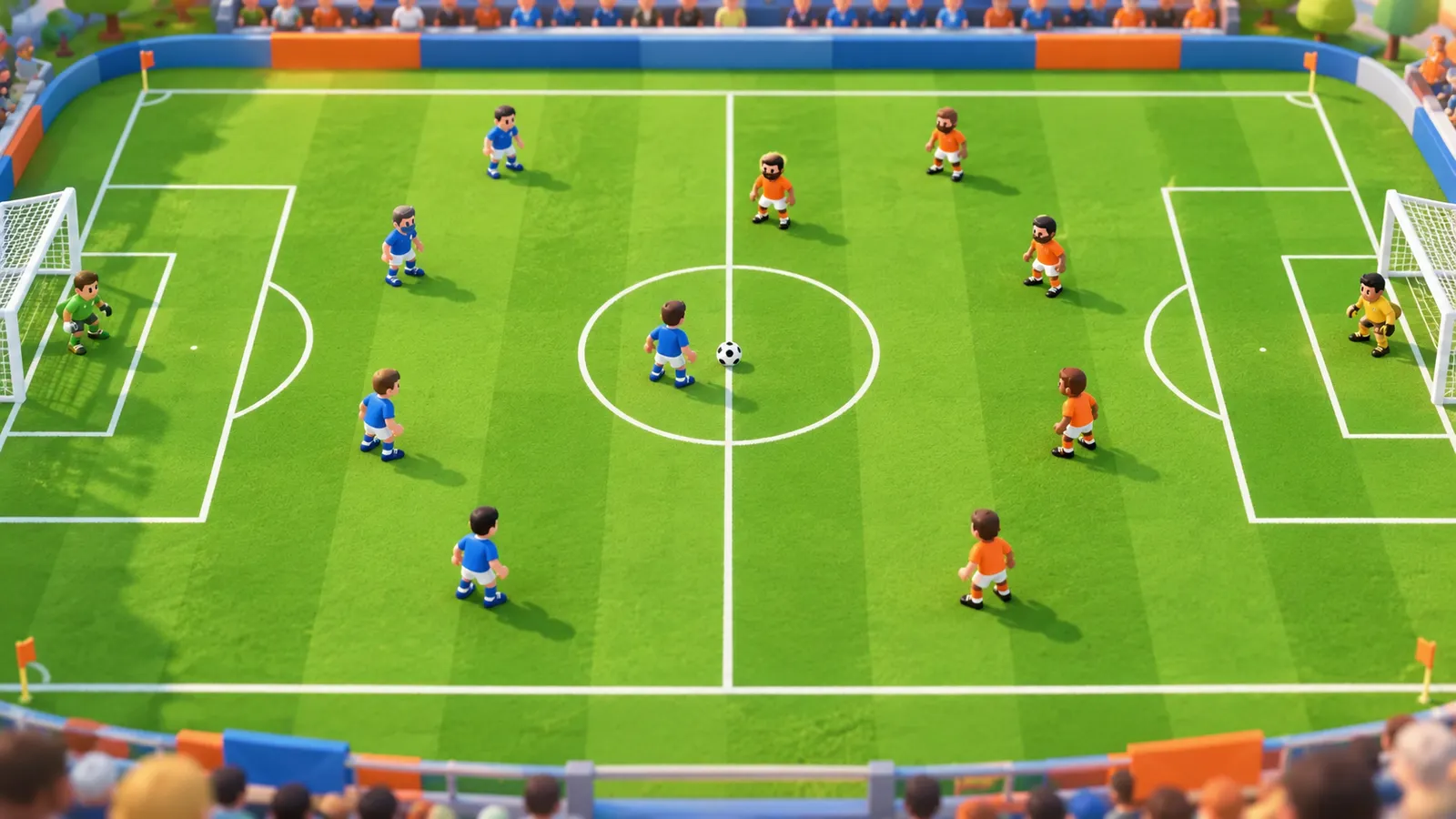
Make the restart a complete state change
After scoring, identify who receives possession, where every athlete and the ball return, when the clock resumes and which controls become available. Clear old pass targets, shot requests and celebration locks. The next kickoff should not inherit an action queued before the goal.
Also define a non-goal stoppage and the end of the match. A minimal arcade game may simplify touchlines and fouls, but the simplification must be intentional. State whether a loose ball is reset, returned to an approved position or kept in bounds by the arena. A polished pitch without these rules can leave a match stuck.
The level acceptance guide owns objectives and encounter sequencing across a playable route. This match specification owns ball and player state at the restart. Use both where relevant without treating a generic level reload as a substitute for a correct kickoff.
Review one controlled sequence before expanding production
Name a build, pitch revision, input method, initial positions and clock setting. Begin with blue A passing to B, B receiving and shooting, one accepted goal and an orange kickoff. Then change one condition at a time. Record expected results before observation; the following checks remain proposals until a real build has been reviewed.
- Interception: place an orange defender in the pass path; verify which player may next act on the ball.
- Lost possession: request a shot and lose control before release; confirm the agreed cancellation or continuation.
- Repeated crossing: keep the ball in the goal area; ensure the same goal is not awarded again.
- Clock boundary: repeat the approved shot near the final whistle and check the chosen priority.
- Restart: hold an input through celebration; the new kickoff must not replay an obsolete request.
- Retry: start another match; the previous score, target and end-state locks must not leak into it.
Keep visual preference separate from rule failure. A slower pass may be a tuning request; possession going to the wrong team is a different issue. Receive the editable configuration, known limitations and observation record with the playable increment before multiplying teams or stadiums.
Ask for evidence that matches the engagement
Our ROADFORGE case study demonstrates connected Unity controls, gameplay states, progression and device validation. It is not a completed football product. The proposed football increment needs its own review evidence, including touch readability, ball behavior and reset correctness on the agreed devices.
Send the intended match format, player input, visual references, platforms, rules you want simplified and materials you have permission to use. Separate the first playable match from a full content catalogue, online services and store-release work. A reviewable boundary makes proposals more comparable than a request to “build something like” a large franchise.
Football game commissioning questions
What should a football game development prototype prove?
It should prove a complete agreed match sequence: possession, passing, receiving or interception, shooting, one correctly recorded goal, a clean restart and the match ending. Review named starting conditions and boundary cases before expanding teams, stadiums or modes.
Does football game development require a full realistic sports simulation?
No. A project can commission a bounded arcade match with simplified controls, original teams and explicit rules. Realistic simulation, licensed content, online ranking and large season systems are separate scope decisions, not automatic inclusions in a football prototype.
Define your first playable football match
Send your match format, target platforms, control idea and visual references. We can discuss a scoped Unity arcade engagement with explicit ball-state rules, review checkpoints and organized source handover.
Explore game development services · Describe your football game project · Discuss it on WhatsApp