Arabic implementation scope
Arabic Game Localization: What to Commission Beyond Translation
Define the text, direction, layout and language-switch evidence before commissioning an Arabic-ready Unity build.
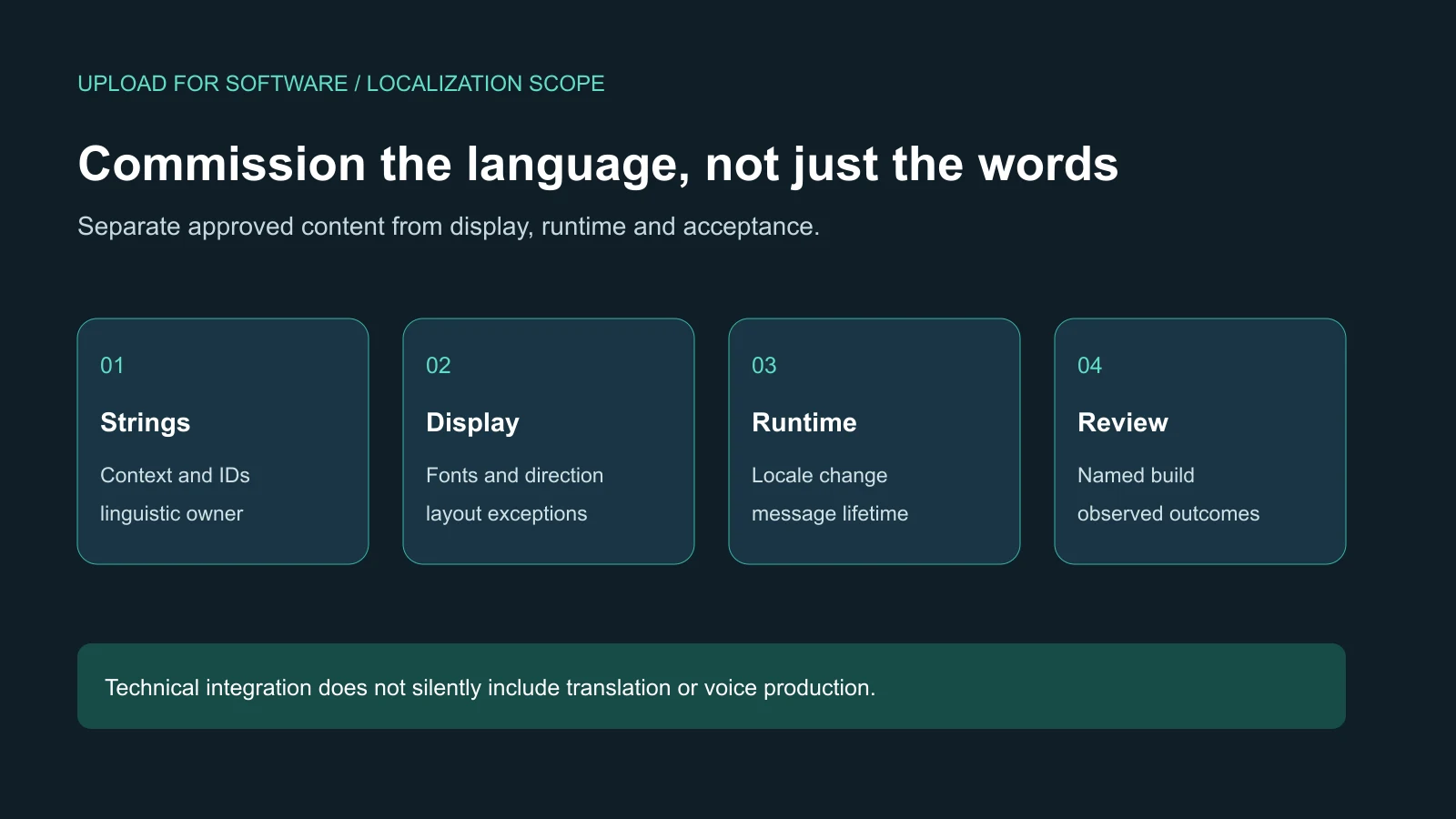
Short answer: Arabic game localization needs more than replacing English words. Commission a defined string inventory, approved Arabic copy, suitable font coverage, correct handling of mixed-direction text, layout exceptions and language-switch behavior inside a named build. Agree who owns translation and linguistic review, then accept a representative playable flow before expanding to the whole game.
This guide is for a publisher or game owner preparing an existing Unity game for Arabic-speaking players. It helps separate a linguistic assignment from a technical implementation milestone. Our Unity game development services cover scoped production and integration; translation, cultural review, dubbing and their rights must have explicit owners rather than being silently assumed.
Separate the responsibilities before requesting a quote
A translator can approve the meaning of a sentence without controlling how the game renders it. A developer can place text correctly without being the right person to approve tone, terminology or cultural suitability. Treat those as connected responsibilities, not interchangeable skills. Name the person or supplier who approves the Arabic copy, the implementation team, and the owner who accepts the playable result.
Specify whether the first milestone covers interface labels, tutorials, objectives, dialogue, subtitles, store material or an entire content library. List what is excluded, such as voice recordings or rewriting story content. Decide how approved text revisions reach the project, who resolves a terminology conflict and what happens when new English content arrives after the Arabic review. A vague promise to localize everything leaves the largest dependencies outside the estimate.
Build a string inventory with context
Provide stable identifiers and source text, not screenshots alone. Each entry needs its screen or event, purpose, variable values and any space constraint. A button verb, a mission objective and a completed-action notice can use similar English words while needing different Arabic wording. The reviewer should know whether the player is being instructed, warned or told that an action already happened.
Preserve placeholders as data contracts. If a reward message includes an amount, item name or player name, explain the values that may appear and which part owns formatting. Include singular and plural requirements where relevant, numbers, punctuation and line breaks. Do not let an implementation team guess meaning from short labels. Screenshots and a representative build provide context, while the inventory remains the authoritative text revision.
Test a reference corpus, not one attractive sentence
Choose a small set of approved examples that exposes the rendering risks: a short action label, the longest expected instruction, an Arabic phrase beside a Latin item name, an amount with punctuation, a multi-line objective and an unsupported-character case. The exact expected display should be reviewed by someone competent in the language. A visually connected Arabic word does not prove that reading order or meaning is correct.
Arabic shaping and bidirectional ordering are different concerns. Font coverage, connected forms, Latin names, numbers and punctuation must work together in the chosen text system. W3C's bidirectional text guidance illustrates why opposite-direction phrases need careful boundaries. Its HTML examples are not a Unity implementation recipe; they explain a class of problems that the game's renderer must also handle.
Define layout exceptions instead of mirroring everything
Right-to-left reading does not mean every visual element should reverse. Establish which text blocks change alignment, how mixed-script values sit within them, and whether navigation order changes. Review icons, diagrams, numbers, progress displays and gameplay controls separately. A steering control is part of the playable input design, not automatically a text-direction decoration.
Agree wrapping, minimum readable size, overflow handling and the screen sizes included in acceptance. If the approved Arabic instruction is longer, changing only its font size can make it unreadable. The fix may instead need another line, a larger panel or different information hierarchy. Our game UI/UX service owns those interface decisions; this localization scope defines the language-specific cases that the interface must support.
Decide what changes when the player switches language
A language change can affect messages that already exist, not only the next screen. Decide whether the player can switch during play, only from a menu, or after a restart. If live switching is allowed, persistent prompts and notices should reflect the selected locale without accidentally extending their lifetime. A prompt that expired before the switch must not return merely because the display was refreshed.
Separate text refresh from gameplay state. Switching language must not award coins, repeat a purchase, reset a mission or recreate a result event. Confirm that the saved language preference survives the agreed scene transitions and app restart, while a missing preference selects the documented default. If some content cannot change until reload, communicate that rule and include the reload path in the milestone.
A bounded implementation pattern from ROADFORGE
In our original ROADFORGE Unity project, a source-level pattern retains paired English and Arabic strings for labels that can outlive a settings change. A language-change notification refreshes the label from those retained inputs. The setting is stored separately from the label. This illustrates a practical boundary: a display update should select presentation text, not rerun the gameplay action that created the message.
The legacy Arabic display helper is explicitly bounded to its known interface vocabulary. It is not proof of a general-purpose Unicode text engine, arbitrary user-name support or a fully reviewed Arabic release across every device. Existing audit code describes checks for visible language leakage and live prompts, but an audit definition is not a passed test report. A commissioned implementation should use a suitable text system and demonstrate the approved corpus in its actual build.
Accept one representative flow before the content batch
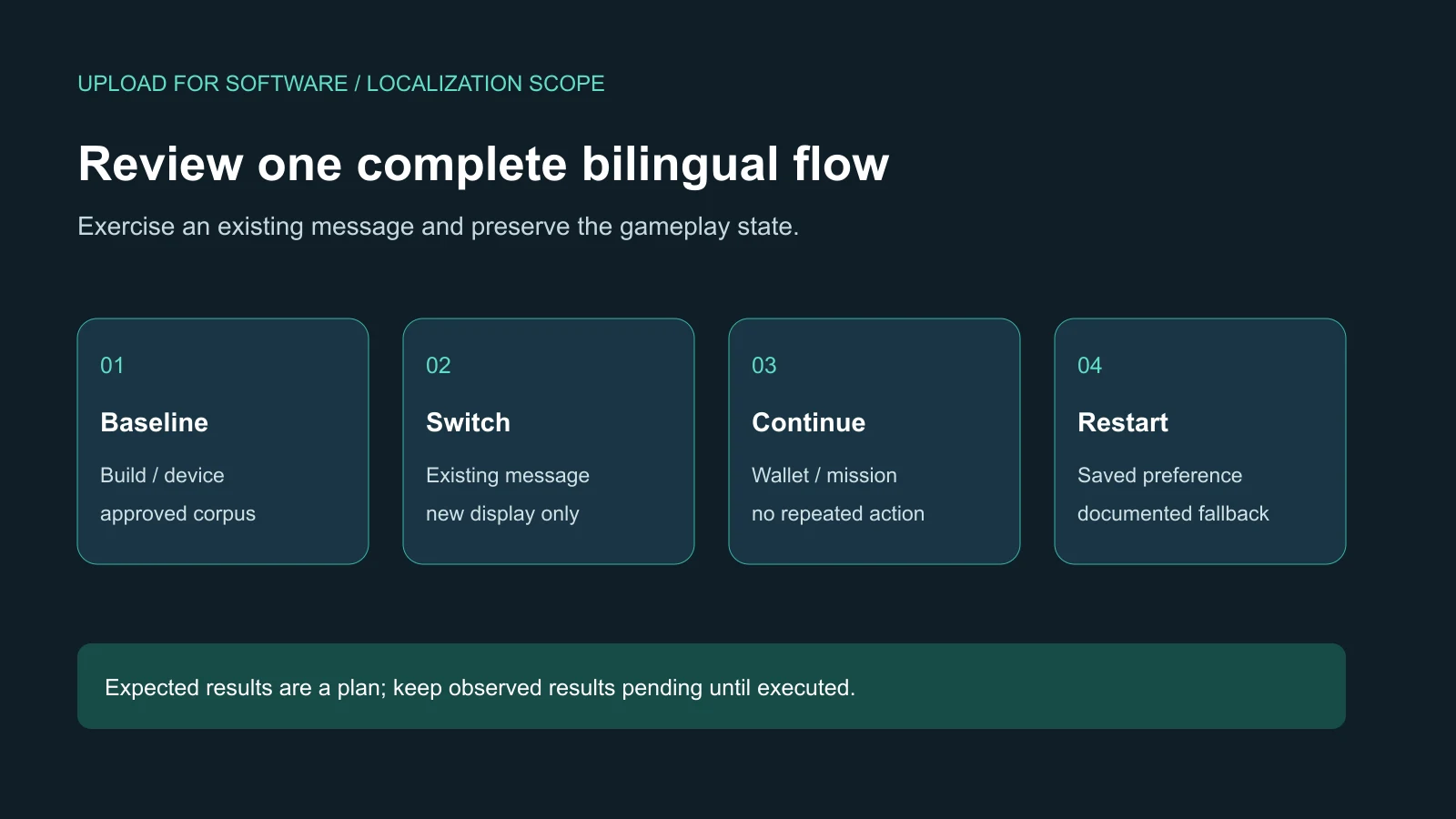
Use a route that combines interface, a changing value and a persistent message. A hypothetical sequence is: open the workshop, view an item price, enter play, show an objective, switch the locale through the supported settings path, continue the mission and return to the menu. The exact route should reflect your game rather than becoming a universal checklist.
| Review case | Expected evidence | Do not infer |
|---|---|---|
| Approved corpus | Both locales, exact string revision and mixed-script examples | One good label proves every string |
| Existing message | Text refreshes under the agreed switch rule; lifetime remains correct | Creating a new message proves old labels update |
| Continue play | Input, mission and wallet state match the baseline | A visual change cannot affect state |
| Restart | Selected locale and default/fallback rules behave as agreed | In-session selection proves persistence |
Record the build, device, screen size, language settings, string revision, expected result and observed result. Leave observations pending until someone actually executes the case. Language acceptance complements the mobile release checklist in Arabic; it does not replace stability, purchase or platform testing.
Make the handover usable by the next content update
Receive the approved string inventory, locale configuration, fonts and their licenses, relevant source changes, build instructions and the reference corpus. Record unresolved strings, unsupported characters, layout exceptions and checks not executed. Document who will approve and integrate future translations. A delivery that looks correct today but has no update path is difficult to maintain when the next mission arrives.
If the game is also moving to Android or iOS, keep that platform scope separate. The Unity mobile-porting guide in Arabic covers source, plugins, input and device constraints. Adding a language does not automatically establish platform compatibility, and a successful platform build does not establish a correct Arabic interface.
Scope the Arabic-ready milestone for your game
Send the Unity version, current build, screen and string inventory, target devices, language-switch requirement and the owner of approved Arabic copy. We can define the implementation boundary, representative flow and evidence to review before expanding production.
Review Unity development services — Request a scoped estimate — Discuss the implementation on WhatsApp
Questions before commissioning the implementation
What should an Arabic game localization scope include?
String inventory, approved linguistic responsibility, fonts and text-direction handling, layout exceptions, runtime-switch rules, persistent locale settings, named devices and build acceptance evidence. Translation, cultural review and voice production require explicit owners and are not implied by technical implementation.
How do you accept Arabic game localization in an existing Unity build?
Review a representative flow in both locales, switch while a persistent message is visible, check mixed-script values and truncation, continue and restart the game, and compare gameplay state with the baseline. Record the build, device, approved string revision, expected result, observed result and unresolved limits separately.