External game QA buying guide
Game Testing Company: What to Require Before Release
Choose a QA partner by the evidence, coverage, and release decisions it can deliver—not by a tester count or a device-list headline.

Short answer: a game testing company should give you a repeatable way to decide whether a build is ready. Before signing, define the playable scope, platforms, device and OS matrix, accounts and network conditions, build channel, defect evidence, severity rules, triage rhythm, regression policy, performance checks, security boundaries, and final report. Then compare vendors through a small representative pilot instead of comparing promises.
This guide is for a studio or product owner considering an external QA partner. It does not replace your internal release checklist. Our mobile game testing checklist explains what a candidate build should pass. This article explains the working agreement and deliverables the external testing company should provide while helping you reach that gate.
Start with the release decision the team must support
“Test the game” is not a usable scope. State the milestone, target platforms, lowest supported devices, required OS versions, regions, languages, account states, network conditions, controller or input variants, and the game areas included in the build. Name what is outside the engagement as clearly as what is inside it.
Define the decision at the end of each cycle: accept the build, accept it with known risks, reject it for blocking issues, or request a focused regression build. A vendor can execute hundreds of cases and still leave the buyer unable to make a release decision if the report does not connect findings to the agreed acceptance rules.
Ask for a test strategy, not only a list of test cases
The proposal should explain how the team will explore new features, verify requirements, check save data and progression, exercise interrupted sessions, test installation and updates, cover payments or advertising when applicable, and revisit surrounding systems after a fix. It should also show which work is manual, which checks can be automated, and which areas remain dependent on your internal tools or subject-matter experts.
Automation is useful when it protects stable behavior repeatedly. Unity’s Test Framework documentation describes Edit mode and Play mode testing. A supplier should still explain what the automated result proves, where it runs, who maintains it, and which player-experience risks require manual observation.
Make the build and environment matrix explicit
Every report should identify the build, branch or content version, backend environment, feature flags, account role, locale, device, operating system, graphics setting, input method, and network condition used. Without that context, a defect may be impossible to reproduce and a “pass” may refer to an environment unlike the release candidate.
| Area | Define before testing | Evidence at review |
|---|---|---|
| Build | Version, branch, backend, feature flags, install path. | Build identifier on every result and defect. |
| Coverage | Features, exclusions, accounts, locales, network states. | Executed scope, blocked work, and untested risks. |
| Devices | Models, OS versions, performance tier, controllers. | Result matrix and device-specific findings. |
| Defects | Severity, priority, ownership, duplicate rules. | Reproduction, evidence, logs, and affected version. |
| Release | Exit criteria and accepted limitations. | Regression result, open risks, and recommendation. |
For Android work, Google’s testing documentation describes configuring multiple test devices and reviewing results in a test matrix. Your commercial scope does not need to copy a tool screen, but it should preserve the same principle: results must stay attached to the environment in which they were produced.
Require defects that a developer can act on
A useful defect includes a short title, affected build, environment, starting state, exact reproduction steps, expected and actual behavior, frequency, severity rationale, evidence, logs when relevant, and links to related issues. Video should show the setup and outcome without replacing the written state needed to reproduce the problem.
Agree how crashes, data loss, progression blockers, purchase failures, account problems, exploits, visual defects, performance drops, and usability concerns are classified. Severity should describe impact; priority is the product decision about when to fix. If the vendor combines both without a shared definition, triage becomes an argument rather than a decision process.
Design the defect lifecycle before the first report
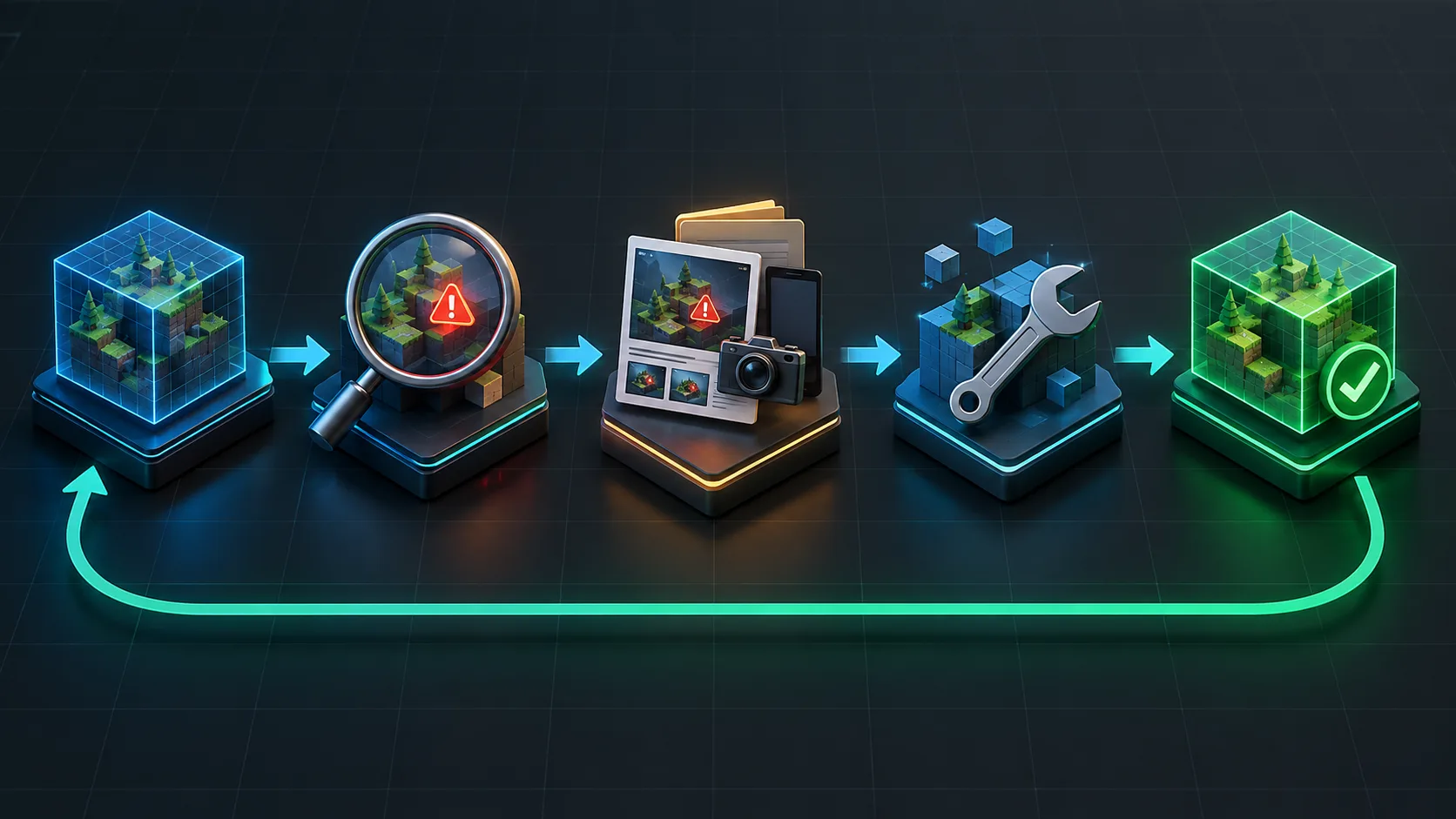
Choose one source of truth for status. Define who confirms a new issue, who marks duplicates, who can change severity, what information returns a ticket to the tester, which build contains the proposed fix, and what closes the issue. Include states for cannot reproduce, deferred, accepted risk, and not a bug so unresolved decisions do not disappear into a generic closed column.
Set a triage rhythm appropriate to the milestone. A weekly review may work early; a release candidate can require daily or build-based triage. Ask the vendor to highlight blockers immediately through the agreed channel while keeping the ticket system complete enough for later audit and handover.
Separate retest, regression, and new exploration
A retest checks whether a specific reported defect is fixed in the named build. Regression checks whether that change damaged connected behavior. Exploration looks for risks the scripted coverage did not predict. The plan should allocate time for all three rather than consuming the entire final cycle by rechecking only the issues already known.
Define the regression set by product risk: authentication, save migration, progression, inventory, economy, multiplayer session flow, purchases, ads, localization, platform lifecycle, and any system touched by the change. A claim that “all bugs were closed” is weak evidence when the surrounding features were never exercised again.
Choose the device matrix from users and risk
A long device list can still miss the devices that matter. Group coverage by performance tier, GPU or chipset family, screen shape, memory, operating-system version, input type, and known market share where you have reliable analytics. Include at least one low-end target, representative mainstream devices, and the specific hardware tied to a launch promise.
For Apple builds, TestFlight supports tester groups, multiple builds, feedback, screenshots, and crash context. Agree who owns the App Store Connect configuration, which group receives each build, how feedback becomes a tracked issue, and how personal tester data is handled. Tool access should be the minimum needed for the engagement.
Do not accept performance claims without a test route
Performance results require a named device, build, graphics setting, resolution, thermal starting state, network condition, and repeatable camera or gameplay route. Define the indicators relevant to the project—frame pacing, memory, loading, temperature, battery impact, network behavior, or crash stability—without inventing universal thresholds.
If the vendor reports an average frame rate only, ask for the sections that produce spikes, the duration of the run, and the evidence used to compare builds. A performance result is useful when your development team can reproduce the same route and verify the improvement.
Protect builds, accounts, and player data
List who may access source code, development builds, dashboards, test accounts, analytics, crash reports, store consoles, and unreleased content. Prefer role-based accounts, time-limited access, least privilege, revocation at handover, and an incident path for leaked credentials or devices. Never send production secrets inside defect descriptions.
Clarify data retention for videos, logs, save files, player identifiers, and third-party services. The contract should name the approved storage and communication channels, deletion or return requirements, and subcontractor limits. A broad confidentiality clause is not a replacement for practical access control.
Compare vendors with a paid representative pilot
Give shortlisted teams the same small build, scope, timebox, device requirement, reporting template, and known seed defects. Include enough complexity to reveal communication and reasoning, not only obvious visual problems. Do not hide dangerous behavior in production systems or share live customer data for a test.
Score the pilot on defect usefulness, reproduction rate, evidence quality, risk discovery, duplicate control, communication, adherence to scope, and the clarity of the final summary. The cheapest report can become expensive if developers spend days asking for missing states and retesting vague tickets.
What belongs in the final QA handover?
Request the final scope, builds tested, environment and device matrix, executed coverage, blocked and skipped work, defect export, evidence links, regression results, performance runs in scope, open issues, accepted risks, known limitations, account and access handover, automation assets you own, and a concise release recommendation.
Make exports usable outside the vendor’s private portal. Confirm that attachments, issue IDs, relationships, status history, and build references survive export. Close or revoke access only after the buyer has verified the archive and assigned owners for every open risk.
Build QA into the delivery plan
Send us the target platforms, current build, milestone, device range, integrations, and release risks. We can define the game-development scope, acceptance gates, and evidence needed before a build moves forward.
Explore our game development service — discuss your project — send the brief on WhatsApp
Game testing company questions
What should a game testing company deliver?
Require an approved test scope, build and device matrix, named environments, reproducible defect reports with evidence, severity rules, triage records, regression results, coverage and risk summaries, and a final list of open issues and accepted limitations.
How do you compare game testing companies?
Compare the same paid pilot or representative build. Score defect usefulness, reproduction quality, device coverage, communication speed, regression discipline, access controls, reporting clarity, and the team’s ability to explain residual release risk.
When should an external game QA team start?
Bring the team in when a stable playable slice and testable requirements exist, before release pressure begins. Early setup lets both sides agree on builds, devices, accounts, evidence, severity, triage, and regression before the full content load arrives.